
As US Threatens Sanctions on China, Nvidia CEO Defends AI Distillation
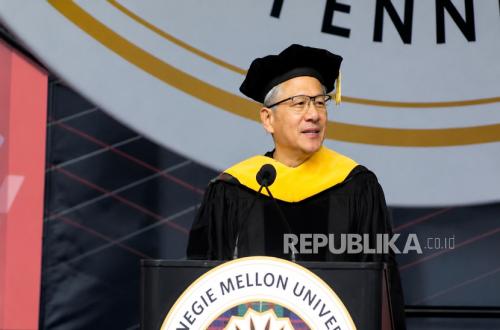
The competition for artificial intelligence (AI) has entered a new phase. Amid allegations from the United States government that Chinese companies are stealing US-made AI model capabilities, Nvidia CEO Jensen Huang has taken a different position.
Huang rejected the notion that the practice of AI model distillation is identical to theft. According to him, studying competitors’ technology is a common part of competition that occurs across various industries.
“That is what competition is,” said Huang when questioned during the Squable Box programme, as reported by CNBC on Monday, 28 September 2026.
Huang’s statement has reignited the debate regarding the boundary between technological learning and the theft of intellectual property within the AI industry. This issue is becoming increasingly significant because American AI companies spend vast sums of money training models, while competitors can utilise the outputs of those models to train cheaper systems.
This practice is known as distillation. Technically, distillation is a legitimate method for transferring the capabilities of large-scale AI models into smaller models.
The problem arises when this method is used against a competitor’s models without permission. The US government believes such practices could potentially serve as a shortcut to acquiring capabilities built with billions of US dollars in investment.
Huang views it from a different perspective. He stated that companies essentially have the right to test and study competitors’ products.
Nvidia itself, Huang noted, experiences similar situations. The company’s hardware products are frequently purchased by competitors, dismantled, and studied to understand the technology used within them.
He admitted that it would certainly be more comfortable if competitors did not do this. However, according to Huang, competition actually encourages companies to continuously improve their technology.
If a company does not want its products to be used in a certain way, Huang continued, the company can tighten customer selection or terminate service access.
This view stands in opposition to US Treasury Secretary Scott Bessent. In July, Bessent stated that the government had found traces of American models within several Chinese AI models.
Bessent even opened the possibility of imposing sanctions. “We have the ability to impose sanctions on them because of this theft,” he told Fox Business, as quoted by CNBC.
Huang has not changed his stance. A day after Bessent’s statement, he said that US companies should still be permitted to use AI models made in China.
Accusations Intensify
The debate shifted from a mere war of words to a national security issue in September. Three US government agencies accused six Chinese AI developers of conducting what is described as an “industrial-scale knowledge distillation campaign.”
The six developers include Alibaba and DeepSeek. The allegations were brought forward by the National Security Agency (NSA), the Federal Bureau of Investigation (FBI), and the Cybersecurity and Infrastructure Security Agency (CISA).