
As the World Grows More Complex, Indonesian Youth Need Stronger Global Political Literacy
The increasingly complex dynamics of world geopolitics make the ability of Indonesia’s younger generation to understand global issues and inter-state interests ever more important.
Conflict, trade, migration, energy, security, and maritime territorial disputes can have direct or indirect impacts on national interests and people’s lives.
For this reason, strengthening global political literacy cannot be achieved through theoretical learning alone. Young people also need practical experience to understand how a country pursues its interests, conducts negotiations, builds coalitions, and seeks agreement in international forums.
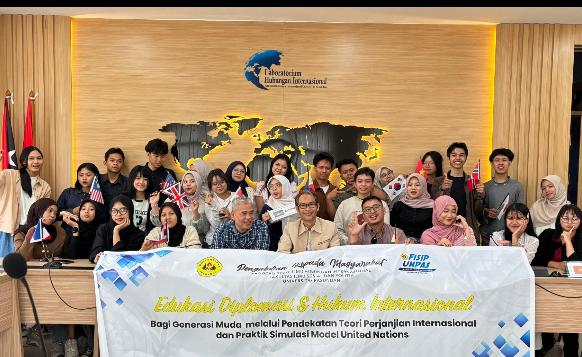
This effort was undertaken by the Community Service Group of the International Relations Study Programme, Faculty of Social and Political Sciences (Fisip), Pasundan University, through a community service programme (PkM) based on Model United Nations (MUN) simulations.
The programme, which ran for one month at the Diplomacy Laboratory of Pasundan University in Bandung, involved 50 high school students from various regions of West Java. The majority of participants came from Bandung City, and the activity also involved the Bandung City Student Council Forum (Forum OSIS Kota Bandung).
PkM Team Leader Iyan Septiyana said the MUN simulation was designed so that students would not only understand diplomacy and international politics theoretically, but also directly experience the negotiation process in a multilateral forum.
“We want students not only to understand diplomacy and international politics from a theoretical perspective, but also to experience how a country pursues its interests, negotiates, builds coalitions, and seeks agreement,” said Iyan.
According to him, such experience can shape a critical and open mindset towards various perspectives, especially when young people face the flood of information about global issues.
Before the simulation, participants received training on diplomacy, international law, the structure and functions of the United Nations (UN), international law of the sea, the United Nations Convention on the Law of the Sea (UNCLOS), dispute settlement mechanisms, and MUN rules of procedure.
Participants then took on the roles of delegates from 13 countries in a simulation of the United Nations General Assembly (UNGA), including Indonesia, Japan, the United States, the United Kingdom, South Korea, the Philippines, Malaysia, Vietnam, Brazil, Norway, France, Thailand, and China.
They were required to present their country’s position, defend national interests, negotiate, build coalitions, and draft resolutions. The simulation proceeded through opening statements, moderated debate, unmoderated caucus, drafting of resolutions, and voting.
One of the issues discussed was international law of the sea, including territorial boundaries and maritime security. Differences in countries’ positions on UNCLOS made participants face complex negotiation dynamics.
PkM team member Professor Anton Minardi said the experience showed that diplomacy is not merely the ability to speak, but also the ability to listen, understand the interests of other parties, devise strategies, and find solutions.
The dynamics were visible in the voting process. Most countries approved the draft resolution, while the United Kingdom voted against it and China abstained. This situation illustrated how national interests, international law, and negotiation strategies interact in multilateral diplomacy.
Evaluation results showed that 28 of the 50 participants completed the programme, a completion rate of 56%. Open interviews also showed that participants gained new understanding of international politics, diplomacy, UNCLOS, and UN meeting procedures.
The PkM team assessed that MUN simulations can be developed as a participatory learning method to strengthen global political literacy. Future programmes could be expanded with a larger number of participants and issues closer to young people’s lives, such as health and education.
“Strengthening global political literacy is expected to make young people not merely consumers of international information, but able to understand world issues critically and see their connection to Indonesia’s interests,” concluded Iyan.
Source: jawawa.id (https://jawawa.id/newsitem/as-the-world-grows-more-complex-indonesian-youth-need-stronger-global-political-literacy-1788231029)
Originally published by Media Indonesia (https://mediaindonesia.com/politik-dan-hukum/928235/dunia-makin-kompleks-literasi-politik-global-generasi-muda-indonesia-perlu-diperkuat), translated from Indonesian