
As the Dead Sea Dries Up, People Around the World Feel the Impact
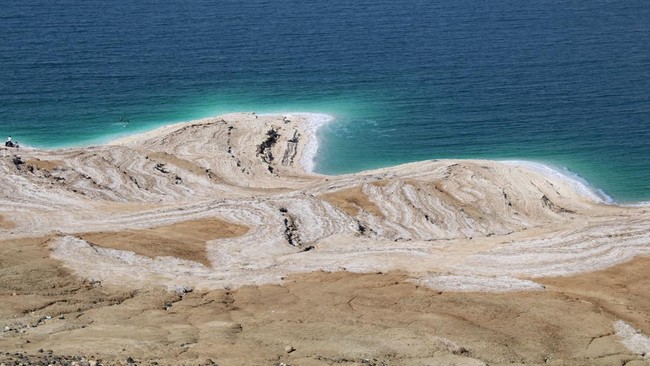
The Dead Sea is experiencing both a falling water level and rising temperatures at the same time.
A new study has found that the shrinking water level is driven not only by rising air temperatures, but can also accelerate the warming of the water and increase evaporation in the highly saline lake.
Human activity has also contributed to the continued decline in the water level and the deposition of salt by diverting water that would otherwise flow into the lake.
The study, led by Emmanuel Guillerm of Germany’s GFZ Helmholtz Centre for Geosciences and Binghamton University in the United States, examined the relationship between the shrinking lake, rising salt concentrations and heat exchange in the Dead Sea.
Between 1979 and 2019, the Dead Sea’s water level fell by about 34 metres. Over the same period, temperatures in the deeper water layers rose by 2.8°C, while those in the upper layers increased by about 1.7°C.
The researchers developed a model to separate the effects of rising air temperatures and falling water levels on the lake’s warming. Simulations showed that rising air temperatures contributed about 1.3°C to the warming of deep water by the 2010s, while the falling water level accounted for about 1.5°C.
The mechanism is linked to evaporation. Evaporation normally carries heat away from water, cooling what remains, much like sweat evaporating from the human body.
However, the high salt concentration changes this process. Dissolved salt reduces water’s tendency to evaporate at a given temperature. As water continues to disappear and salt concentrations rise, the cooling effect of evaporation weakens.
As a result, the remaining water can become warmer. When the water is warmer than the air above it, that temperature difference can sustain evaporation even when salt levels are high. This creates a feedback loop: the shrinking lake warms, while warming in turn encourages further evaporation and water loss.
“Some of this water warming is caused by water diversion, and adds to the warming caused by anthropogenic increases in air temperature,” Guillerm said, according to Science Alert on Friday (9 October 2026).
Heat can also be transferred to deeper water layers. In summer, warmer, saltier water sits above cooler water with a slightly lower salt concentration. Because heat diffuses faster than salt, descending flows can carry heat and salt into deeper layers through a process known as salt fingering.
Winter mixing also helps transfer atmospheric warming to deeper layers.
The researchers then used their model to project conditions in the Dead Sea through to 2100 under two warming scenarios. The simulations assumed that all inflows would stop, industrial water extraction would cease, and the lake would continue to mix once a year.
Under those conditions, the water level is projected to fall by about 85 metres by 2100. Water temperatures are also expected to rise by around 5–8°C, depending on greenhouse gas emissions.
The projections nevertheless have limitations. Excluding inflows tends to make the projected decline in water level and warming appear greater. Conversely, excluding industrial water extraction tends to make water loss appear smaller. The amount of groundwater flowing into the lake also remains uncertain.
The study also found that rising salt concentrations could sustain warming even after the increase in air temperatures included in the simulations was halted.
Guillerm said restoring freshwater inflows to the Dead Sea to historical levels could stop the decline in its water level. “The warming caused by increased salinity would stop,” he explained.
He added that a less saline freshwater layer at the surface could also insulate deeper water from atmospheric warming, although warming would continue at the surface.
Unusually warm ancient brines and minerals are often interpreted as evidence of extremely hot or dry conditions.
The study’s model suggests that isolation and shrinkage could produce such conditions even when the regional climate is not especially extreme.
The researchers propose using temperature-change data to trace how far ancient sea levels fell as the sea shrank.
Source: jawawa.id (https://jawawa.id/newsitem/as-the-dead-sea-dries-up-people-around-the-world-feel-the-impact-1792374621)
Originally published by CNBC Indonesia (https://www.cnbcindonesia.com/tech/20261019060455-37-777288/laut-mati-mengering-manusia-di-seluruh-dunia-rasakan-dampaknya), translated from Indonesian