
As Suyudi Eyes National Police Chief Position, Public Satisfaction Surveys Under Scrutiny: Must Serve as Basis for Evaluation
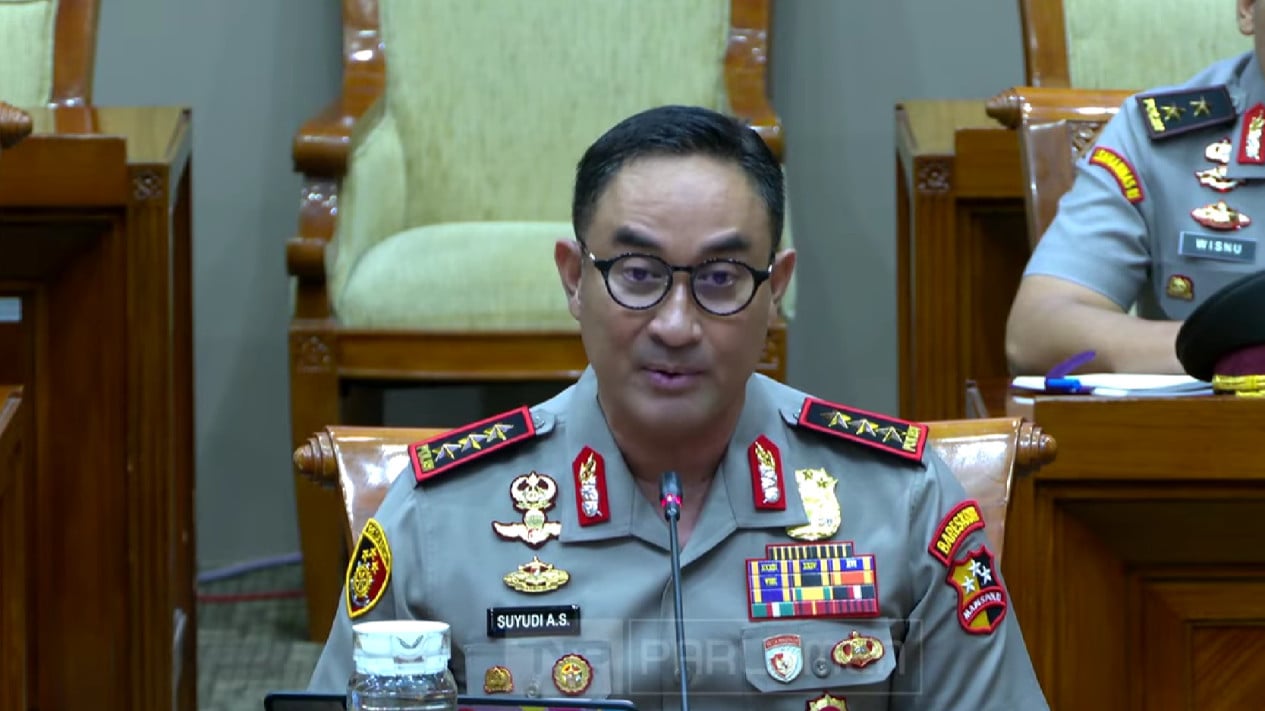
Police Commissioner General Suyudi Ario Seto addressed public satisfaction data regarding the Indonesian National Police (Polri) during a fit and proper test at Commission III of the Indonesian House of Representatives (DPR RI).
As a candidate for the position of National Police Chief to succeed General Listyo Sigit Prabowo, Commissioner General Suyudi emphasised that survey results must be interpreted clearly and not cherry-picked to favour the institution. The Head of the National Narcotics Board (BNN RI), who is also the former Banten Regional Police Chief, presented survey results from several agencies, including Litbang Kompas, LSI, and Indikator Politik.
According to the Litbang Kompas Q2 2026 survey, conducted from 9 to 15 April 2026, involving 1,200 respondents across 38 provinces, 82.4% of respondents are confident that Polri’s performance will improve in the future. Furthermore, Polri’s positive image rose from 64.4% in 2025 to 71.5% in 2026. Service satisfaction increased from 65.3% to 67.6%, and the service professionalism index rose from 7.76 to 8.37.
Additionally, based on the Indonesian Survey Institute (LSI) data from 20 to 28 January 2025, 71% of respondents expressed trust in Polri regarding law enforcement. “I am not conflating this data with other agencies that happen to use the abbreviation LSI. As a final comparison, the National Survey by Indikator Politik Indonesia, conducted from 15 to 21 January 2026, noted that 67% of respondents have moderate or high trust in Polri,” Suyudi stated before the DPR on Thursday (1/10/2026).
According to General Suyudi, the discrepancies between survey figures should be analysed alongside the survey timing, question formulation, sampling, and methodology, rather than being contested in a simplistic manner. The 1994 Police Academy (Akpol) graduate noted that these survey results could serve as a strong initial foundation for his potential tenure as the head of Polri until 202ng.
“My stance is clear: good numbers are capital, not a reason for complacency; low numbers are a warning, not a reason to be defensive. All surveys must serve as material for evaluation to improve the public’s experience when interacting directly with Polri,” he asserted.
Nevertheless, Suyudi acknowledged that internal achievements must be viewed alongside the public’s lived experience. Complaint patterns indicate that investigations, interrogations, services, legal certainty, integrity, and the use of authority remain areas that require continuous improvement.
“The public must be heard, respected, provided with explanations, and see that rules are applied consistently. The logic that must change is not ‘report and wait for it to go viral before taking action,’ but rather: report, verify, handle, provide updates, and resolve according to the law,” he concluded.