
As Saguling Reservoir Dries Up, It Turns Into Farmland
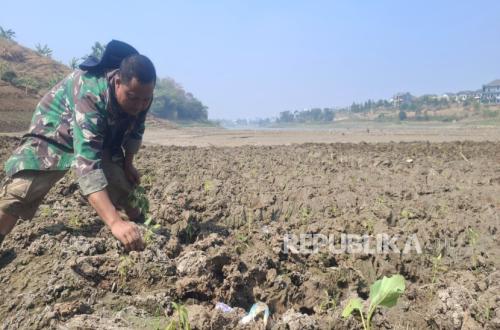
The prolonged dry season triggered by the El Niño phenomenon has caused the water volume of Saguling Reservoir in Bojonghaleang Village, Saguling District, West Bandung Regency, West Java, to shrink drastically. The dried-up water area is being used by residents as land for growing crops.
Based on monitoring on Thursday (20/8/2026), Saguling Reservoir, located in the Cireundeu River Block, has turned into dry land reaching the middle section and has been turned into makeshift farmland. Local residents are planting various types of secondary crops such as chillies, aubergines, cucumbers, pak choi and others on the dry land.
Encek Supriadi (50) is one of the residents taking advantage of the receding Saguling Reservoir to farm. That afternoon, he was planting chilli and aubergine seeds in the already dried-up area. Encek prefers secondary crops that have a faster harvest time and are suitable for the dry season.
“This year I want to plant chillies, aubergines, cucumbers and pak choi. Some have already been planted, some are newly planted,” said Encek.
He said that using the Saguling Reservoir area for farming is a routine whenever the water level recedes. According to Encek, the decline in water discharge has been occurring since four months ago, precisely when the long dry season arrived accompanied by the El Niño phenomenon. Encek said this year’s dry season is the same as what happened in 2023.
“The dry season has lasted about four months. It’s the same as 2023, six to seven months until it receded. Now it’s also the same, until dry land is visible in the middle section. Last year it wasn’t like this,” Encek explained.
To take advantage of the receding water level of Saguling Reservoir, Encek was willing to temporarily leave his business selling stone mortars in Lampung. He also has to spend capital, starting from procuring seeds, maintenance costs such as fertiliser, to paying farm labourers.
“Usually I sell stone mortars in Lampung, but when the water in Saguling recedes, I come home first to plant vegetables. When it’s no longer receding, I go back to selling,” he said.
Encek’s sacrifice in temporarily leaving his trading activity has paid off, as the harvest from the seasonal farming area is quite decent for meeting his family’s needs. When conditions are good, his chilli harvest can reach Rp20-30 million.
However, that figure has not yet been reduced by production costs, including procurement, maintenance and farm labourers, which are quite substantial. Moreover, farming during the dry season, according to Encek, requires considerable maintenance.
“When it’s good, chillies can reach 70 kg, cucumbers can reach more than 8 quintals, pak choi 50 kg, and aubergines can yield 2 quintals when conditions are good,” said Encek.