
As RTS Link nears opening, JB faces test of making its car-dependent centre more walkable
As RTS Link nears opening, JB faces test of making its car-dependent centre more walkable
Transport experts say Johor Bahru’s city centre lacks a connected pedestrian network, while authorities explore solutions and exchange ideas with global firms including Zaha Hadid Architects.
JOHOR BAHRU: On a typical afternoon, the streets of Johor Bahru’s central business district are a hive of activity: office workers rushing out for lunch, tourists moving between malls and, most prominently, cars and motorcycles weaving through packed streets.
Some stretches of pedestrian walkways and bicycle lanes - part of efforts to create a more car-lite city centre - are pockmarked with potholes or obstructed by haphazardly parked vehicles.
Elsewhere, pockets of prime land in the heart of the central business district (CBD) sit vacant and neglected, some strewn with rubbish.
Along the refurbished Sungai Segget canal a short walk from the popular Johor Bahru City Square mall, Malaysian Johnson Anthony told CNA recently that walking around central Johor Bahru has become more pleasant in recent years, but remains far from “what it should be”.
“It’s cleaner now than before, but there are ways to make it more comfortable and convenient for pedestrians,” said the 71-year-old security officer, who works in Singapore and was visiting Johor Bahru on his day off.
“There’s still too many cars,” added Anthony, who said he had struggled to cross a road at a traffic light that morning because vehicles did not stop.
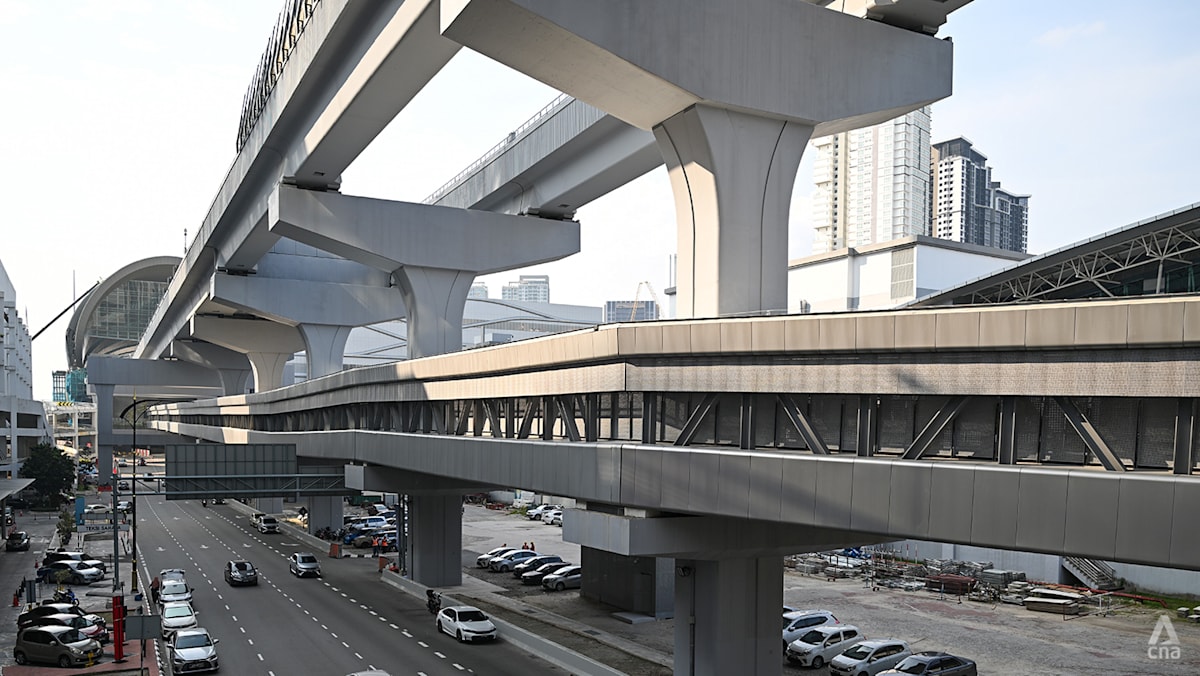
Anthony, like many in Johor Bahru, is keenly anticipating the opening of the Johor Bahru-Singapore Rapid Transit System (RTS) Link and, with it, an elevated pedestrian walkway connecting the Bukit Chagar station with other transport nodes, including taxi stands and a bus bay, as well as nearby malls such as Johor Bahru City Square and Komtar JBCC.
Johor Bahru’s CBD, gazetted as the Ibrahim International Business District (IIBD), will encompass 101ha in the state’s southern economic region, roughly the size of 141 standard-sized football fields.
It is set to become an increasingly important part of the city’s development story, with the RTS Link expected to begin service in January 2027 and the Johor-Singapore Special Economic Zone (JS-SEZ) expected to draw more companies, workers and visitors.
But urban planning experts told CNA that the proposed pedestrian linkway and the city centre’s existing street layout have shortcomings, particularly the lack of a continuous and comfortable pedestrian network and the area’s continued dependence on vehicles.
Still, experts are optimistic that authorities recognise these challenges and are looking for solutions, including potentially from overseas experts.
One sign, they said, was a seminar in July involving internationally renowned Zaha Hadid Architects, where representatives from the global firm spoke on how to improve Johor Bahru’s city centre urban systems.
In June 2025, the Johor state government reiterated plans to transform IIBD into a “world-class business hub” and raise its economic value from RM208 million (US$51.46 million) to RM21 billion by 2040, with plans encompassing shopping districts, work centres and integrated public transport systems.
Architect Chau Loon Wai told CNA the renewed focus on the city centre was welcome, after years of development on Johor Bahru’s outskirts had contributed to the “hollowing out” of its traditional core.
Chau said that infrastructures such as highways connecting incoming motorists from Singapore had led to the CBD being bypassed, causing Johor Bahru to lose its “spatial centrality”. But the RTS Link will soon bring the focus back to the IIBD, he said,
“We have no choice but to bring the focus back to the centre and address the tensions that come with it,” said the senior lecturer at Universiti Teknologi Malaysia’s Faculty of Built Environment and Surveying.
CALLS FOR BETTER PEDESTRIAN, CYCLING NETWORK
Urban planning and transport experts whom CNA spoke to said Johor Bahru’s city centre was largely designed around cars, pointing to the amount of land devoted to car parks and the network of roads cutting between shophouses and other buildings.
The result is a built environment where getting around without a vehicle can be difficult. Transport expert Muhammad Zaly Shah described walking in Johor Bahru’s city centre as “unforgiving”.
“One pothole, one blocked crossing, one lane of parked cars, and the entire trip (can) fail,” said Zaly, a professor of transportation and logistics at Johor’s Universiti Teknologi Malaysia.
With the RTS Link and JS-SEZ expected to bring more people into the city centre, making walking a viable alternative to driving will become increasingly important, he said.
The RTS Link alone will have the capacity to carry up to 10,000 passengers per hour in each direction once operational.
“This is not anti-car. The arithmetic is simple. What the RTS and SEZ will bring in will make it impossible for everyone to travel within the CBD by car. Therefore, walking has to be a viable option,” Zali added.
Doing so, he stressed, would require firm policies and consistent enforcement, including keeping designated lanes clear during stipulated hours and clearly setting out which government agencies are responsible for enforcing the rules.
Architect Chau agreed that a shift towards active mobility was necessary, and said Johor authorities recognise the need for change.
“Authorities are aware of the importance of promoting active mobility, to reduce congestion, make people healthier both bodily and mentally, and to (switch) to public transport.”
But transforming a city centre built around cars will not be straightforward, Chau acknowledged, given decades of infrastructure devoted to highways, roads and car parks.
“Once you put them in place, it’s not simply something you can redo,” he added.
For cyclists, the limitations of the existing infrastructure have long been apparent.
Avid cyclist Wong Chien Yee, who cycles acros
Source: jawawa.id (https://jawawa.id/newsitem/as-rts-link-nears-opening-jb-faces-test-of-making-its-car-dependent-centre-more-walkable-1787525409)
Originally published by CNA (https://www.channelnewsasia.com/asia/malaysia-johor-bahru-cbd-rts-link-urban-renewal-6332931)