
As Jakarta Approaches Its 500th Anniversary, Kearney Forum Highlights What It Takes to Become a Global City
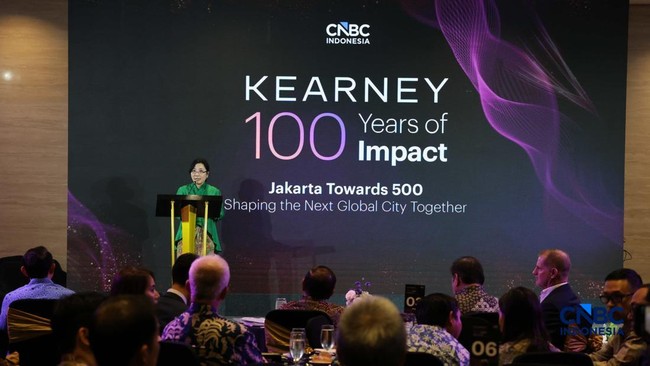
Jakarta’s position as Indonesia’s capital plays an important role in strengthening the country’s place in the regional and global economy. Transforming Jakarta into a global city will require better infrastructure and urban development, alongside a competitive investment climate, progressive economic policies, a strong business ecosystem and deeper integration with the global economy.
Jakarta aims to enter the top 50 of the Kearney Global Cities Index by 2030. The Jakarta provincial government is continuing to address various obstacles in order to provide investors with greater certainty.
To support Jakarta’s drive to become a global city, global management consultancy Kearney held KEARNEY 100 YEARS OF IMPACT under the theme “Jakarta Towards 500: Shaping the Next Global City Together”.
Kearney Indonesia President Director Shirley Santoso outlined changes made by the Jakarta provincial government under Governor Pramono Anung. She said these changes were helping Jakarta become a competitive, inclusive and sustainable global city.
“What has impressed us most is not only the range of programmes being carried out, but also the spirit behind them: the courage to act, the optimism to see opportunities and the commitment to keep improving,” she said, as quoted on Monday (2 November 2026).
However, she said, no single party could build a successful global city. Jakarta needs collaboration among the provincial and central governments, the public and private sectors, academics and the community.
“Jakarta is not built in a day, nor is it built by one party alone. We all build Jakarta together, through the decisions we make and the partnerships we form,” Shirley said.
Kearney Global Managing Chairman Bob Willen also praised the stakeholders attending the event. He said that throughout its 100-year history, Kearney had sought to deliver a positive, tangible impact.
“Throughout our journey, we have always connected our work to impact, tangible results and working together with our clients,” he said.
Jakarta’s transformation and major challenges
Jakarta Governor Pramono Anung said the city was now the world’s leading metropolitan area, ahead of Tokyo and New York. He also said Jakarta ranked 15th globally for public transport in a Time Out survey, and second in ASEAN behind Singapore.
Nevertheless, Jakarta still faces a number of challenges, including poverty. Pramono said the city’s main problem was its Gini ratio, which stands at 0.45 and needs to be reduced. The next target is to promote education, which he said was considered one of the ways to break the cycle of poverty.
Pramono is also focused on improving the transport system so that people can switch from private vehicles to public transport. One initiative is TransJabodetabek, which connects satellite cities with central Jakarta.
“This is significant because the number of people switching from private vehicles to public transport has risen sharply. It has increased by 15%, and Jakarta’s connectivity now stands at 93%,” he said.
At a fireside chat, Coordinating Minister for Economic Affairs Airlangga Hartarto said tourism was the fastest way to generate revenue. Jakarta, he said, had considerable potential to host events that attract tourists.
“If you are looking for the quickest model for generating revenue, it is tourism, because tourism earns foreign exchange without importing components. When Kanye West was here recently, hotel occupancy in Jakarta reached 90%,” Airlangga said.
Experts and stakeholders discuss Jakarta’s development potential
The forum also held a panel discussion to explore perspectives from government, businesses, investors and other stakeholders on policy direction, investment opportunities, economic competitiveness and Indonesia’s role in international trade.
Pandu Sjahrir, CIO of BPI Danantara Indonesia, said Jakarta was becoming the world’s largest city in terms of its growing gross domestic product. One of the city’s achievements, he said, was the development of a large service-based economy.
“I don’t know whether you are all here this weekend, but we have two major events, don’t we? We have a running festival and an event by Ye, or Kanye,” Pandu said.
He said such events generated economic activity, as tourists—many of them foreign nationals—visited and saw Jakarta’s progress.
“That is one of the things that artificial intelligence cannot disrupt: entertainment and live entertainment,” he added.
Indonesian Employers Association (APINDO) chairwoman Shinta Kamdani said Jakarta was undergoing rapid transformation. Investment grew by 62.5% between 2023 and 2025, she said, exceeding the national average.
She identified artificial intelligence and data centres as major investment opportunities for Jakarta, alongside green business and sustainability.
“The creative economy may not yet be on the radar of many industries. That is an enormous opportunity; it has not yet become a driver. I believe synergies can be built,” she said.
Indonesia Stock Exchange President Director Jeffrey Hendrik also highlighted Jakarta’s progress, particularly in terms of inclusivity. He cited 33 million investors, 962 listed companies and daily transactions worth Rp20.5 trillion on the exchange.
“The key word is inclusivity—bringing everyone in. As an exchange that was once known as the Jakarta Stock Exchange, I believe Jakarta also needs to demonstrate inclusivity so that everyone can take part in building the city,” Jeffrey said.
EMTEK Managing Director Sutanto Hartono likewise said Jakarta’s progress required connectivity between the government and the private sector. The government, he said, needed to provide regulations that supported private-sector growth.
“Our industries and the private sector already know many of the solutions to the problems and what we would like to see. The government needs to help, whether through regulation, support or other measures,” he said.
Blue Bird Group chief executive Adrianto Djokosoetono praised the Jakarta provincial government’s coordination with local governments across Bodetabek—Bogor, Depok, Tangerang and Bekasi—on investment and transport. He said he hoped partnerships with the private sector would become more transparent, allowing development to be delivered more quickly and on a larger scale.
“We hope public-private partnerships will become more transparent and more numerous, so development can be faster, more extensive and benefit more people, both in Jabodetabek and among those coming from elsewhere. Major events also stimulate economic activity; we must not let that momentum pass,” he said.
Raden Pardede, a special staff member at the Coordinating Ministry for Economic Affairs, added that everyone needed to work together for Jakarta’s development and progress.
“We are all Jakarta residents and stakeholders, and we must take responsibility for the city’s development. Financing, too, must be a collective effort. The private sector has the money, and it is the private sector that can work productively,” he said.
Optimism about Jakarta’s global-city ambitions
Rudolph Lohmeyer, head of Kearney Foresights and Global City Index, who brought the KEARNEY 100 YEARS OF IMPACT programme to a close, said Jakarta had a future as a global city, noting its significant investment growth.
“That matters not only to companies around the world that need supply chains and Jakarta’s connectivity at the centre of the world’s fastest-growing region, but also to Jakarta’s residents,” he said.
He also described Jakarta as democratic, saying this characteristic contributed to its development. The city had succeeded in giving residents choices to build businesses and drive the economy, he said, adding that this could inspire others.
“I want to recognise that. When we look at other cities around the world, of course it is competitive, and many are trying to become global in different ways,” he said.
The Kearney 100 Years of Impact event underscored the importance of collaboration between government, business and other stakeholders in driving economic growth and making Jakarta more connected and globally competitive. Marking Kearney’s 100 years of impact on business and society, the discussions were intended to broaden perspectives and encourage practical steps towards realising Jakarta’s potential as a global city.
Source: jawawa.id (https://jawawa.id/newsitem/as-jakarta-approaches-its-500th-anniversary-kearney-forum-highlights-what-it-takes-to-become-a-global-city-1793778667)
Originally published by CNBC Indonesia (https://www.cnbcindonesia.com/news/20261104134512-4-782254/menuju-5-abad-forum-kearney-ungkap-modal-jakarta-jadi-kota-global), translated from Indonesian