
As inflation hits Indonesia, some businesses absorb costs while others raise prices
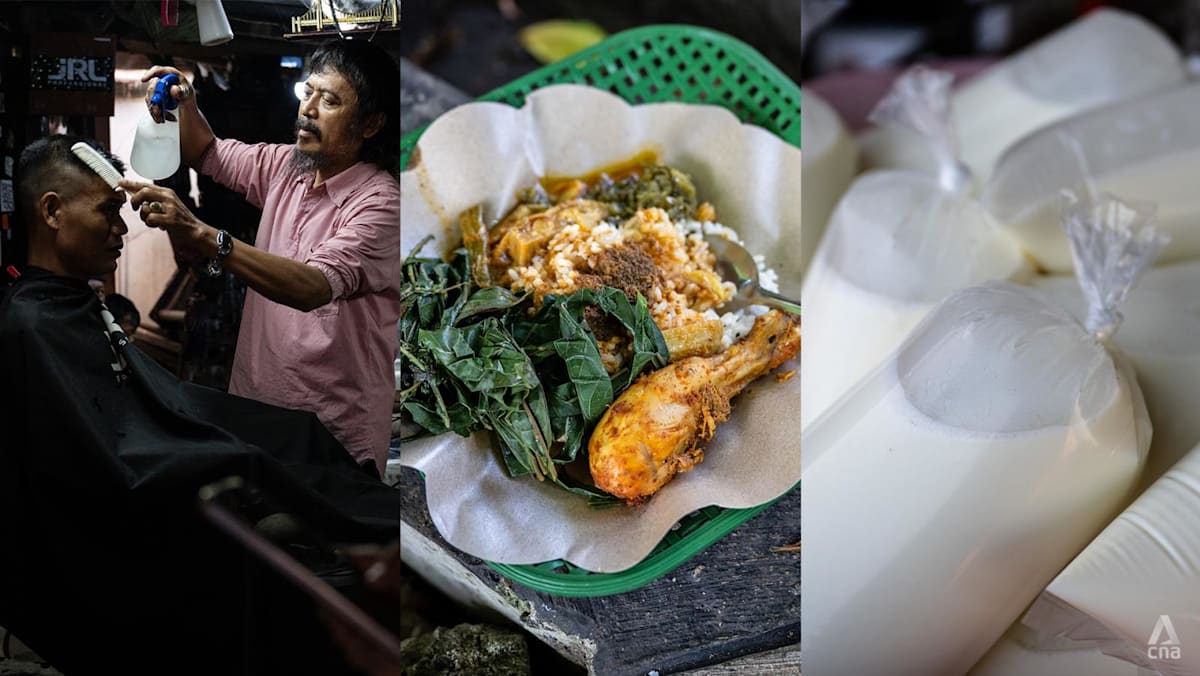
As inflation hits Indonesia, some businesses bite the bullet while others pass the buck
From a US$0.31 haircut to a US$0.67 meal, some Indonesian businesses have refused to pass rising costs on to consumers, providing small but meaningful relief to their communities. Others make the “hard choice” to raise prices.
BOGOR, Indonesia: At first glance, Pemuda Barbershop looks like the sort of place customers might avoid.
The tiny establishment operates out of a weather-beaten hut on one of the busiest streets in Bogor - about 60km south of Indonesian capital Jakarta - with a warping zinc roof that looks to be on the verge of collapse.
Inside, there is no air conditioning.
Customers have their hair trimmed while sitting on two decrepit barber chairs with broken backrests, dimly lit by a makeshift overhead skylight which leaks when it rains and a couple of neon lights slung from a bamboo rafter.
The walls are cluttered with Javanese puppets, faded hairstyle posters and weathered stickers - some of which date back to the shop’s opening in the late 1980s.
Yet there could be anywhere between 30 and 50 customers streaming in from the moment the shop opens at 10am.
The clientele is mostly drawn in by the barber’s skillful hands and a price of just 5,000 rupiah (US$0.31) per haircut, about a third of what working-class barbershops typically charge and around a tenth of the price at middle-class salons in Indonesia.
“I don’t have the heart to raise my prices. Where else will these people go?” the establishment’s owner and main barber, Supriyanto, who like many Indonesians goes by one name, told CNA.
He hasn’t increased his charges in decades, since 2008.
Pemuda Barbershop is one of a handful of businesses in Indonesia that have refused to pass rising costs on to customers, even as a weakening rupiah and soaring prices squeeze already thin margins and force other businesses to pass the buck onto consumers.
They have become a small but meaningful buffer against a slumping economy, particularly for the 23 million people who live below the country’s poverty line. Indonesia defines poverty as those earning less than 600,000 rupiah a month.
Across the archipelago, a weakening rupiah has driven up the cost of imported goods, while the conflict in the Middle East has pushed energy prices higher, filtering through to everything from transport to food.
While some business owners like Supriyanto hold fast, several food vendors interviewed by CNA said they had reluctantly increased prices in recent months as the cost of ingredients and fuel continued to climb.
Higher energy and raw material costs have also squeezed manufacturers, contributing to the closure of dozens of factories and a wave of layoffs.
According to the Ministry of Manpower, more than 43,000 workers lost their jobs between January and June, a 34 per cent increase compared to the same period in 2024.
But experts highlighted the fact that according to the Indonesian Bureau of Statistics nearly 60 per cent of Indonesian workers are working in the informal sector, which the ministry does not monitor.
“This means the true figure is likely much higher because not all job losses are recorded,” Achmad Nur Hidayat, an economist from Jakarta’s National Development University, told CNA.
There have been some forms of relief.
Food prices have eased during this year’s school holidays as supplies originally meant for the free nutritious meal programme flood the market.
The programme - one of President Prabowo Subianto’s signature initiatives - aims to provide one free meal a day to millions of school children nationwide, costing Indonesian taxpayers around one trillion rupiah per day.
Indonesia has also rolled out a 26.3 trillion rupiah stimulus package for the second half of 2026, including food assistance, transport incentives and temporary employment programmes. But economists have questioned whether the stimulus is enough to cushion households from the economic fallout of the Middle East conflict.
For Supriyanto, the hardship facing his customers is reason enough to keep his prices where they have been for nearly two decades.
“5,000 (rupiah) may not seem like much, but for informal workers and people earning below the minimum wage, it’s a lot of money,” he said. “Especially in today’s economy, when everything costs more but people’s wages have stayed the same.”
SKYROCKETING PRICES
Compared with many other small businesses, Supriyanto considers himself fortunate as his two biggest expenses - 2 million rupiah on monthly rent and around 1 million rupiah in wages for a freelance second barber - have remained largely unchanged.
Even so, he has had to tighten his own belt.
“We have to be frugal in times like this. Less eating chicken and more eggs,” Supriyanto said with a bitter smile.
Many other businesses in the country, however, have faced a significant hit.
In Indonesia, global pressures, such as the conflict in the Middle East, have been compounded by a weakening rupiah, which has lost as much as 7.8 per cent of its value against the United States dollar over the past year. On Jun 8, the currency hit a record low of 18,190 rupiah to the dollar, far weaker than the government’s 2026 budget assumption of 16,500.
According to the Indonesian Central Bank’s Strategic Food Price Information Centre, the price of cooking oil has climbed from about 19,000 rupiah per kilogram before the US-Iran conflict escalated in late February to around 20,500 rupiah today.
Over the same period, red chilli prices have risen from 46,500 rupiah to 51,000 rupiah per kilogram, while soybeans have jumped from about 9,000 rupiah to 13,000 rupiah per kilogram.
For Susilowati, who runs a catering business in Jakarta, the surge in ingredient costs has left her with little choice but to raise prices by up to 10 per cent.
“It was a hard decision. We tried keeping our prices the same, but after a while we realised it was either raise prices or switch to cheaper ingredients, which would affect t