
As Indonesia’s Toll-Road Business Approaches Half a Century, These Five Operators Dominate
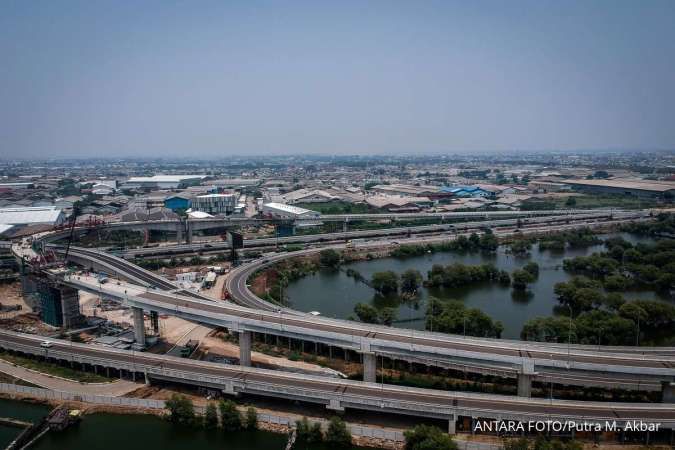
KONTAN.CO.ID – Jakarta. Indonesia’s toll-road business will turn 48 in 2026. As it approaches its half-century mark, the sector remains concentrated among several major operators, particularly state-owned companies.
The five leading players with extensive toll-road portfolios are PT Jasa Marga (Persero) Tbk (JSMR), PT Hutama Karya (Persero), Astra Infra, PT Waskita Toll Road (WTR) and PT Citra Marga Nusaphala Persada Tbk (CMNP).
Data from the Ministry of Public Works (PU) show that Indonesia has about 3,100 kilometres of operational toll roads, comprising 76 sections. Investment in building the network has reached Rp 779 trillion.
Public Works Minister Dody Hanggodo previously said the national toll-road network was managed by 54 toll-road business entities (BUJT).
Amid ongoing toll-road infrastructure development, each operator has adopted a different business strategy. Jasa Marga and Hutama Karya are major players with extensive networks, while Astra Infra is increasing the capacity of sections already in operation.
Waskita Toll Road, meanwhile, is consolidating its portfolio by divesting assets, while CMNP is maintaining its focus on several strategic concessions, particularly in urban areas.
Here is an overview of the five leading players in Indonesia’s toll-road business.
PT Jasa Marga (Persero) Tbk remains Indonesia’s largest toll-road operator.
As of October 2026, the company operated about 1,318 kilometres of toll roads, equivalent to around 42% of the total operational network in Indonesia.
Jasa Marga’s toll-road network spans several regions, including Java, Sumatra, Bali, Kalimantan and Sulawesi.
In financial performance, Jasa Marga recorded operating revenue of Rp 15.6 trillion through the third quarter of 2026. Net profit attributable to owners of the parent entity was about Rp 2.7 trillion.
The company is also continuing to develop several strategic projects, including the Jakarta-Cikampek II Selatan Toll Road, Patimban Access, the 75.12-kilometre Yogyakarta-Bawen Toll Road, and Solo-Yogyakarta-YIA Kulon Progo.
These network developments are part of Jasa Marga’s efforts to maintain its position as the country’s largest toll-road operator.
PT Hutama Karya (Persero) is another major player in toll-road development in Indonesia, particularly through its mandate to build the Trans-Sumatra Toll Road (JTTS).
The government assigned the project under Presidential Regulation No. 100 of 2014 on accelerating the development of toll roads in Sumatra, which has since been amended several times.
By the third quarter of 2026, the total length of toll roads operated by Hutama Karya and its subsidiaries had reached about 872.5 kilometres. This includes the Jakarta Outer Ring Road Section S (JORR-S) and Tanjung Priok Access.
The operational section of the JTTS network alone extends for about 847 kilometres.
One of its main sections is the approximately 189-kilometre Terbanggi Besar-Pematang Panggang-Kayu Agung Toll Road.
For the next stage of development, Hutama Karya is focusing on continuing several Trans-Sumatra corridors, including Palembang-Betung, Betung-Jambi and Rengat-Pekanbaru.
The network’s development is expected to improve regional connectivity and support logistics distribution and economic activity on Sumatra.
In the private sector, Astra Infra is one of the major operators with several strategic concessions.
Through PT Astra Tol Nusantara and its subsidiaries, Astra Infra manages a number of toll-road sections in Indonesia, particularly along the Trans-Java corridor.
Its portfolio includes the 72.5-kilometre Tangerang-Merak Toll Road, the 116.8-kilometre Cikopo-Palimanan Toll Road and the 40.5-kilometre Jombang-Mojokerto Toll Road.
Astra Infra’s strategy is not limited to acquiring new concessions; it also seeks to increase capacity and improve service quality on roads already in operation.
One example is the development of the Tangerang-Merak Toll Road. Of its total 72.5 kilometres, about 51.1 kilometres have three lanes, while a further 12.3 kilometres have four lanes.
The capacity upgrades are intended to anticipate growth in vehicle volumes and keep traffic flowing smoothly.
Astra Infra also uses infrastructure-monitoring technology to support toll-road maintenance and improve road-user safety.
- Waskita Toll Road: portfolio consolidation through asset divestments
Unlike other operators, PT Waskita Toll Road (WTR), a subsidiary of PT Waskita Karya (Persero) Tbk, is pursuing a portfolio-consolidation strategy.
The strategy involves selling stakes in several toll-road sections as part of efforts to improve the company’s financial health.
In Waskita Karya’s 2024 annual report, the Waskita Group said it still had a portfolio of 10 toll-road sections.
One divestment involved the sale of its stake in PT Cimanggis Cibitung Tollways. Waskita Toll Road announced a material transaction relating to the divestment in December 2025.
Divestment is one of the company’s measures to optimise assets, improve its financial structure and reduce financing burdens.
Waskita Toll Road’s current direction is therefore not solely focused on adding kilometres of toll roads, but also on consolidating and optimising its remaining portfolio.
- CMNP: private operator with strategic concessions
PT Citra Marga Nusaphala Persada Tbk (CMNP) is also an important player in the national toll-road industry.
The company, which has operated since 1987, holds several toll-road concessions through its parent company and subsidiaries.
One of its strategic assets is the approximately 27.1-kilometre Cawang-Tanjung Priok-Ancol Timur-Jembatan Tiga/Pluit Toll Road, part of Jakarta’s inner-city toll-road network.
CMNP’s portfolio also includes the Waru-Juanda, Depok-Antasari, Soreang-Pasir Koja, Cileunyi-Sumedang-Dawuan and Bogor Outer Ring Road toll roads.
According to company reports, the CMNP Group holds six toll-road concessions. Some sections are operational, while others are still under development.
CMNP is also developing the Harbour Road II project, or the approximately 9.6-kilometre Ancol Timur-Jembatan Tiga/Pluit Toll Road.
Meanwhile, extending the Cawang-Pluit Toll Road concession until 2060 is an important aspect of the company’s portfolio management.
Cross-ownership makes the toll-road operator landscape more complex
Although these five business groups have extensive toll-road networks, the national market cannot be mapped simply by adding up the length of roads managed by each company.
This is because Indonesia’s toll-road industry includes cross-ownership arrangements through joint-venture companies.
Under such arrangements, a single toll-road section may involve more than one investor or operator. As a result, the length of road managed by a business group may not all be directly owned by that company.
Calculating market share by road length therefore requires consideration of the shareholding structure and operating rights for each section.
Government targets an additional 2,461 kilometres of toll roads by 2029
Competition in the toll-road business is expected to become more dynamic as the government plans to expand the national infrastructure network.
Under the 2025–2029 General Plan for Government-Business Cooperation Projects and Creative Financing in the Toll-Road Sector, the government has prepared plans to develop 45 toll-road sections with a combined length of about 2,461.37 kilometres.
The plans cover network development in Sumatra, Java and Bali.
With this expansion, Jasa Marga and Hutama Karya are expected to continue playing important roles in developing the national toll-road network. Private operators, meanwhile, may strengthen their businesses by optimising concessions, increasing capacity and developing strategic sections.
The operators’ differing strategies will help shape competition in Indonesia’s toll-road industry over the coming years.
Source: jawawa.id (https://jawawa.id/newsitem/as-indonesias-toll-road-business-approaches-half-a-century-these-five-operators-dominate-1793577046)
Originally published by nasional.kontan.co.id (https://nasional.kontan.co.id/news/menuju-setengah-abad-bisnis-jalan-tol-indonesia-masih-dikuasi-5-penguasa-ini), translated from Indonesian