
As Foreign Exchange Reserves Continue to Shrink
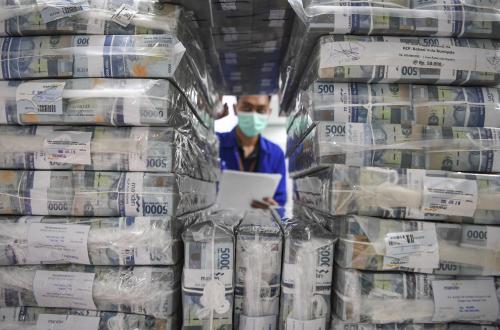
In terms of sheer volume, Indonesia’s foreign exchange reserves remain relatively secure. As stated by Bank Indonesia’s Head of Communications, Ramdan Denny Prakoso, the reserves we possess are still capable of supporting external sector resilience and maintaining macroeconomic and financial system stability. Overall, the position of foreign exchange reserves at the end of May 2026 is equivalent to 5.6 months of imports, or 5.5 months of imports plus government foreign debt payments. The standard for adequacy in various countries is usually around 3 months of imports.
With foreign exchange reserves at $144.9 billion, Indonesia’s position as of May 2026 remains above international adequacy standards. While this is reassuring, it does not mean the situation is entirely safe. From time to time, our foreign exchange reserves have continued to shrink. Ongoing conflicts in the Middle East and global economic uncertainty could accelerate this depletion if not anticipated early. Experience has proven that continuously shrinking reserves could have detrimental impacts on the national economy in the future.
On various occasions, the government has repeatedly stated that our foreign exchange reserves are safe. This statement is not incorrect; statistically, the amount we hold is more than sufficient. However, because the reserves are steadily declining, steps must be taken to address this. As geopolitical crises spread to various countries, we can see reserves shrinking alongside stabilisation efforts and high demand for foreign currency. Efforts by the government to save the rupiah have not yet been fully successful, as the rupiah exchange rate continues to depreciate.
To prevent the rupiah from further depreciation, one option that may need to be considered is an increase in interest rates. Although Bank Indonesia recently decided to raise the benchmark BI-rate, the possibility of further hikes remains if external resilience weakens. In recent months, it has been reported that foreign exchange reserves shrank by $11.6 billion (approximately Rp 197.8 trillion), marking the deepest decline in five years. This ongoing depletion requires serious attention, serving as an alarm for the nation’s economic defences.
There are several primary impacts to anticipate. First, it adds pressure to the rupiah exchange rate. Reserves shrink because the state must meet foreign debt obligations, intervene in the market to support the rupiah, or finance swelling imports. Bank Indonesia’s market interventions are a major factor in draining reserves. To prevent deep depreciation and ‘imported inflation’, Bank Indonesia has frequently utilised reserves for stabilisation. Consequently, the central bank’s capacity to dampen market volatility becomes more limited.
Second, the risk of a surge in inflation (imported inflation). Much of domestic industry remains heavily dependent on imports for strategic needs, including energy and industrial raw materials. If the exchange rate weakens due to shrinking foreign currency supply, the cost of bringing these goods into the country will skyrocket. Psychologically, this could erode market confidence, trigger speculation, and cause the domestic currency to weaken further against the US dollar, eventually leading to higher general prices for consumers.
Third, an increased risk of default and credit rating downgrades. Theoretically, sufficient foreign reserves serve as a guarantee of a country’s international liquidity. If reserves erode towards critical limits, international rating agencies such as Moody’s, S&P, or Fitch may downgrade the nation’s debt rating. This would make the cost of borrowing more expensive for both the government and private corporations.
Fourth, it affects economic growth. To foreign investors, strong foreign exchange reserves are an indicator of macroeconomic health and the ease of repatriating profits. A significant depletion of reserves could potentially trigger capital flight. If capital outflows increase, the impact will inevitably slow down investment and national economic growth. To address the depletion caused by currency interventions and debt payments, proactive measures are essential.