
As China Exports More Robots and AI, What Could It Mean for the World’s Workforce?
As China exports more robots and AI, what could it mean for the world’s workforce?
As China ramps up exports of robots and AI, global buyers are turning to automation to tackle risky and repetitive jobs, raising questions about how work will change.
GUANGZHOU: Installing cables on live power lines. Cleaning skyscraper windows hundreds of metres above the ground. Chasing birds away from airport runways.
These are jobs long considered too dangerous, repetitive or labour intensive for humans.
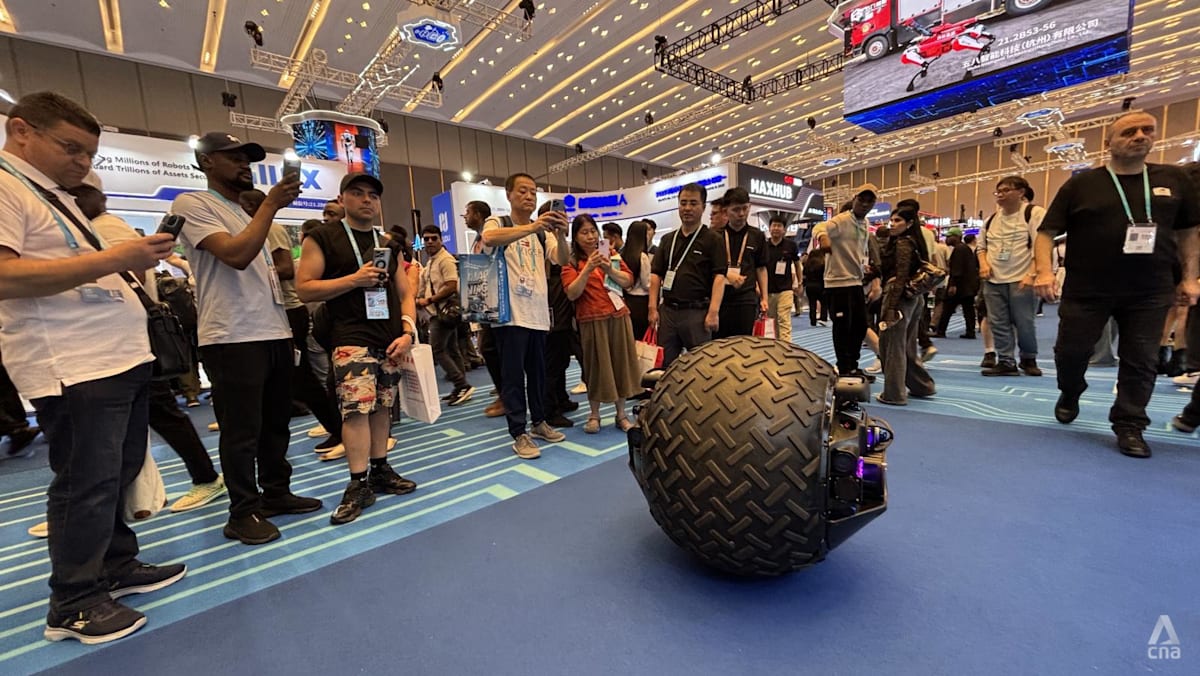
At the Canton Fair in Guangzhou which is China’s largest trade exhibition first launched in 1957 and held twice yearly, Chinese companies are showing how robots may increasingly be able to do them instead - and some overseas buyers are already placing orders for the machines.
Across the exhibition halls of the current spring session running from Apr 15 to May 5, and featuring more than 32,000 exhibitors across various sectors, machines can be seen climbing walls, inspecting power lines and patrolling industrial sites, drawing crowds eager to see how automation could fit into their businesses.
Buyers from Europe, Southeast Asia, the Middle East and Latin America say the technology could help address labour shortages, rising costs and workplace safety risks.
China’s industrial robot exports rose 48.7 per cent in 2025, making the country a net exporter of industrial robots for the first time, according to Chinese customs data.
China is already the world’s largest market for industrial robots, accounting for about 54 per cent of global installations in 2024, with roughly 295,000 units deployed, according to the International Federation of Robotics.
The shift raises a broader question: what could the spread of automation mean for workers around the world?
Kenneth Huang, a professor specialising in innovation and technology management at the National University of Singapore (NUS), said the shift could reshape labour markets but not necessarily through widespread job losses.
“Robotics will significantly reshape labour markets - but not through simple, across the board job destruction,” he said.
GLOBAL DEMAND FOR ROBOTS
Automation is already expected to have a substantial labour-market impact.
The World Economic Forum estimates that 22 per cent of today’s jobs could be created or displaced by structural labour-market changes by 2030, while 41 per cent of employers plan to reduce their workforce where AI can automate tasks, according to its Future of Jobs Report 2025.
China is also among the world’s most automated manufacturing economies. Its factories operate about 470 industrial robots for every 10,000 workers, far above the global average of 162, the International Federation of Robotics said.
For some overseas buyers, the appeal of automation lies in reducing labour intensive work.
Jhonier Jimenez, owner of Colombian construction company Conversion WM SAS, said he was particularly interested in a robot developed by Guangdong Crownpower Electric Power Technology Development (Crownpower Tech) to install connectors on live power lines.
For companies carrying out infrastructure work, tasks such as electrical installation can also involve additional safety risks.
“If you can eliminate that part, (it) is better for us,” Jimenez said.
Even so, he said automation should not necessarily be seen as a threat to workers.
“It’s not a risk. (It is an) opportunity to explore new fields for new skills for the people.”
Others see automation as a way to improve efficiency in service industries.
Brazilian entrepreneur Geraldo Patury Accioly Neto, who runs a cleaning services business, said he was particularly interested in machines designed to clean windows and floors.
“The window cleaning and the self-cleaning for floors … both of them were very interesting for us,” he said.
His company bought a window-cleaning machine at the fair and may purchase more if the technology proves reliable.
“Yes, this is the first purchase. We may do more purchases for the window cleaning,” Neto said.
While acknowledging concerns that automation could replace some jobs, he said robots could also improve productivity.
“Some jobs will be more effectively done by robots and AI than by persons. And people can do other things.”
TAKING ON DANGEROUS JOBS
Many of the machines attracting attention at the Canton Fair are not humanoid robots designed to resemble people.
Crownpower Tech, the company behind the live power line robot, has also developed machines for other power grid maintenance work, including removing ice from overhead lines and applying insulation coatings to electrical equipment.
While most of its sales are currently within China, Li Shuzhang, a brand manager at the company, said enquiries are emerging from Vietnam, Brazil, Europe and parts of South America.
Some robots are designed for dangerous situations beyond industrial maintenance.
At Chinese robotics company Rotunbot, patrol robots are used to monitor large facilities such as airports and oilfields.
The machines can patrol vast areas for hours, detect risks and even chase birds away from airport runways to help prevent aviation incidents.
In emergency situations, the robots can also be sent ahead of human responders to assess threats.
“Our view is that this is an era of human machine collaboration,” said Duan Tianye, the company’s vice general manager for sales and partnerships.
“For emergency situations, the robot can go in first to investigate and reduce risk before people step in.”
Inside factories, robots are increasingly being used to handle repetitive tasks.
Guangzhou-based Shiyuan Electronics, a company that started out producing circuit boards for television panels, is now expanding into robotics and artificial intelligence.
At its booth, robotic arms demonstrate how they can pick up and sort items with extremely fine precision.
But the company’s goal is not just accuracy. It is flexibility.
Traditional automated production lines are often designed for a single product and ca