
Article 33 Is Not Capitalism or Socialism, but a Balance for People's Prosperity
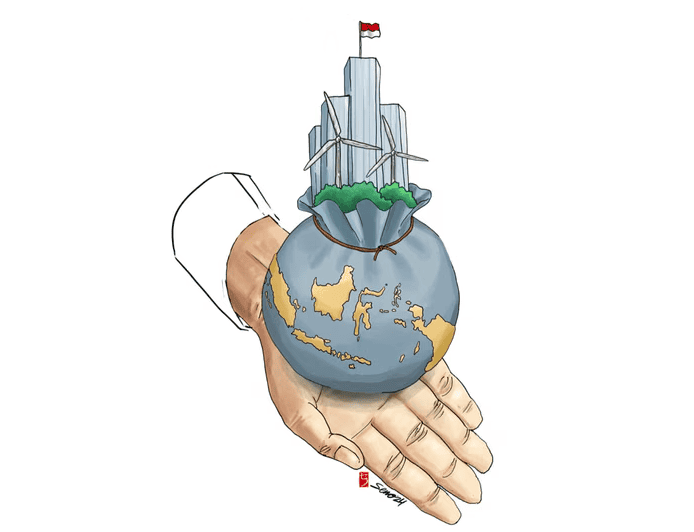
The debate over whether the economic system under Article 33 of the 1945 Constitution leans towards capitalism or socialism has drawn a response from Didin S. Damanhuri, Chairman of the Expert Council of the Indonesian Indigenous Entrepreneurs Association (ASPRINDO). He explained that the original intent of Article 33, based on the thinking of the founding fathers—particularly in the economic sphere, such as Bung Hatta and Soemitro—did not create a dichotomy between the state and the market. Rather, it placed them proportionally.
“Bung Hatta himself stated in 1976 that the economic structure envisioned by Article 33 involves three constitutional actors: state corporations or state-owned enterprises (BUMN), the private sector, and cooperatives,” Didin said in a statement in Jakarta on Wednesday (19/8).
He stressed that Indonesia’s economic architecture requires a credible state role and a healthy market mechanism in which economic actors—BUMN, the private sector, and cooperatives—are able to bring prosperity to the people.
He explained that cooperatives would handle economic activities that have not yet reached the medium-to-large category and are not yet highly productive. For the sake of economic stabilisation, state enterprises would take on roles that the private sector cannot touch.
“But there is a message: MSMEs and cooperative enterprises must move up in class. So if asked whether Article 33 is capitalism or socialism, I would answer that Article 33 is not a mixture of the two, but it requires both,” he said.
Thus, in the debate between a stronger state role and a stronger market role, he asserted that the founding fathers emphasised the need for a balance between the two.
“During the reform era, people talked about the importance of the market and the private sector, then forgot about the role of the state. Yet during the Soeharto era, it was the state’s role that made Article 33 of the 1945 Constitution work, particularly in the management of natural resources such as forests, or in technological control during the Habibie era. That was because of the state’s role,” Didin stressed.
He stated that an economy in which the state plays an active and credible role is a prerequisite for fulfilling social justice for all Indonesian people and for bringing prosperity to the greatest possible number of people.
“So what must be measured is the state’s ability, or the system’s realisation, in creating a political-economic structure. How natural resources, markets, and technology can be guaranteed by the state so that they do not fall into interests that conflict with public welfare or the public interest,” he said.
This refers to oligarchy—a small group of economic controllers sheltering behind the state—as well as misguided state capitalism that creates rampant rent-seeking from both the private sector and state-owned enterprises.
He expressed hope that the government could realise a political-economic structure capable of ensuring that natural resources, man-made resources, technology, markets, and even digitalisation are managed for the greatest possible prosperity of the people.
“The institutionalised economic structures from the New Order and reform eras number only two. First, the state-owned enterprise or state corporation experience. Second, the private sector. Even the political sector has been institutionalised, with regular elections. Unfortunately, the most fundamental thing—maximising public welfare—has not yet been institutionalised,” he concluded.
Source: jawawa.id (https://jawawa.id/newsitem/article-33-is-not-capitalism-or-socialism-but-a-balance-for-peoples-prosperity-1787136750)
Originally published by Media Indonesia (https://mediaindonesia.com/ekonomi/923592/pasal-33-bukan-kapitalisme-atau-sosialisme-tapi-keseimbangan-untuk-kemakmuran-rakyat), translated from Indonesian