
Arrow breaking symbolises peace in Papua Highlands
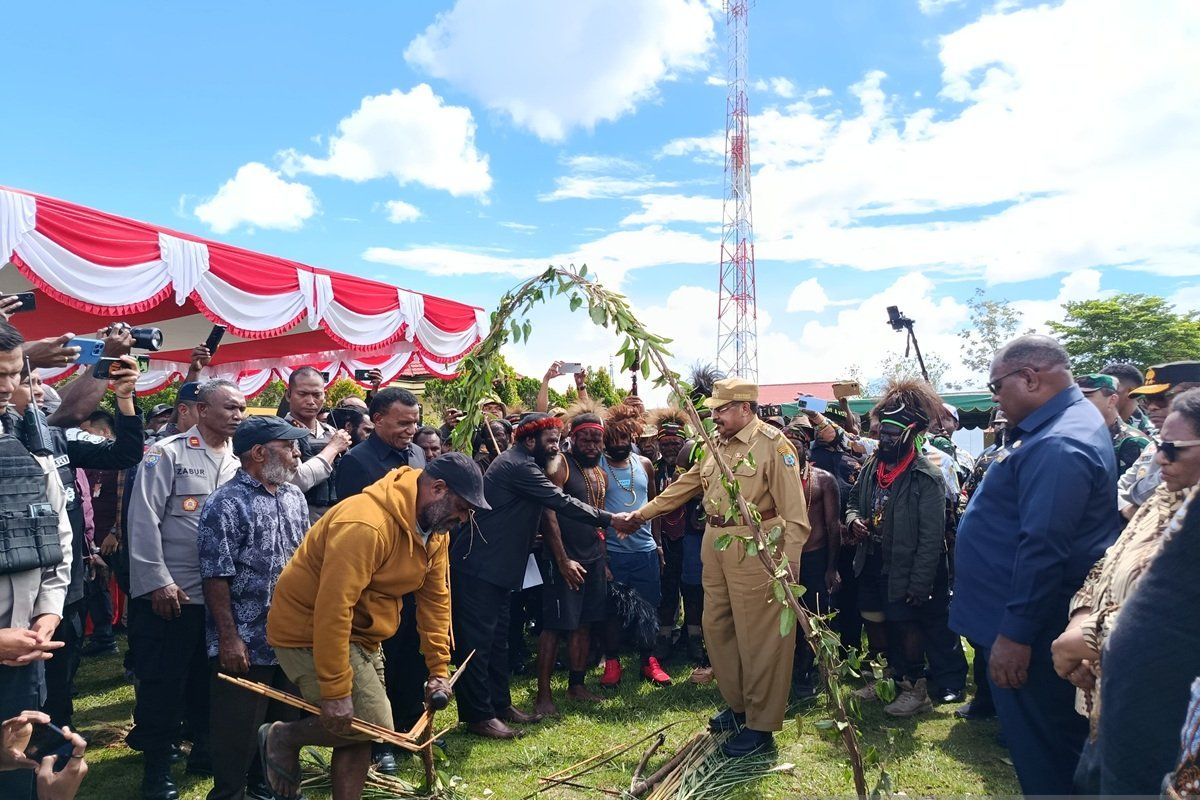
Wamena (ANTARA) - The atmosphere at the Jayawende Police Headquarters was quite tense that afternoon. Security at the entrance was maintained by Jayawijaya Police members, assisted by Brimob personnel, to ensure that no weapons were brought into the venue, allowing the peace process attended by the Deputy Minister of Home Affairs, Ribka Haluk, to proceed safely and smoothly.
The peace process was conducted through traditional customs, specifically the breaking of arrows or the releasing of bowstrings, as a sign of the cessation of hostilities between the two conflicting tribes in Wamena City, Jayawijaya Regency.
The ‘broken arrow’ ceremony, held at the Jayawijaya Police Headquarters assembly field, served as a manifestation of the state’s presence. The two warring parties were separated, with the Chairmen of the LMA (Indigenous Peoples Association) for Jayawijaya and Lanny Jaya standing in the centre, explaining the ritual process using the Hubula and Lani local languages.
The Chairmen of the LMA for Jayawijaya and Lanny Jaya stood at the front, while each conflicting tribe sent five representatives to face one another. They were guided through the established peace sequence—breaking arrows and releasing bowstrings—witnessed by Deputy Minister of Home Affairs Ribka Haluk, several regional officials, and security forces.
After agreeing to the terms presented by the LMA Chairmen, the five representatives from each tribe proceeded to break the arrows and release the bows as a symbol of peace and the end of the war.
Following this, the representatives signed a formal report to serve as a legal basis for the government and security forces, stating that inter-tribal warfare would no longer be conducted. Should tribal warfare between these two groups recur, legal action will be taken under positive law to provide a deterrent effect for the perpetrators.
The indigenous communities of the Highland Papua region continue to uphold the culture and customs passed down by their ancestors for hundreds of years in their daily social lives.
The people of Highland Papua maintain a communal way of life, living within a shared social order, such that all social, agricultural, and plantation activities, as well as dispute resolutions, are conducted collectively.
The Indigenous Papuans of the Highlands inhabiting the Central Papua and Highland Papua regions are often referred to as ‘Highland’ people, comprising many different tribes.
Jayawijaya Regency is home to the Dani or Hubula tribes; Yahukimo Regency includes the Yali, Hubula, Kimyal, and Momuna tribes; while Lanny Jaya and Tolikara Regencies are home to the Lani tribe.
Furthermore, Nduga Regency is inhabited by the Nduga tribe; Pegunungan Bintang Regency by the Ngalum, Ketengban, Murop, and Lepki tribes; Yalimo Regency by the Yali tribe; and Mamberamo Tengah Regency by the Dani and Lani tribes.
In addition to those mentioned, various other sub-tribes are spread across the customary territories of Highland Papua. Most of these tribes still strictly adhere to ancestral traditions, such as the ‘bakar batu’ (stone burning) ceremony, residing in traditional Honai houses, and tribal warfare.
Given the numerous tribes inhabiting Highland Papua, friction between them is inevitable, stemming from disputes over customary land boundaries, immoral acts, murder, alcohol consumption, theft, traffic accidents, insults, and more.
Recently, in Wamena—the capital of Jayawijaya Regency and the Highland Papua Province—tribal warfare broke out between the Lani and Yali tribes, resulting in significant loss of life and property.
The conflict was triggered by a traffic accident and a criminal murder of a woman, which escalated into inter-tribal warfare. This issue has become a serious concern for both the central and regional governments.