
Army Chief of Staff Supports Renewable-Energy-Based Waste Management in Bali
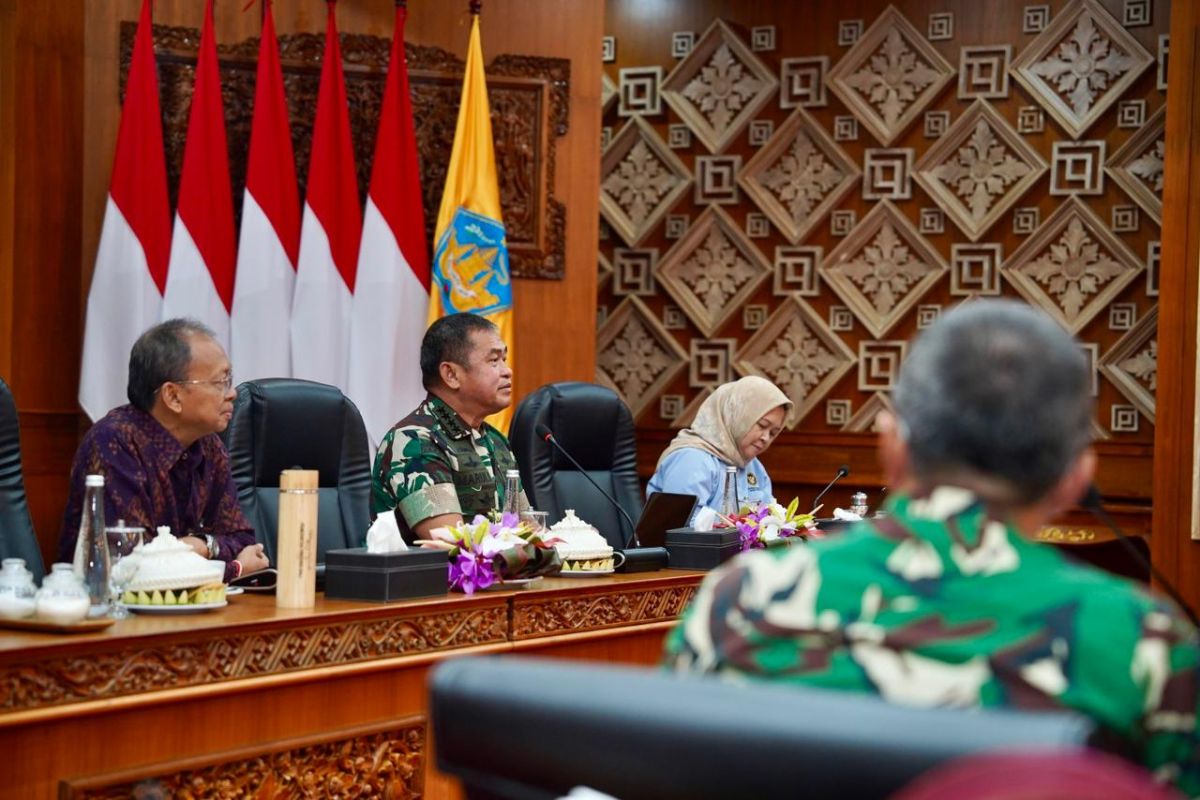
Denpasar, Indonesia — The Army Chief of Staff (Kasad) General TNI Maruli Simanjuntak said the Indonesian Army (TNI AD) stands ready to support renewable-energy-based waste management in Bali through the deployment of pyrolysis technology, which he described as effective and environmentally friendly. He spoke during a working visit of Kasad to the Governor of Bali’s Official Residence, Jaya Sabha, in Denpasar, on Friday, accompanied by IX/Udayana Military Regional Command Commander Major General TNI Piek Budyakto.
The visit was part of a coordination meeting and review of the location of Waste-to-Electricity Plants (PSEL) and proposed new PSEL sites in Bali Province together with the Bali Provincial Government.
Kasad General TNI Maruli Simanjuntak explained that pyrolysis has several advantages, including that it does not require government investment, the waste processing is relatively fast, targeted to commence operation in April 2027, does not require government subsidies, and uses environmentally friendly technology without open emissions.
‘The Indonesian Army is also ready to assist in supporting the waste collection and management system in Bali to accelerate integrated handling of waste issues,’ said the Kasad.
In his briefing, Kasad noted that some of the supports needed for programme implementation include administrative support, provision of land of about five hectares for a processing capacity of 100 tonnes of waste per day, guarantees for the sale of processed diesel as a renewable energy source, and sustained cooperation for 30 years.
According to him, Bali must be able to maintain cleanliness, environmental preservation, and ecosystem sustainability amid increasing waste volumes from the public and the tourism sector.
‘The construction of PSEL must be carried out transparently, accountably, and involve community participation. The aspirations of the surrounding community must be heard and become an important part of the planning and implementation process for this project,’ said Koster.
He explained that the waste-to-electricity project is still in the development stage and targeted to start operating in December 2027 as a long-term solution to waste management while also supporting Bali’s energy resilience.
On the same occasion, Neni, a staff at the Coordinating Ministry for Food Affairs of the Republic of Indonesia (Kemenko Bidang Pangan RI), explained the importance of source-based waste management in accordance with Bali Governor Regulation No. 47 of 2019 on Source-Based Waste Management. She explained that segregation of organic waste, economically valuable plastics, and household waste must be done from the source.
Organic waste such as food scraps, leaves, fruit, and vegetables can be processed into compost, liquid fertilizer, or maggot cultivation or Black Soldier Fly (BSF).
The use of PSEL technology and processing waste into renewable diesel is considered capable of helping curb the waste emergency in the Denpasar Raya area, including reducing the burden on the Suwung Final Disposal Site (TPA).
Bali has also been designated as one of the pilot locations for pyrolysis technology alongside several other major cities such as Jakarta, Surabaya, Bekasi, Bandung, Bogor, and Semarang, with implementation to be supported by the Indonesian Army and a cross-ministerial and agency integrated team.