
Army Chief of Staff Claims Local Government Directed Ban on 'Pesta Babi' Screening
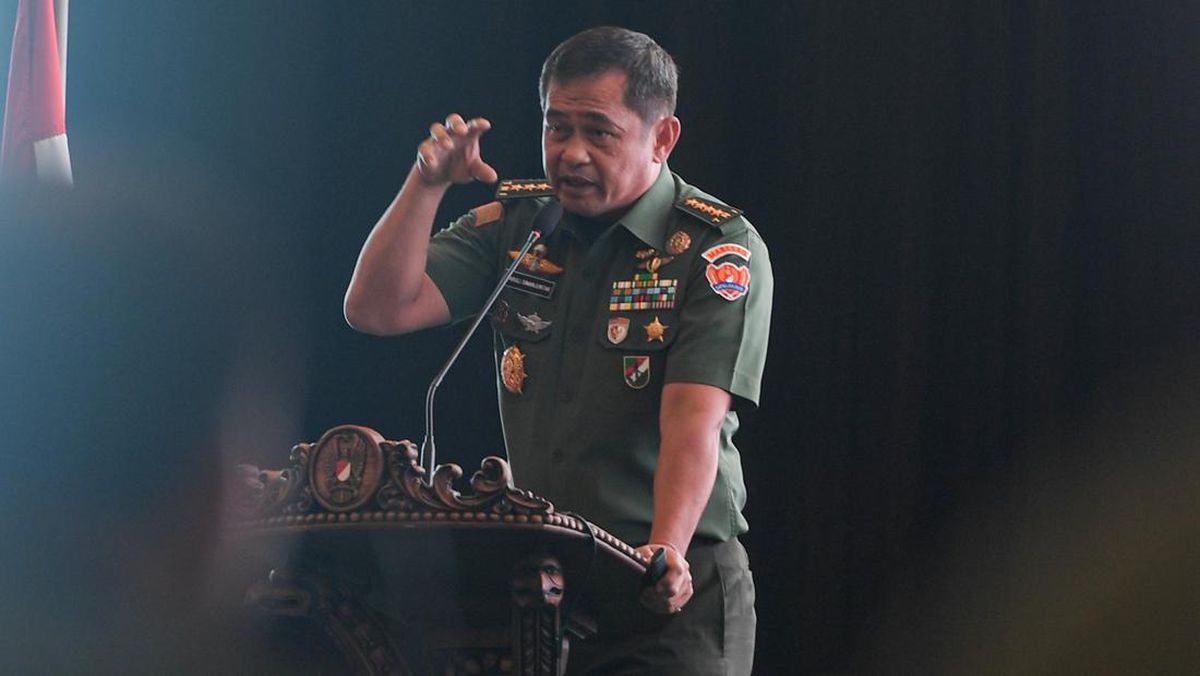
The Army Chief of Staff (KSAD) General Maruli Simanjuntak claims that the dispersal and even the prohibition of a group screening (nobar) and discussion of the documentary Pesta Babi: Colonialism in Our Times, which occurred in several regions in recent days, were not based on a direct instruction from the Indonesian Armed Forces (TNI). The four-star general said the action to disperse was a decision by local governments regarding security considerations in the area.
‘That is something you should really ask them about, because the dispersal came from the local government for the security of the region. That is their responsibility, the regional coordinator, between government officials there who deemed there was a risk of disturbance. Yes, it was them; there were no direct instructions,’ Maruli told reporters at the Parliament Complex, Senayan, Jakarta, on Tuesday (19/5).
Maruli said local governments are authorised to secure their territories.
In addition, he asserted that the content of the documentary might not be accurate, even questioning the funding sources of the work by the duo directors Dandhy Laksono and Cypri Paju Dale.
‘So now the problem is that people make videos, and how the story goes, where the money comes from? Come on, you know? People come there, make a video, fly here and there, affluent people,’ he said.
During that occasion, Maruli also stated that the presence of the TNI in Papua is to assist the people there.
‘There are people there who do not have clean water and there are schools that are not functioning. We are actually present there a lot, helping them. Try to speak directly with the people there,’ he added.
The documentary Pesta Babi focuses on indigenous communities—especially in Papua—fighting for their customary land rights.
Meanwhile, at least four locations dispersals of the nobar were reported, such as at Mataram University (Unram), Mandalika Educational University (Undikma) in Mataram, and State Islamic University (UIN) Mataram, NTB, as well as in Ternate Tengah, North Maluku.
The documentary Pesta Babi, by Dandhy Laksono and Cypri Paju Dale, highlights the loss of forests in Papua after conversion into industrial plantations under the banner of food security and energy transition. The film also records the struggle of Papuan communities to defend their ancestral lands.
For the dispersal in Ternate carried out by the TNI, Dandim 1501/Ternate Colonel Inf Jani Setiadi touched on licensing issues and SARA (ethnicity, religion, race) concerns behind the dispersal. Jani also claimed to have checked activities involving the Alliance of Independent Journalists (AJI) Ternate along with a number of student organisations, and said there was no permit.
The nobar event was organised by the Society of Indonesian Environmental Journalists (SIEJ) Maluku Utara together with the Alliance of Independent Journalists (AJI) Kota Ternate at Pendopo Benteng Oranje, Gamalama Village, Ternate Tengah, on Friday (8/5).
‘Aside from licensing aspects, authorities are also scrutinising the content and themes of the event, which are considered sensitive for society. The use of the film title and banners bearing ’Pesta Babi’ could lead to misunderstandings and provoke negative reactions in a plural society, particularly if linked to SARA issues or past social conflicts,’ he told Detikcom on Tuesday (12/5).
He claimed the TNI did not ban the event’s discussion as long as it was conducted in accordance with procedures and with permits. He also noted that the content presented should not incite conflict within the community.
‘So far, security authorities, along with related elements, are still engaging in dialogue and coordination with the organisers to ensure the situation remains safe and under control,’ a statement read.
Meanwhile, Coordinating Minister for Law, Human Rights, Immigration and Corrections Yusril Ihza Mahendra emphasised that the government does not ban group screenings (nobar) or discussions of the documentary Pesta Babi: Colonialism in Our Time.
According to him, the film remains acceptable content, and he urged the public not to be provoked simply by the title; people are invited to watch it.
Yusril said to stakeholders—especially the public—not to be provoked into unethical acts, because the film’s title was likely designed to attract public attention.
‘Let the public watch it, and afterwards hold discussions and debates. This way the public becomes critical; pro and con can occur,’ said the former constitutional law expert in a written statement on Thursday (14/5).
Source: jawawa.id (https://jawawa.id/newsitem/army-chief-of-staff-claims-local-government-directed-ban-on-pesta-babi-screening-1779545985)
Originally published by CNN Indonesia (https://www.cnnindonesia.com/nasional/20260519160545-20-1360057/ksad-klaim-pembubaran-nobar-pesta-babi-arahan-pemda), translated from Indonesian