
Army Chief of Staff and Bali Governor Coordinate PSEL Waste-to-Energy Plant at Suwung Landfill
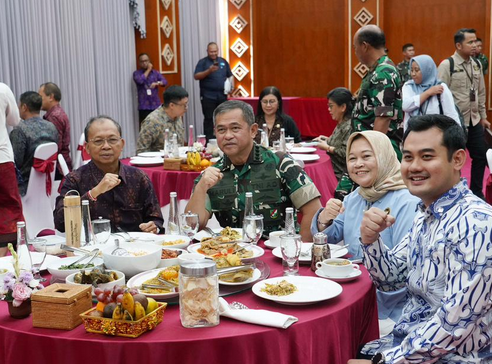
Kepala Staf Angkatan Darat (KSAD) Jenderal TNI Maruli Simanjuntak held a strategic meeting with Bali Governor Wayan Koster at the Governor’s Office, Jayasabha, Denpasar, on Friday (22 May 2026). The meeting aimed to strengthen coordination for accelerating the development of a PSEL (Waste-to-Energy) facility at Suwung landfill in Bali. Maruli was accompanied by IX/Udayana Army Commander Major General TNI Piek Budyakto and senior TNI AD officials, as well as a representative from the Coordinating Ministry for Food Affairs of the Republic of Indonesia. The main focus was to seek concrete solutions to Bali’s waste management challenges, a major concern for this world-renowned tourism destination. Governor Koster outlined that the PSEL project is currently in the construction phase, with an estimated duration of 18 months and a target to operate fully in December 2027. He stressed the importance of transparency and public participation in the project. In response to the challenge, General Maruli offered the use of pyrolysis technology, which is claimed to be more effective and efficient than conventional methods. The technology is said to have several competitive advantages, including being environmentally friendly with no open emissions, not requiring government investment or subsidies, and a faster process that could begin earlier in April 2027. To implement the program, the Army Chief detailed technical needs, including the involvement of staff from the Coordinating Ministry for Food Affairs (Ibu Neni) who noted that Bali has been designated as one of the pilot sites for national pyrolysis technology alongside major cities such as Jakarta, Surabaya, and Bandung. This cross-agency collaboration is expected to significantly alleviate the burden at Suwung. Besides the PSEL technology, the government continued to promote source-separated waste management. Organic waste would be directed toward composting, liquid fertiliser production, and maggot farming (BSF), while high-value plastics would feed into the recycling chain. The strategic step by the Indonesian Army (TNI AD) and the Bali Provincial Government is hoped to mark a transformative, sustainable shift in modern waste management while maintaining Bali’s reputation as a clean cultural and tourism hub on the world stage. In contrast, the closure of the Suwung organic waste section since 1 April 2026 has caused field-level disorder. The Environment Ministry and the Environmental Control Agency (KLH/BPLH) are conducting on-site monitoring and inspections at Suwung. Trucks that do not yet meet the regulations must return to their source for re-sorting. In addition to DLHK (the regional environmental agency), waste-haulage services such as BUMDes Dalung have also been disseminating guidance on waste sorting. There are hundreds of trucks lined up at the Suwung entry gate, with queues stretching nearly two kilometres. Governor Koster asserted that all activities within the sacred area around temples must be free of plastic waste. Reports indicate a rise in international criminal cases involving foreigners in Bali in 2026, although Koster stressed that Bali remains safe. The event, which involved thousands of Pecalang (traditional Balinese police) across Bali, aimed to bolster readiness for Nyepi Year Saka 1948 and Idul Fitri 1447 H. Koster also expressed hope that improved relations between the Indonesian and Chinese governments could enhance Bali’s cooperation with China. He plans to allocate funds for Pecalang across adat villages in Bali, with a grant of Rp 50 million per village.