
Argo Bromo Train Collides with KRL: KNKT Focuses on Locomotive Windshield Condition
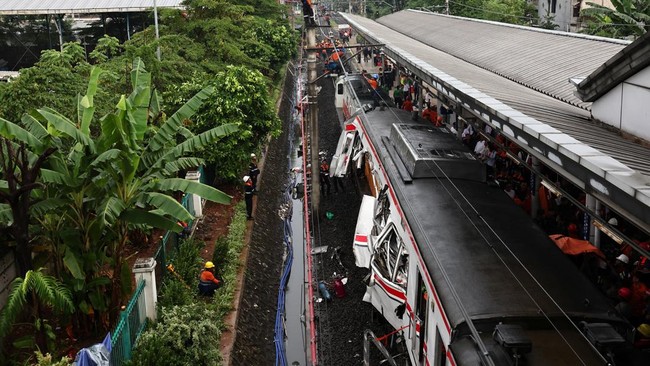
The National Transportation Safety Committee (KNKT) has highlighted the condition of the CC 206 locomotive windshield of the Argo Bromo Anggrek train (KA 4B) during its collision with the KRL TM6000 (KA 5568A) at Bekasi Timur Station on 27 April 202 مب 2026. The condition of this windshield has become a key point in identifying potential hazards.
According to KNKT documents released on Monday (5/10/2026), the locomotive windshield, which suffers from scratches and swirl marks, causes light scattering when exposed to light from signals and the surrounding environment at night, thereby obstructing the Driver’s visibility. “Such visibility disturbances increase the risk of failure to identify signal aspects because light sources appear more blurred with significant light scattering,” stated the KNKT.
Interviews revealed that this condition disturbed the vision of both the Driver and the Assistant Driver and had the potential to increase eye fatigue, yet this was not recorded as a potential hazard. The KNKT noted that all locomotives within the PT KAI (Persero) network use windshields made of polycarbonate material, in accordance with the Official Memo from the Director of Rolling Stock Management, PT KAI (Persero) No. 001/KR.203/R/XII/2015 regarding the replacement of locomotive cabin glass with polycarbonate.
“The KA 4B locomotive uses a polycarbonate windshield, and in its current state, many wiper scratches and swirl marks were found on the surface. At night, light sources appear more blurred with significant light scattering from the locomotive cabin using polycarbonate windshields with numerous wiper scratches and swirl marks,” the KNKT wrote.
Consequently, the KNKT has requested KAI to ensure that the condition of locomotive windshields always meets ergonomic and operational safety aspects through regular inspection, maintenance, and periodic replacement.
Furthermore, there was a discrepancy in the response between the occupancy status of tracks 104AT and 104BT regarding the behaviour of the J12 Exit Signal at Bekasi Station during route formation. The J12 exit signal can function as a ‘proceed with caution’ indication for Block Signal B104 when the occupancy status of track 104AT is ‘occupied’. However, when 104AT is ‘clear’, there is no information providing a caution indication for Block Signal B104. In this condition, the Driver faced a red aspect at Block Signal B104 without the preceding J12 Exit Signal providing a yellow warning as expected in normal operations (Green - Yellow - Red).
This can prevent the Driver from anticipating the signal and adjusting speed appropriately to stop before Block Signal B104. In a 2022 design review document, the signalling aspects were depicted in a signal-to-signal relationship without track occupancy status; therefore, the differing behaviour of the J12 Exit Signal relative to the occupancy status of tracks 104AT and/or 104BT was not illustrated. Because this was not depicted, the condition remained unidentified from the design review and testing stages through to the operation period leading up to this accident.
Source: jawawa.id (https://jawawa.id/newsitem/argo-bromo-train-collides-with-krl-knkt-focuses-on-locomotive-windshield-condition-1791194060)
Originally published by CNBC Indonesia (https://www.cnbcindonesia.com/news/20261005141707-4-773395/ka-argo-bromo-tabrak-krl-kondisi-windshield-lokomotif-disorot-knkt), translated from Indonesian