
Archipelagic Region Bill Must Provide Fiscal Certainty and Realistic Connectivity
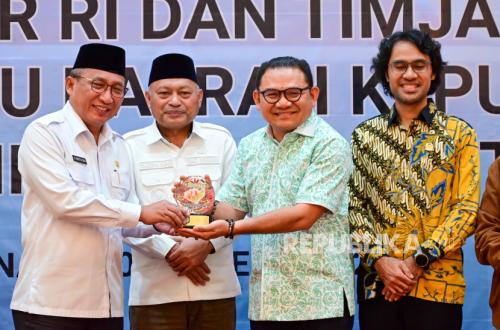
The Deputy Chairman of the Special Committee (Pansus) for the Archilimago Bill of the Indonesian House of Representatives (DPR RI), Jaelani, has asserted that the formation of the Archipelagic Region Bill must not merely stop at the recognition of geographical status. According to him, this legislation must provide operational legal certainty that directly impacts affirmative financing, inter-island connectivity, and the improvement of public service standards in maritime-based regions.
Jaelani made these remarks while leading a Specific Working Visit (Kunspek) of the Archipelagic Region Bill Special Committee to Ternate, North Maluku Province, on Wednesday (30/09/2026). The purpose of this visit to Ternate was to gather comprehensive input from the North Maluku Provincial Government, the Ternate City Government, the Regional House of Representatives (DPRD), and academics to refine the draft bill included in the 2025–2029 National Legislation Programme (Prolegnas).
“Our national maritime potential is vast, yet the contribution of the coastal and marine sectors to the GDP remains sub-optimal. On the other hand, hundreds of inhabited islands in provinces with archipelagic characteristics, such as North Maluku, still face high costs of distance and limited access to basic services. Therefore, archipelagic characteristics are a constitutional identity according to Article 25A of the 1945 Constitution, which must be translated into affirmative state policies,” said Jaelani.
Jaelani added that special treatment for archipelagic regions is not merely a form of privilege, but a constitutional mandate to achieve social justice and equitable development. Furthermore, the push to finalise this bill aligns with the mandate of the President’s State Address.
“The state must intervene in this inequality through a prosperity and security approach. The specific regulations in this Bill are urgent so that the high costs of logistics, energy, and even education and health facilities on isolated islands no longer burden the community or local governments,” he emphasised.
Furthermore, Jaellagni revealed that all eight factions in the DPR RI have now compiled their List of Identified Problems (DIM). The Special Committee is scheduled to hold a working meeting with the Ministry of Home Affairs on 6 October to receive the government’s version of the DIM to enter the harmonisation stage.
In alignment with the DPR RI Special Committee, the Ternate City Government welcomed the push for affirmative regulation. The Mayor of Ternate, Tauhid Soleman, expressed that the geographical condition of his region, which encompasses Ternate Island and outermost islands such as Batang Dua, Hiri, and Moti (BAHIM), demands significantly higher costs and longer times for service delivery compared to mainland areas.
“For Ternate City, the Archipelagic Region Bill is vital because archipelagic characteristics clearly affect the costs and patterns of governance. We believe that archipelagic regions require affirmative policies that do not only recognise their geographical characteristics but also provide real consequences in terms of financing, authority, connectivity, and public service standards,” explained Tauhid Soleman.
Tauhid Soleman also highlighted the need to reform the indicators for the Special Archipelagic Fund (DKK) to compensate for the objective service costs of the region, while also strengthening regional nomenclature and the status of governmental affairs.
“So far, metrics such as population size and land area do not fully reflect the cost of services in archipelagic regions. Moving forward, factors such as the number of inhabited islands, maritime area, inter-island distance, and transportation costs must be considered. Additionally, the use of governmental nomenclature needs to be clarified, such as ‘Ternate Archipelagic City Government,’ to ensure legal certainty in regional empowerment. The marine and fisheries sector, which previously held the status of an optional affair, also needs to be changed to a Mandatory Affair in this Bill to ensure stronger mandatory budgeting,” he continued.
Meanwhile, Siti Barora Sinay, an academic from the Faculty of Law at Khairun University Ternate, who attended as a resource person, emphasised the importance of designing asymmetric decentralisation and clear division of authority for marine space management between the central and regional governments.
“This Bill is not enough to just recognise status; it must provide operational legal consequences through clear asymmetric decentralisation. The division of marine management space, such as 0–4 miles for regencies/cities and 4–12 miles for provinces, must be interpreted as administrative competence for community service, not a division of sovereignty,” explained Siti Barora.
Furthermore, Siti Barora underscored the urgency of integrating the management of land, coastal, and marine spaces into a single bio-ecoregion unity. “The transfer of authority must be accompanied by an adequate funding scheme (money follows function and geographical burden) through the Special Archipelagic Fund (DKK). The DKK must be focused on productive spending and equalisation spending to reduce fiscal inequality and guarantee the right to basic services for communities on small islands,” she concluded.
Source: jawawa.id (https://jawawa.id/newsitem/archipelagic-region-bill-must-provide-fiscal-certainty-and-realistic-connectivity-1791190749)
Originally published by Republika (https://news.republika.co.id/berita/tmfcfx430/ruu-daerah-kepulauan-harus-beri-kepastian-fiskal-dan-konektivitas-yang-realistis), translated from Indonesian