
Archaeologists study 67,800-year-old figurative art in Sulawesi karst
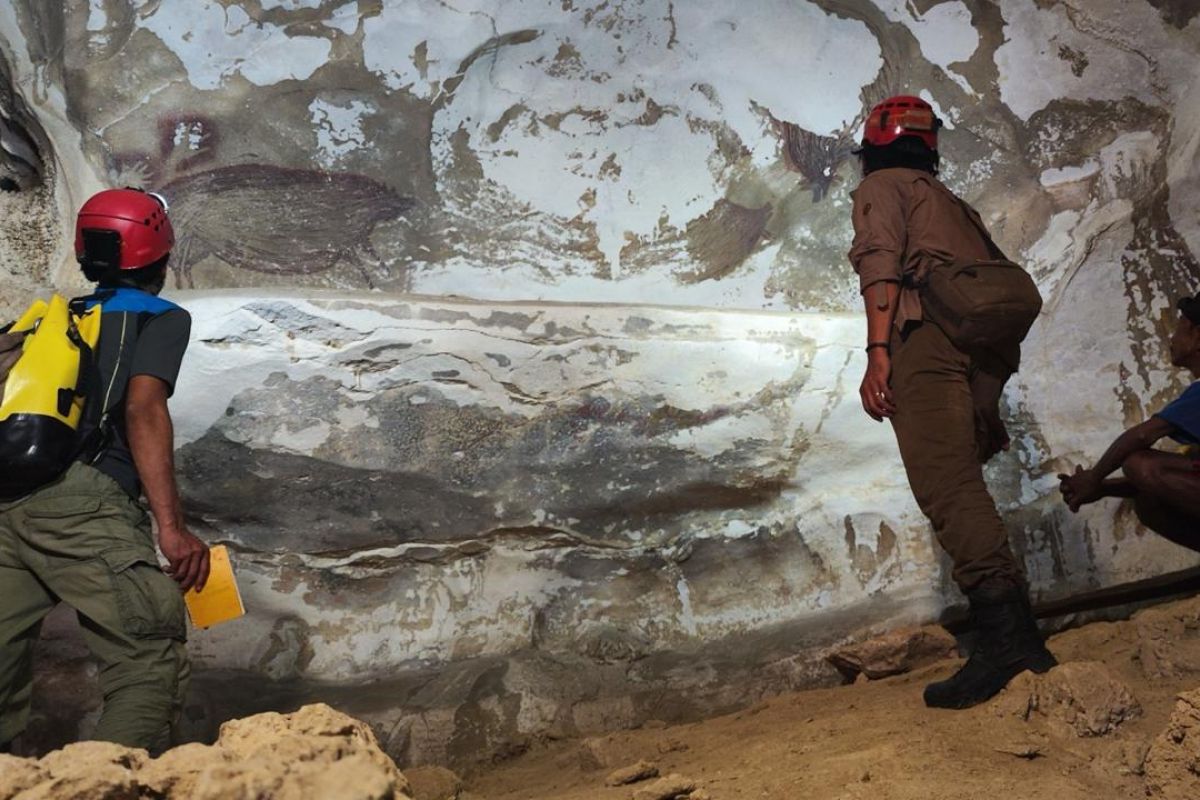
A team of archaeologists is studying a number of figurative paintings drawn by prehistoric humans, estimated to be 67,800 years old, on limestone cave walls scattered across the karst regions of Sulawesi, including Leang Maros and Leang Pangkep in South Sulawesi, and Liang Metanduno on Muna Island in Southeast Sulawesi.
“This research refutes the theory we have long learned from books that the oldest paintings originated in Europe. That has now been disproven,” said Professor Akin Duli, a researcher and archaeologist from Hasanuddin University, in Makassar, South Sulawesi, on Monday.
The rock art includes pointed fingertips, animal figures, and past hunting strategies depicted as maroon shadow-like images made from ochre. The drawings are quite detailed and remain clearly visible on the walls despite being thousands of years old.
Analysis shows these are human handprints, but with an anomaly: the fingers are not blunt like those of humans, but taper to points resembling animal claws.
This latest discovery overturns previous narratives. Uranium-series dating has produced a startling figure of around 67,800 years, indicating these paintings are not only the oldest art, but also a “manual” of technology and social organisation from the distant past.
“Sulawesi is part of the Wallacea region and plays an important role. This evidence forms the basis for us to refute the claim that cave painting culture originated in Europe,” he stressed.
The origins of beauty are not a European claim alone. The theory that beauty emerged from Europe is what is actually being challenged. Art is inherent in the human body. “The sense of beauty exists alongside anger or laughter. Humans anywhere have the potential to produce it,” said fellow researcher Muhamad Nur.
In the paintings, archaeologists have identified aesthetics. There are bold line patterns and human figures surrounding prey animals such as wild boar and anoa. Experts refer to this as the ‘pointed finger’ strategy, a collective encirclement technique.
“Findings at sites such as Bulu Sipong show highly organised social activity. The hunting scene is very clear. Herds of boar or anoa were driven by hunters. This is not merely a picture, but a social activity about hunting,” explained the protohistory expert from Hasanuddin University.
Archaeologists are viewing these paintings through a new lens, considering them not as meaningless aesthetic scribbles, but as technological archives. On the cave panels, human figures are depicted alongside prey animals, connected by precise line patterns.
“This depiction has a very intimate parallel relationship with how humans survived. The modification of fingers to resemble animal claws has been practised by early modern humans for quite a long time,” said Budianto Hakim, an archaeologist from the National Research and Innovation Agency (BRIN).
The paintings are evidence that since 67 millennia ago, humans in the Nusantara archipelago already had rules of conduct: what could be hunted, what was taboo, and how a group moved together. He sees a common thread between the cave paintings and the traditions of modern Bugis-Makassar society.
To this day, the ritual of making handprints on the pillars of new houses is still performed as a “penolak bala” (warding off misfortune) or magical barrier believed in by the people of Sulawesi.
This interpretation positions humans in Sulawesi 67,000 years ago as beings already capable of complex abstract thinking.