
Archaeologists Discover Pharaoh's Golden Sarcophagus Following a Boy's Clue
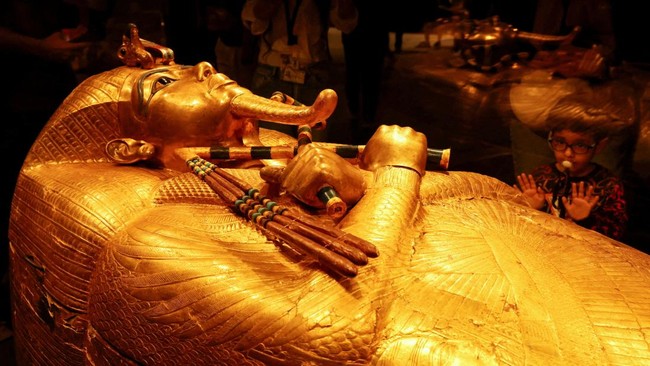
King Tutankhamun was an Ancient Egyptian pharaoh of the 18th Dynasty who ruled around 1332-1323 BC. He is one the most famous pharaohs in the modern world, not due to great military achievements, but because of the discovery of his intact tomb, which was filled with spectacular treasures.
Interestingly, archaeologists managed to find the Pharaoh’s tomb, along with the treasures within, by following a clue from a young boy.
Under the scorching sun of the Egyptian desert, archaeologist Howard Carter and his team spent years digging through sand grains. This was done in an attempt to find the tomb of Pharaoh Tutankhamun, which had reportedly been lost for 3,200 years.
This search for the tomb was not easy. From sunrise to sunset, excavations always ended in dead ends. The ancient archives he studied provided no answers, and every layer of sand brought only new disappointment. Finally, a clue arrived not from a scientist or a nobleman, but from a young water carrier named Hussein Abd el-Rassul.
On Saturday, 4 November 1922, while Hussein was delivering water to the treasure hunters, he noticed a strange mound of sand shaped like a staircase. Driven by curiosity, he reported this to the workers, and the news reached Carter.
Carter immediately arrived at the location. He inspected the mound and began digging slowly. It turned out that beneath the sand, there was indeed a staircase leading downwards. Alongside the labourers, Carter removed the layers of sand one by me until he found a small door on the 12th step. The door bore the seal of the Necropolis, depicting the god Anubis standing over nine defeated enemies.
“Before us, there is sufficient evidence that this is the entrance to an intact tomb,” Carter wrote in his diary, as quoted by Live Science.
Work eventually continued. After breaking through the debris blocking the path, Carter saw a door inscribed with the name of Tutankhamun. However, he did not dare to be certain until 26 November 1922, when he made a small hole in the second door and lit a candle. As the light began to spread, a golden shimmer appeared.
“It took a long time before the eyes could see clearly, but when the candlelight penetrated the room, all the ancient beauty suddenly came back to life,” he revealed.
What Carter discovered was not merely a tomb. He found the only intact pharaonic tomb discovered in the modern era. Inside, Tutankhamun’s golden death mask shone amongst statues, jewellery, and royal furniture. Hidden for over three thousand years, the tomb’s history was brought back to life thanks to the perseverance and luck of a young boy.
According to the Britannica website, the tomb of King Tutankhamun was the first pharaoh’s tomb found unlooted in the modern era. It was filled with extraordinary wealth. One of the most famous artefacts is the intricate death mask, made of 22 pounds (10 kilograms) of pure gold and adorned with gemstones.
Additionally, Tutankhamun was buried with various pieces of furniture and clothing believed to be used in the afterlife. This great discovery immediately shook the world. However, amidst the euphoria, other stories emerged regarding the truth of the ‘pharaoh’s curse’, which supposedly befell anyone who dared to open the tomb.
A month later, tragic news arrived. The financier of the archaeological excavation, Lord Carnarvon, passed away. Doctors revealed the cause was an infection following a mosquito bite and shaving over the same wound. Nevertheless, many believed the curse was real.
Regardless of belief, Carter’s discovery continues to enrich the heritage of world civilisation.
Who was Pharaoh Tutankhamun?
Tutankhamun was an Ancient Egyptian pharaoh who ruled during the New Kingdom period, ascending the throne at the age of 9 before dying suddenly at age 19. Genetic and radiological studies indicate that he died from malaria combined with a bone disorder.
Currently, the golden sarcophagus and thousands of other artefacts found in Tutankhamun’s tomb are exhibited at the Grand Egyptian Museum, which features a special gallery dedicated to the young king. However, the mummy of Tutankhamun remains in the Valley of the Kings in Luxor, Egypt.
Source: jawawa.id (https://jawawa.id/newsitem/archaeologists-discover-pharaohs-golden-sarcophagus-following-a-boys-clue-1790736738)
Originally published by CNBC Indonesia (https://www.cnbcindonesia.com/lifestyle/20260929144142-33-771831/berkat-ikuti-petunjuk-bocah-arkeolog-temukan-peti-emas-firaun), translated from Indonesian