
Archaeologists Discover 'Mystical Portal' to the Afterlife
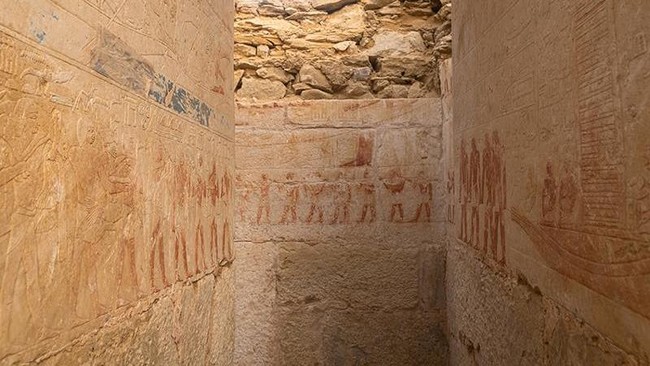
An international team of archaeologists has made a stunning discovery at a historic site in Egypt, uncovering a 4,000-year-old tomb belonging to one of the most influential high-ranking officials of the Ancient Egyptian era. The tomb contains a mysterious structure described as a ‘mystical door’ leading to the afterlife.
The ancient burial site was found in the Bubasteion Necropolis area in Saqquna, known as one of the most crucial archaeological centres in Egypt. Based on hieroglyphic carvings on the walls, the tomb has been confirmed to belong to a high official of the Old Kingdom named Sakhnetio-Btah (Sekhentyu-Ptah).
According to reports, the inscriptions on the tomb proclaim him as the ‘keeper of the king’s secrets’. While this may sound like a detective fiction plot, experts explain that the title does not relate to guarding hidden treasures, but rather refers to an elite position responsible for managing secret royal documents and decrees on behalf of the pharaoh.
Furthermore, Sakhnetio-Btah held several other strategic positions, including treasurer or royal chamberlain, priest of the Goddess Maat, and supervisor of the royal great library. “These hieroglyphic inscriptions help determine the owner’s name and his series of titles, including the keeper of the royal secrets, reflecting the high position he held within the ancient state administration system,” stated the Egyptian Ministry of Tourism and Antiquities.
Discovery of False Doors and Mummy Well Networks
The magnificent tomb complex includes the remains of a funerary chapel and a ‘false door’—a symbolic niche. Ancient Egyptians believed this false door served as a magical threshold or ‘portal’ balancing the worlds of the living and the dead.
Inside the complex, archaeologists also found various funerary ritual implements still arranged in their original positions, such as offering tables, cult stones, and purification vessels. This in situ discovery provides a rare and authentic glimpse into the funerary traditions of the nobility during the Old Kingdom era.
The excavation also revealed a network of interconnected burial shafts around the tomb area. These shafts contained numerous human remains and piles of decorated funerary cartonnage.
Cartonnage is a protective mummy layer similar to colourful papier-mâché, decorated with paintings of Egyptian gods, hieroglyphs, and symbols intended to protect the soul on its journey to the afterlife. The research team also found more than 100 ushabti figures—servant statues believed to serve the deceased master in the afterlife.
Intact Sarcophagi and the Mysteries of Saqqara
Another spectacular find includes three stone sarcophagi that remain tightly closed and perfectly sealed in their original locations. Supporting artefacts, such as a wooden eagle statue, various ancient pottery vessels, and other high-value historical relics, were also recovered from the site.
Although initial investigations indicate that some parts of the tomb were looted by thieves in ancient times, most of the treasures within remain intact and in extraordinary condition. Researchers hope this discovery will unveil new insights into the historical dynamics and the reuse of burial sites throughout the ages.
Saqqara itself is an ancient burial complex that never ceases to yield mysteries. The region is home to the oldest stone building in the world, the Step Pyramid of Djoser, built approximately 4,700 years ago. In recent years, Saqqara has continued to produce sensational finds—ranging from dozens of intact mummies and mummification workshops to underground chambers filled with ancient statues—radically enriching the world’s understanding of Ancient Egyptian civilisation.
Source: jawawa.id (https://jawawa.id/newsitem/archaeologists-discover-mystical-portal-to-the-afterlife-1790499166)
Originally published by CNBC Indonesia (https://www.cnbcindonesia.com/tech/20260927113451-37-771208/arkeolog-temukan-portal-gaib-ke-alam-baka-ini-lokasinya), translated from Indonesian