
Aramco Headquarters in Saudi Arabia Attacked: Could Indonesia Feel the Fallout?
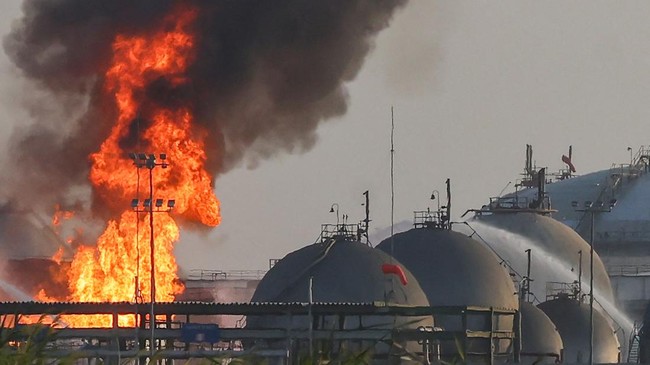
Jakarta, CNBC Indonesia — Saudi Aramco’s headquarters in Dhahran has again drawn attention amid escalating conflict between Saudi Arabia and Yemen’s Houthi group. After the complex was attacked on 13 October 2026, the company reportedly instructed employees to leave its headquarters and work remotely on Thursday, 22 October 2026.
Six people familiar with the matter told Reuters that staff had been ordered to evacuate. The specific reason for the move was not known, and Aramco had not responded by the time the report was published.
The previous attack, on Tuesday evening, 13 October, caused a fire that spread across several floors of Aramco’s headquarters. A Reuters source said the building had suffered extensive damage, while Saudi Arabia’s Energy Ministry said the incident had caused a limited fire.
The Dhahran complex is more than an office building. It houses a control centre that helps Aramco monitor onshore and offshore drilling facilities, refineries, export terminals and thousands of kilometres of pipelines.
The sequence of events has once again highlighted the scale of Aramco’s business and its strategic position in the energy industry. How extensive are its operations, and how much revenue does the company—one of Saudi Arabia’s major sources of income—generate?
Aramco operates in more than 50 countries
Saudi Aramco’s business is not confined to Saudi Arabia. The company also operates in a number of countries, with activities ranging from oil and gas production, refining and energy trading to distribution and technology development.
According to its 2025 annual report, Aramco has an operational network in more than 50 countries through subsidiaries, affiliates and joint ventures.
A list compiled from its global operating locations includes 56 countries and territories across Asia, Europe, the Americas, Africa and Oceania. Indonesia is among them.
Aramco had previously planned to work with state-owned PT Pertamina (Persero) to develop the Cilacap Refinery in Central Java through the Refinery Development Master Plan (RDMP) project.
The partnership, initiated in 2016, aimed to increase the refinery’s processing capacity from around 348,000 barrels per day to 400,000 barrels per day.
After several years of negotiations, however, Aramco and Pertamina ended their cooperation on the project in 2020. Pertamina then continued with its refinery development plans without Aramco.
Aramco’s refining capacity reaches 7.8 million barrels per day
In addition to producing crude oil, Aramco has a refining network spanning several countries.
Aramco’s global gross refining capacity reached 7.8 million barrels per day in 2025, up from 7.7 million barrels per day the previous year.
Net refining capacity, which accounts for Aramco’s ownership share, rose from 4.1 million to 4.2 million barrels per day.
In its 2025 Global Refining Footprint, Aramco lists 17 refining facilities and company entries in seven countries: Saudi Arabia, the United States, China, Japan, South Korea, Malaysia and Poland.
Saudi Arabia has the largest number of refineries listed in Aramco’s report.
The company has nine refineries in the country, with total crude processing capacity of 3.35 million barrels per day. Aramco wholly owns five, while the other four are jointly owned with business partners.
Ras Tanura is the largest, with capacity of 550,000 barrels per day, followed by SATORP at 465,000 barrels per day and YASREF at 450,000 barrels per day.
Together, the nine refineries accounted for about 43% of Aramco’s total global gross refining capacity in 2025.
Aramco’s hydrocarbon production
Alongside its extensive refining network, Aramco recorded an increase in hydrocarbon production throughout 2025.
The company’s average production of liquid hydrocarbons, or total liquids, reached 10.68 million barrels per day, up about 3.8% from 10.29 million barrels per day in 2024.
This production includes crude oil and other liquid hydrocarbons, including natural gas liquids (NGLs) and condensate.
Total hydrocarbon production, including natural gas, reached 12.89 million barrels of oil equivalent per day in 2025, an increase of about 3.9% from 12.40 million barrels of oil equivalent per day in 2024.
In the first half of 2026, Aramco’s average liquid hydrocarbon production was 9.06 million barrels per day. Total hydrocarbon production stood at 11.03 million barrels of oil equivalent per day.
These figures are daily production averages for the first six months of 2026, whereas the 2024 and 2025 figures cover full years.
Aramco produces several grades of crude oil, from Arabian Super Light and Arabian Extra Light to Arabian Light, Arabian Medium and Arabian Heavy.
Of these five grades, Arabian Super Light, Arabian Extra Light and Arabian Light accounted for about 70% of Aramco’s total crude oil production in 2025, up from 68% the previous year.
Aramco revenue once reached US$535 billion
The scale of Aramco’s business is also reflected in its annual revenue, which runs into hundreds of billions of US dollars.
Company financial statements show that Aramco’s revenue was US$204.83 billion in 2020. It surged to US$359.18 billion in 2021 and rose further to US$535.19 billion in 2022.
The 2022 figure was the highest annual revenue recorded from 2020 to 2025. Aramco’s net profit also peaked that year, at US$161.07 billion.
After reaching that high, both revenue and net profit fell over the following three years.
In 2025, Aramco reported revenue of US$415.82 billion, down about 4.8% from 2024.
Net profit also declined, falling from US$106.25 billion in 2024 to US$93.39 billion in 2025, a year-on-year decrease of about 12.1%.
Aramco’s weaker performance was mainly driven by lower prices for crude oil, refined products and chemicals. The impact was partly offset by higher sales volumes.
Given the scale of Aramco’s business and Saudi Arabia’s importance to global oil supplies, the latest attack on the company’s facilities has renewed concerns about the security of energy infrastructure in the region.
There has been no confirmation of any production disruption following the attack in Dhahran. However, developments in the conflict warrant close attention, particularly if attacks spread and disrupt oil production, refining or distribution facilities.
Source: jawawa.id (https://jawawa.id/newsitem/aramco-headquarters-in-saudi-arabia-attacked-could-indonesia-feel-the-fallout-1792925442)
Originally published by CNBC Indonesia (https://www.cnbcindonesia.com/research/20261025121142-128-779212/kantor-pusat-aramco-di-arab-saudi-diserang-awas-indonesia-kena-imbas), translated from Indonesian