
Arabia in the Year of the Elephant: The Economy of Mecca at the Time of Prophet Muhammad's Birth
When Prophet Muhammad was born in Mecca, the city’s economy had already developed despite being situated in a desert region with minimal natural resources. Unlike Yathrib, which relied on agriculture, Mecca depended on trade, caravan journeys, seasonal markets, and the flow of people coming to the Kaaba. This position made Mecca one of the key points in the Arabian Peninsula’s trade network, with goods and merchants moving from southern regions such as Yemen northwards towards Syria.
Prophet Muhammad is estimated to have been born on 12 Rabiul Awal, around April 571 CE. His birth is commemorated with the Maulid Nabi celebration, which falls today, Tuesday (25/8/2026). In Islamic tradition, the year of Muhammad’s birth is known as ’Am al-Fil or the Year of the Elephant. This name refers to the story of Abraha, the ruler of Yemen, who came with his army to attack the Kaaba.
But before Mecca became known as the centre of the Islamic world, the city already had its own economic life.
Unlike Yathrib, which was known for its fertile soil and agricultural activities, Mecca’s conditions meant that farming was not the main pillar of its economy. Arab society at that time had diverse livelihoods. Animal husbandry, agriculture in areas with water sources, trade, and market activities developed according to the geographical conditions of each region. In Mecca, natural limitations made trade more important. The city grew through the mobility of people and goods, not from large-scale agricultural production.
This is where the role of the Quraysh began to stand out.
The Quraysh were a tribe that held an important position in Mecca and were known for their trading activities. Quraysh trade was associated with winter and summer journeys, or rihlat al-shita’ wa al-sayf. These journeys connected Quraysh trading activities with southern regions such as Yemen and northern regions towards Syria. This network meant that Mecca’s economy did not stop at transactions within the city. Goods moved with merchant caravans, while profits from trade flowed back to the people involved.
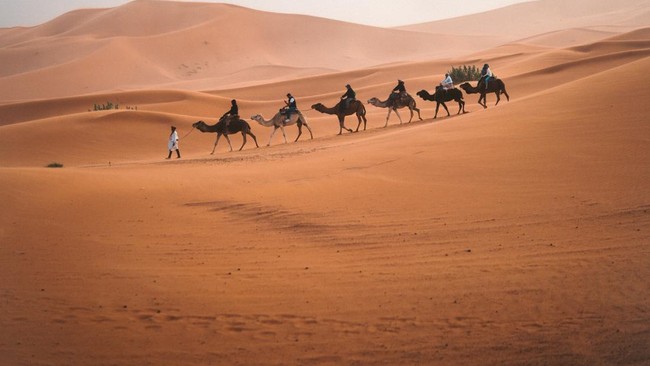
Caravans were an important means of moving goods in the desert environment. Camels were the primary animals because they could survive in semi-desert conditions while carrying goods over long distances. The goods traded were also diverse. Literature on pre-Islamic Arabian economics mentions aromatics, leather, dates, oil, perfumes, precious metals and various goods from regions such as Syria, Egypt and Persia. This means that Meccan trade was not only about selling its own produce. The city was also part of an inter-regional goods exchange network.
Seasonal markets were also an important part of economic life. One of the most famous was ’Ukaz, which was not only a place for trading goods but also a meeting space between tribes. Markets like this brought together merchants and people from various regions. Economic activity ran alongside the exchange of information, social gatherings and inter-tribal negotiations. Besides ’Ukaz, several other markets are known in Arab historical tradition, such as Dumat al-Jandal, Dhul Majaz and the Oman market. Thus, markets at that time were not merely places where people came to buy and sell goods. They became meeting points that kept the flow of people and goods moving.
Before Islam, the Kaaba had already been a place revered by various Arab tribes. Its status as a holy site gave Mecca a different function compared to ordinary cities. The movement of people then created economic activity around it. People who came needed food, goods, shelter, transport and various other necessities during their stay in Mecca. During the pilgrimage season, trading and community gatherings became even busier. A number of markets even took place close to periods of worship and became part of the mobility of Arab society. At this point, religious activity and trade met.
In the geographical conditions of Arabia, camels had far greater economic value than merely as a means of transport. Camels were the main means of caravan travel as well as part of society’s wealth. In Arab social life, these animals were even used in certain transactions, including the payment of dowries and blood money or diyat. There was a network of caravans, transport animals, inter-tribal relations and travel security that allowed these activities to take place.
Mecca’s economy ultimately did not stand alone. It became part of the Arabian economic network that moved along trade routes and seasons.
When Muhammad was born around 571 CE, Islam had not yet become the religious or political force it would later become. Mecca was also not yet the centre of the Islamic world. However, the city already had an economic ecosystem formed by natural conditions, Quraysh trade, caravan journeys, seasonal markets and the flow of people coming to the Kaaba. A few decades later, the same city would undergo far greater changes. But at the time of Muhammad’s birth, Mecca was first and foremost a city that lived from trade networks and human gatherings in the middle of the Arabian Peninsula.
Source: jawawa.id (https://jawawa.id/newsitem/arabia-in-the-year-of-the-elephant-the-economy-of-mecca-at-the-time-of-prophet-muhammads-birth-1787629865)
Originally published by CNBC Indonesia (https://www.cnbcindonesia.com/research/20260825080627-128-762091/arab-di-tahun-gajah-begini-ekonomi-mekkah-saat-nabi-muhammad-lahir), translated from Indonesian