
APTRI supports requirement for refineries to develop their own sugarcane plantations
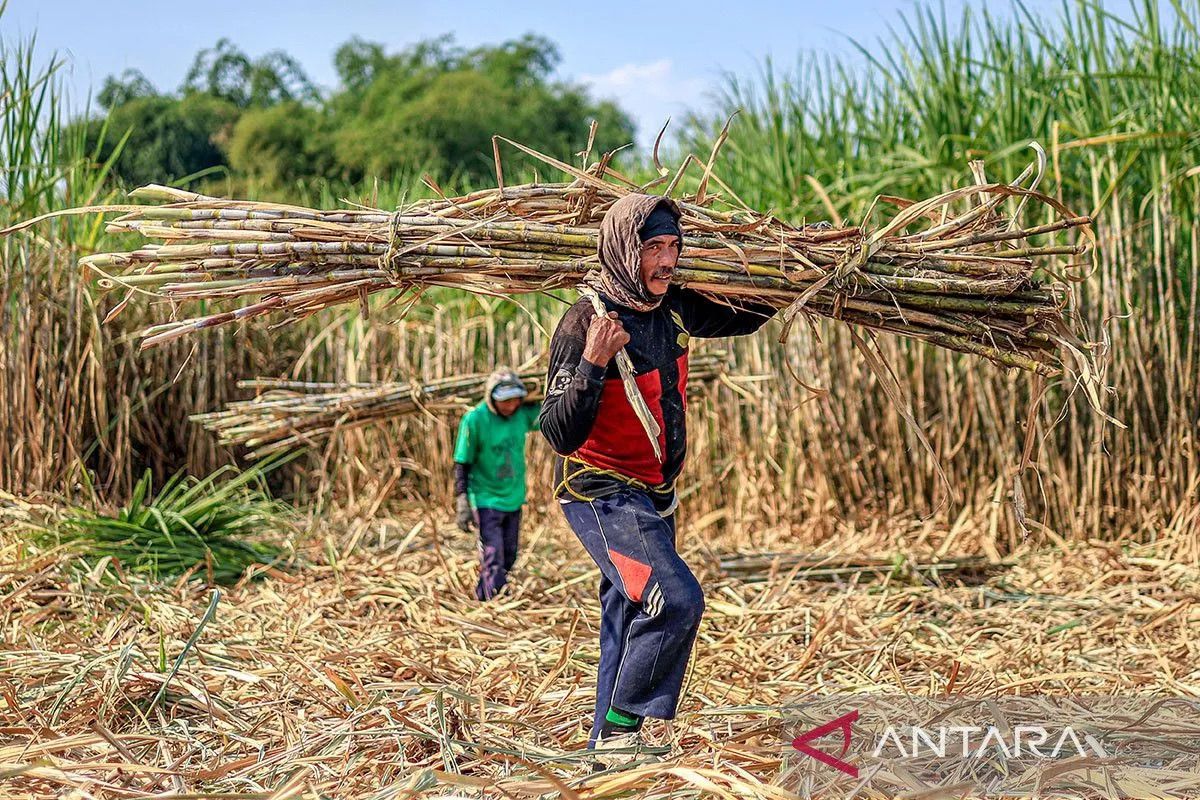
Jakarta (ANTARA) - The Chairman of the Advisory Board of the Central Executive Board of the Indonesian Sugarcane Farmers Association (APTRI), HM Arum Sabil, supports the government’s policy requiring all refined sugar refineries to build their own sugarcane plantations to strengthen raw material supplies and accelerate national sugar self-sufficiency.
“Refined sugar factories must become an integral part of the national sugar supply chain by participating in the development of sugarcane plantations, expanding partnerships with farmers, increasing productivity, and simultaneously strengthening the foundation of Indonesia’s sugar self-sufficiency,” Arum stated in Jakarta on Thursday.
He emphasised that the strengthening of the sugar sector must be carried out comprehensively by involving all industry players, including mandating all refined sugar refineries to develop their own sugarcane plantations to bolster domestic raw material supplies.
According to him, White Crystal Sugar (GKP) factories and Refined Sugar (GKR) factories are two important pillars that must mutually reinforce each other in building the national sugar industry.
“The performance of the national sugar sector is showing an increasingly positive trend. By 2026, the national sugarcane area is projected to increase from 563,000 hectares to 576,537.70 hectares,” he said.
Furthermore, productivity is expected to rise from 69.35 tonnes per hectare to 70.87 tonnes per hectare, while the sugar content (rendemen) is set to increase from 6.83 per cent to 7.45 per cent.
This increase drives the projection for national White Crystal Sugar (GKP) production to reach approximately 3.044 million tonnes in 2026, up from the previous year’s production of 2.67 million tonnes. This figure is estimated to have exceeded the national household sugar consumption requirement, which stands at around 2.9 million tonnes.
Nevertheless, the sugar requirement for the food and beverage industry still ranges between 3.8–3.9 million tonnes per year. Therefore, the government continues to encourage the strengthening of sugar industry downstreaming to reduce dependence on imported raw materials while simultaneously increasing the competitiveness of the national industry.
Arum believes that strengthening the sugar sector must involve all industry players. Consequently, he proposed that refined sugar factories should not only play a role in processing imported raw sugar for industrial needs but also invest in the upstream sector through the development of sugarcane plantations and partnerships with farmers.
In line with the strengthening of the national sugar industry, the Ministry of Agriculture continues to accelerate various strategic programmes, including sugarcane plantation rejuvenation, productivity enhancement through the use of superior seeds, cultivation mechanisation, fertilizer provision, supporting infrastructure development, and sugar factory revitalisation.
Minister of Agriculture Andi Amran Sulaiman stated that his office continues to strengthen the national sugar industry by increasing sugarcane production and reinforcing the integration of the upstream and downstream sectors as a strategic step towards achieving sugar self-sufficiency.
“We must increase sugarcane production, strengthen productivity, and ensure downstreaming proceeds so that added value is enjoyed by both farmers and the national industry. Sugar self-sufficiency can only be achieved if the upstream and downstream sectors move together,” Amran said in Jakarta on Wednesday (29/7).
The Minister of Agriculture emphasised that strengthening the upstream sector is key to the sustainability of the national sugar industry. According to him, every sugar factory needs to be supported by adequate raw material availability to be able to increase production capacity while providing market certainty for sugarcane farmers.
“If the upstream is strong, the downstream will be strong, and thus the national sugar industry will be strong. The ultimate goal is not only sugar self-sufficiency but also increasing the welfare of sugarcane farmers and strengthening the national economy through downstreaming,” said Amran.
He added that through the synergy of the government, farmers, State-Owned Enterprises (SOEs), and industry players, the Ministry of Agriculture is optimistic that sugar self-sufficiency can be realised while creating a resilient, efficient, and competitive national sugar industry.