
Appropriate Technology Drives Gedog Subdistrict to Become a Circular Economy and Innovative Product Hub
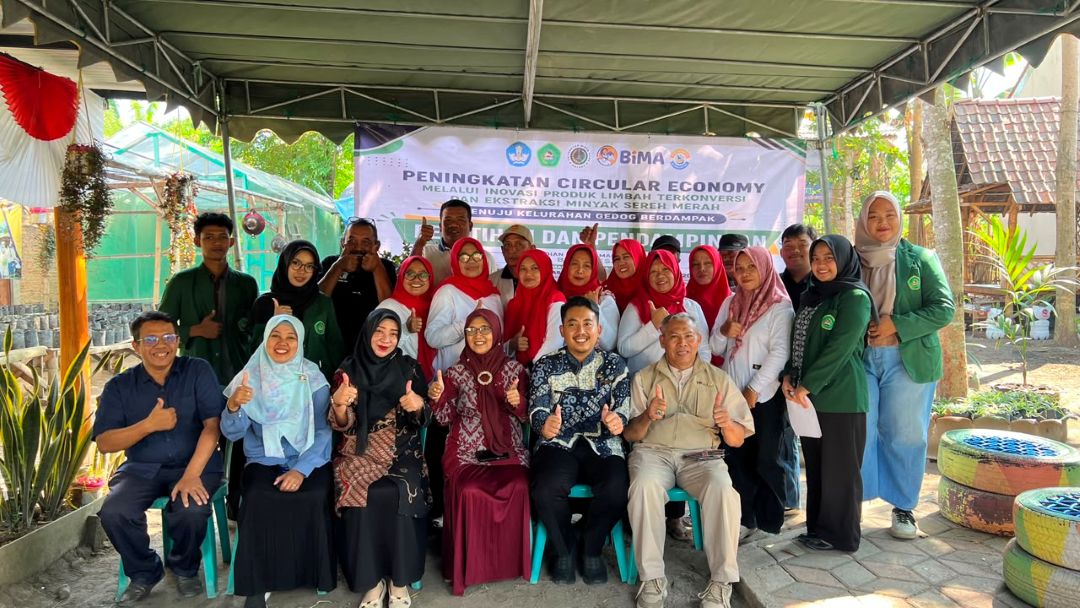
Efforts to build community economic independence through the use of local potential continue in Gedog Subdistrict, Sananwetan District, Blitar City. Through the Year II Assisted Village Community Empowerment Programme, aimed at increasing production capacity and management among partners, a team from Universitas Islam Balitar (Unisba) Blitar and Universitas Widyagama Malang carried out a series of socialisation, training, and mentoring activities for the community and two partner groups: Bank Sampah Gong Lestari and Pokmas Hidrofarm. The programme, which promotes circular economy development through plastic waste conversion products and red citronella oil extraction, is directed at increasing production capacity, community skills, business management, and marketing of products based on local potential.
Programme Chair Palupi Puspitorini said that the activities do not stop at providing technology, but are directed so that the community is able to operate the technology, develop products, and manage the business independently and sustainably to increase its economic capacity. “We want the appropriate technology provided to truly become part of the community’s economic activity. Therefore, the approach is not only socialisation and training, but is followed by practice and mentoring so that partners are able to apply the technology, produce products, and develop their marketing independently,” said Palupi.
For the Bank Sampah Gong Lestari partner, the programme focused on strengthening plastic waste management through the reduce, reuse, recycle (3R) principle. Waste that was previously only collected and sold in raw form is now developed through crushing technology into plastic flakes. Implementation data shows an increase in production of more than 75%. More significantly, the selling price increased, thereby impacting partner income. The training also increased members’ understanding of plastic processing techniques. Evaluation results showed an average increase in understanding of 55%, with the largest increase in the aspect of how to make crushed plastic at 75%.
Bank Sampah Gong Lestari Chairwoman Sutji Pudjiastuti welcomed the mentoring provided by the Unisba team. “With this mentoring, we not only learn to manage waste, but also see that plastic waste can become a material with higher economic value. The crushing machine helps us increase production capacity, while the mentoring opens insights to develop products and marketing.” According to her, the existence of the technology provides motivation for members to be more active in sorting and processing waste. Meanwhile, Pokmas Hidrofarm received mentoring in developing red citronella cultivation and diversifying its derivative products.
Training was carried out from cultivation techniques, seeding and maintenance, to the extraction process using distillation equipment. Not stopping at oil production, the team also provided training in making derivative products in the form of aromatherapy candles and perfume/reed diffusers. Implementation results showed production of 200 bottles each, with product revenue of Rp5 million. Pokmas Hidrofarm Chairman Andi Ahmad Setyobudi revealed that the mentoring provided a new experience for members in developing agricultural products into agro-industrial products. “This mentoring is very helpful because previously we focused more on raw materials and citronella oil. Now we are learning to develop citronella oil into products that are more ready for market, such as aromatherapy candles and reed diffusers made from red citronella oil. We also learned about business recording and digital marketing,” said Andi Ahmad.
The programme is not only oriented towards increasing production. Aspects of business management and human resources are also of concern. Training on financial management, production and sales recording, production target setting, and digital marketing was provided to partner groups. At Pokmas Hidrofarm, participants’ understanding of citronella oil increased by an average of 48%, while understanding of distillation techniques increased by up to 80%. The member participation rate reached 75%, exceeding the 70% target.
Digital marketing has also begun to expand the reach of Hidrofarm products. Red citronella oil, reed diffuser, and aromatherapy candle products are no longer only directed at the local Blitar market, but are beginning to be introduced to the Malang, Kediri, Surabaya, and Yogyakarta areas through digital media.
Gedog Subdistrict Head Yulian Nurdin Ahmad expressed appreciation for the implementation of the programme that directly involves the community. “We greatly appreciate the activities carried out in Gedog Subdistrict. This programme provides real benefits because the community not only gains knowledge, but also gains skills and mentoring to develop the potential that exists in our area. The waste bank and Hidrofarm group are examples that local potential can be developed into productive economic activities.” According to him, collaboration between universities, subdistrict government, community groups, and business actors is important capital for building programme sustainability. “Our hope is that this activity continues to develop so that Gedog Subdistrict truly becomes an impactful subdistrict, both from environmental, social and economic aspects of the community,” he added.
Programme Chair Ir. Palupi Puspitorini, MP, emphasised that the success of the programme is not only measured by the number of tools or products produced, but by the ability of partners to continue activities independently. “Our measure of success is when the group is able to continue the production process, manage its business, maintain product quality, and expand the market without assistance.”