
Apkasi pushes inter-regional trade to strengthen economic resilience
The Association of Indonesian Regency Governments (Apkasi) is pushing for the strengthening of inter-regional trade as a strategy to fortify national economic resilience amidst global economic uncertainty and turmoil.
Apkasi Chairman Bursah Zarnubi stated that Indonesia’s domestic market needs to be optimised by strengthening trade connectivity between regencies, cutting supply chains, and accelerating the downstream processing of key regional commodities.
“Inter-regional trade must become a national economic strength,” Bursah said in an official statement received in Jakarta on Sunday.
According to him, strengthening the domestic market is increasingly important as the global economy continues to face various pressures that could potentially affect trade and investment flows. He assessed that regions need to build interconnected economic networks by bringing together surplus production areas and regions requiring supplies.
“Regencies have production bases for food, agriculture, plantations, and various leading commodities. If these are connected to markets in a more integrated manner, it will create more equitable economic growth,” he said.
This trade pattern is considered capable of smoothing the distribution of goods, maintaining the availability of food commodities, and supporting inflation control in the regions.
Bursah said his organisation continues to strengthen its role as a mediator for inter-regional trade by bringing together regency governments, the business community, and potential investors. “Inter-regional cooperation must result in real transactions. Indonesia’s economic strength starts from the regions, especially regencies that have long been production centres for various strategic commodities,” he stated.
He added that strengthening the economy of regencies must also be directed towards downstream processing so that producing regions gain greater added value from the commodities they produce. According to him, regional economic development cannot continue to depend on the extractive sector or trade patterns involving raw commodities without processing.
He continued that processing industries need to grow closer to production centres to create jobs, increase community incomes, and give rise to new economic growth centres in the regencies.
Bursah, who is also the Regent of Lahat, cited the potential of coffee in Lahat Regency, with production of around 300,000 tonnes per year, which has significant opportunities for development through downstream industries. “If commodities are processed in their region of origin, the added value also stays in the region. The community gets jobs, new businesses grow, and the regency’s economy becomes stronger,” he said.
Apkasi Executive Director Sarman Simanjorang stated that strengthening inter-regional trade is carried out through a ‘supply meeting demand’ concept, directly connecting regional production potential with market needs. He mentioned that several regencies have leading commodities with the potential for market expansion, including rice, coconut, and shrimp from Banyuasin Regency, maize from Gorontalo Regency, and shallots from Brebes Regency.
Deli Serdang Regency was also noted for its strength in the agricultural and plantation sectors as a buffer zone for Medan City. “What we want to build is a direct meeting between regions that have products and parties in need. From there, trade, investment, and downstream processing must emerge,” said Sarman.
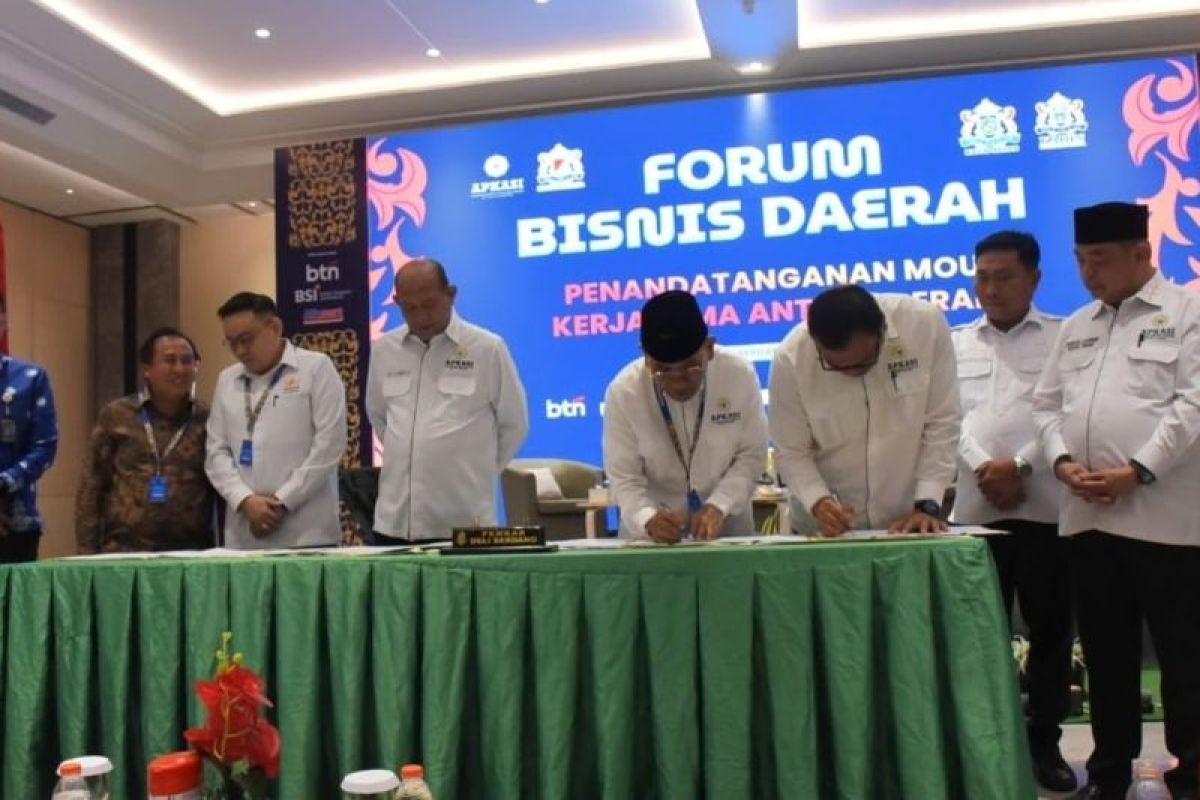
One of the efforts to connect regional potential with market needs was carried out by Apkasi through the 2026 Regional Business Forum (Forbisda) with the Indonesian Chamber of Commerce and Industry (Kadin) in Deli Serdang Regency, North Sumatra. He mentioned that the forum resulted in several inter-regional trade agreements, including cooperation between Deli Serdang and Simalungun to support inflation control, and cooperation between Simalungun and Langkat to enhance regional trade.
Collaboration with the business sector was also built through a shallot commodity trade agreement between business players from North Sumatra and Brebes Regency, aimed at strengthening food distribution and shortening the supply chain. During the forum, regency governments were brought together with national business players to explore investment opportunities and business cooperation, enabling the marketing and downstream processing of regional leading commodities to proceed more quickly.
Apkasi believes that the synergy between regional governments and the business sector needs to be continuously expanded so that Indonesia’s domestic market becomes more integrated and capable of serving as a buffer for the national economy. “The final target is not just the signing of a memorandum of understanding. We want a flow of goods, investment entering the regions, downstream industries growing, prices becoming more stable, and the economic benefits being felt by the community,” Bursah concluded.
Source: jawawa.id (https://jawawa.id/newsitem/apkasi-pushes-inter-regional-trade-to-strengthen-economic-resilience-1783219890)
Originally published by Antara (Indonesian) (https://www.antaranews.com/berita/5635895/apkasi-dorong-perdagangan-antardaerah-perkuat-ketahanan-ekonomi), translated from Indonesian