
Apindo Urges Dialogue-Based Approach for Tobacco Derivative Regulations
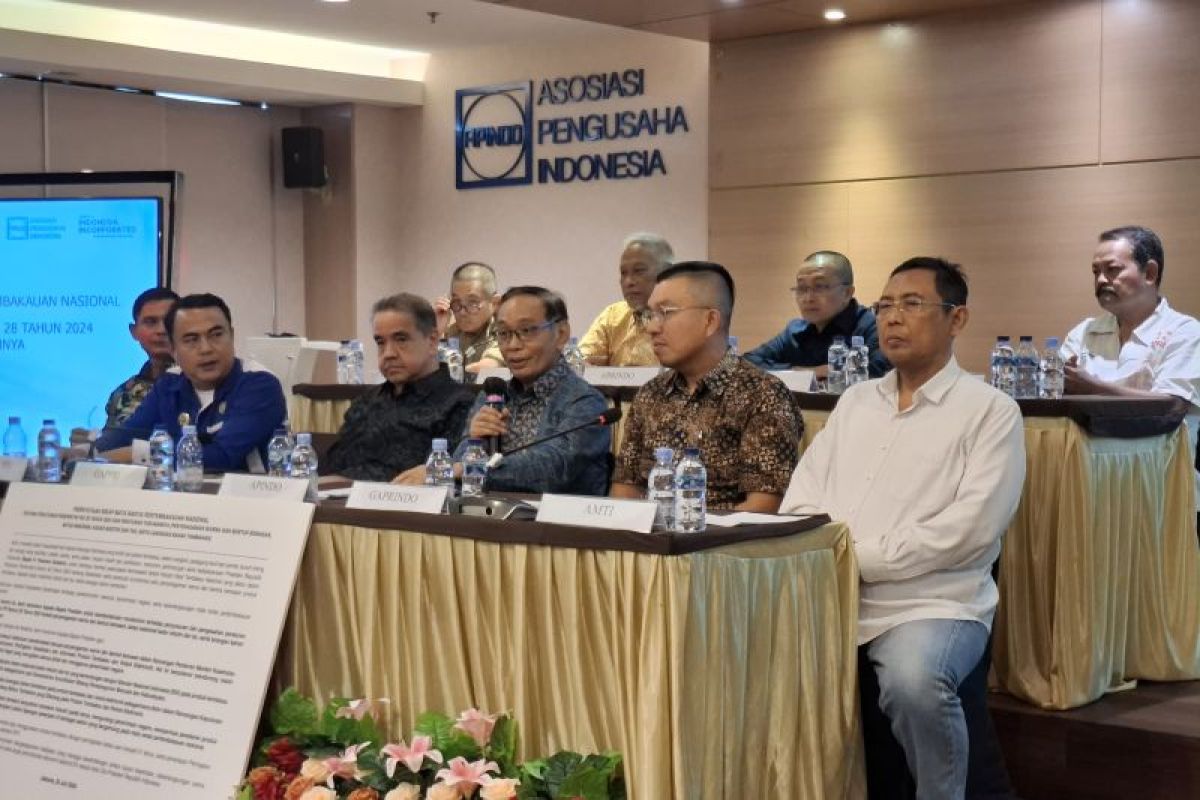
Jakarta (ANTARA) - Apindo, together with 37 national tobacco supply chain associations, has stated that the refinement of three draft derivative policies under Government Regulation (PP) No. 28 of 2024 must be based on more comprehensive dialogue so as to maintain a balance between health objectives, industrial sustainability, and employment absorption.
“Please don’t issue them in the next day or two. Please listen to us first. Talk with us first, then we can reach an agreement,” said Apindo’s Head of Public Policy, Sutrisno Iwantono, in Jakarta on Thursday.
The three contested draft policies cover the standardisation of packaging colour and shape, the imposition of maximum limits on nicotine and tar content, and a ban on the use of additives in tobacco and electronic cigarette products.
In a joint statement, Apindo and the related associations asked the President not to approve the standardisation provisions regarding uniform packaging colours and shapes in the Draft Minister of Health Regulation on Health Warning Safeguards and Product Information for Tobacco and Electronic Cigarettes.
They also asked the government not to impose maximum nicotine and tar limits, which they consider contrary to the Indonesian National Standard (SNI), and not to implement the ban on additives as set out in the Draft Minister of Health Decree on Additives Prohibited in Tobacco and Electronic Cigarette Products.
Henry Najoan, Chairman of the Indonesian Cigarette Manufacturers’ Joint Association (GAPPRI), said businesses do not reject the entirety of PP No. 28 of 2024, but object to the three draft policies deemed to threaten the sustainability of the industry and its supply chain.
“What we reject are only these three provisions. We are not against regulation, but what will clearly kill this industry are these three articles,” Henry said.
He said the associations support the government’s efforts to improve public health and protect the younger generation.
However, he said the drafting of these policies must also consider their impact on farmers, workers, processing industries, traders, retailers, and the creative industry.
He encouraged the government to open a space for dialogue and involve all stakeholders so that the goal of health protection can proceed in step with the continuity of economic activity and jobs.
Edy Sutopo, Chairman of the Indonesian Tobacco Society Alliance (AMTI), said the tobacco supply chain, from upstream to downstream, involves around six million people and generates economic activity worth more than Rp710 trillion.
Edy also said the supply chain produces foreign exchange of around 2 billion US dollars and contributes more than Rp200 trillion in excise revenue.
According to him, if added to other tax revenues, the tobacco supply chain’s contribution reaches around Rp300 trillion, or 10.5 per cent of state revenue.
Edy judged that tobacco product regulation needs to be carried out rationally, fairly, and proportionally, so that efforts to control its negative impacts do not eliminate legitimate economic activity or push such activity into the illegal market.
AMTI said the circulation of illegal cigarettes has reached 13.9 per cent. The organisation considers that standardising packaging could complicate the control of illegal products, as legal and illegal products would become increasingly difficult for the public to distinguish.
Edy asked that the health and economic impacts of these policies be calculated and tested scientifically, taking into account the multiplier effects on farmers, workers, traders, small businesses, retailers, and the families who depend on the tobacco supply chain.
Apindo said it has communicated with the Task Force for Layoff Mitigation (Satgas Mitigasi PHK), the State Secretariat, and the Cabinet Secretariat to convey these aspirations.
The association hopes the government will not issue the three draft policies before holding further dialogue with stakeholders.
On the other hand, the Ministry of Health stated on 5 June 2026 that packaging standardisation is being prepared to reduce the visual appeal of tobacco and electronic cigarette products, particularly among children and adolescents, not to ban the circulation of legal products.
Acting Director General of Disease Control at the Ministry of Health, Andi Saguni, said brand identity and fonts can still be included in accordance with the provisions even if packaging colours are standardised. Pictorial health warnings will also continue to be displayed to provide information on the risks of consuming tobacco products.
“The main purpose of uniform packaging regulation is not to ban legal products, but to reduce the visual appeal that has so far made tobacco products more attractive to children and adolescents,” Andi said.
The Ministry of Health stated that the drafting of the regulation has gone through public consultation, cross-ministerial and institutional coordination, and the receipt of input from academics, professional organisations, businesses, and civil society since 2024.
The Ministry also said the application of health warning and product information provisions is planned to take effect no later than 12 months after the regulation is promulgated.
Furthermore, Henry said the three draft derivative regulations are of urgent concern because, according to businesses’ understanding, the deadline for their issuance falls on 26 July 2026, coinciding with two years since PP No. 28 of 2024 was promulgated.