
Apindo: Textile Industry Investors Remain in Wait-and-See Mode
The Indonesian Employers’ Association (Apindo) assesses that investment opportunities in the textile and textile products (TPT) industry remain open. However, realisation is highly dependent on Indonesia’s ability to improve competitiveness amidst fierce competition with textile-producing countries in Asia.
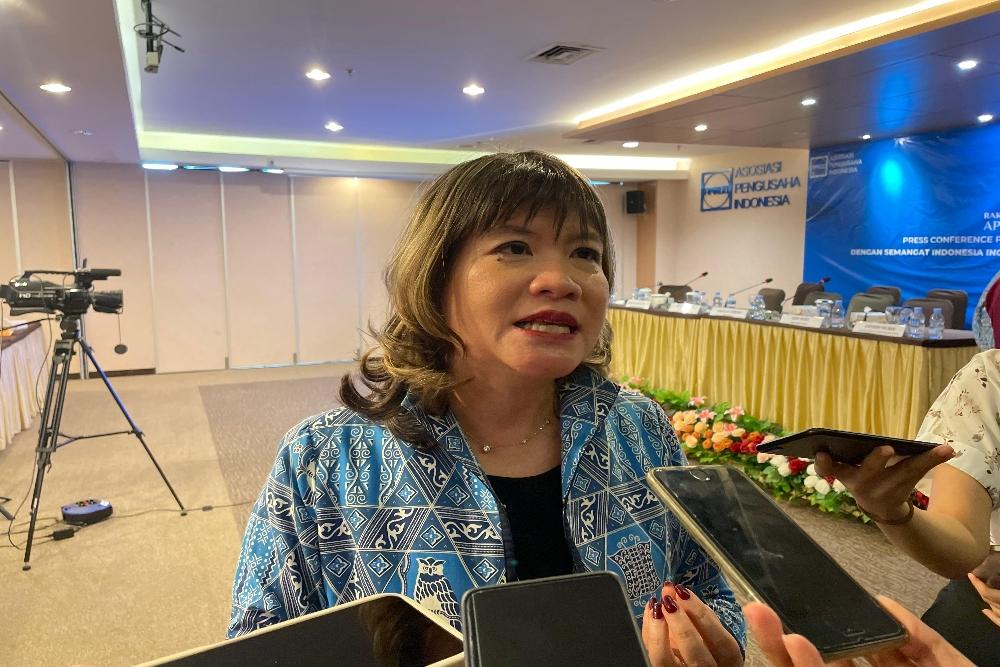
Apindo Chairwoman Shinta W. Kamdani stated that investors are currently adopting a wait-and-see stance amid the pressures facing the labour-intensive industry. This condition is reflected in the slowdown of domestic direct investment (PMDN) in the textile sector at the beginning of the year.
“In the first quarter of 2026, domestic investment in the textile sector reached approximately Rp2 trillion, a quarterly decline of around 4.8%. We currently see investors tending to take a more cautious approach,” Shinta told Bisnis on Sunday (12/7/2026).
According to her, investment decisions in the TPT industry are determined not only by the size of the domestic market but also by production cost efficiency, regulatory certainty, labour productivity, logistics costs, and ease of access to export markets. Moreover, Shinta continued, the textile industry is part of the global supply chain, so investors and international brand owners will constantly compare Indonesia with competing countries.
“They will place investment in countries that can provide business certainty and the most competitive production costs,” she asserted.
Shinta noted that Vietnam, Cambodia, Bangladesh, India, Pakistan, and Jordan are among the countries currently competing directly with Indonesia to attract textile manufacturing investment. Therefore, she considers improving the business climate a crucial factor so that Indonesia does not lose opportunities for investment relocation or new expansion from global industry players.
It is undeniable that the national TPT industry is still facing pressure from the influx of cheap imported products, including those entering through illegal channels and unfair trade practices. According to Shinta, this condition has suppressed demand for local products, causing factory utilisation rates to fall, business margins to shrink, and many companies to postpone expansion.
“Companies end up delaying investment, reducing production capacity, and even implementing workforce efficiencies. Under these conditions, the space for the industry to recover becomes increasingly limited,” she said.
Apindo appreciates the government’s steps to tighten import regulations through changes in trade regulation. However, the employers’ organisation believes the biggest challenge now lies in implementation on the ground. Supervision of illegal import flows and misuse of import provisions is deemed necessary to be strengthened. Additionally, the government is encouraged to optimise trade remedy instruments in accordance with World Trade Organisation (WTO) provisions if dumping practices or import surges that harm the national industry are found.
Nevertheless, Shinta believes the investment prospects for the TPT industry can still improve if the government can enhance the competitiveness of the manufacturing sector through policy reform. According to her, there are three steps that need to be prioritised in the next six months. First, reducing the structural high-cost economy through deregulation, logistics efficiency, certainty of energy and raw material supply, and cheaper financing access. Second, strengthening domestic market protection through more effective import supervision and consistent enforcement of trade rules without disrupting Indonesia’s integration into the global supply chain. Third, encouraging investment for industrial modernisation through incentives for machinery and technology upgrades, strengthening the upstream industry, improving the quality of human resources, and liquidity support for business actors. “Investment incentives for machinery and technology renewal, strengthening the upstream industry, improving the quality of human resources, support for working capital liquidity, and accelerating the transformation towards a more efficient industry will be important factors so that the TPT industry can produce products with higher added value and competitiveness,” she concluded.
Source: jawawa.id (https://jawawa.id/newsitem/apindo-textile-industry-investors-remain-in-wait-and-see-mode-1783893012)
Originally published by ekonomi.bisnis.com (https://ekonomi.bisnis.com/read/20260713/9/1987503/apindo-investor-industri-tpt-masih-wait-and-see), translated from Indonesian