
Apindo Proposes Strategy to Create 2 Million New Formal Jobs Annually
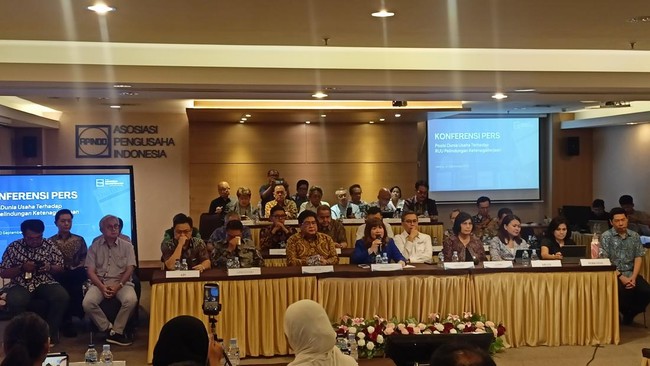
The Indonesian Employers Association (Apindo) supports the formation of the Labour Protection Bill currently being discussed by the Government and the House of Representatives (DPR RI). However, the business community requests that the regulations focus not only on protecting existing workers but also on ensuring the creation of new jobs.
During this process, Apindo has raised 10 key issues, ranging from the expansion of employment opportunities, fixed-term contracts (PKWT), outsourcing, and wages, to severance pay, layoffs, training, working hours, sanctions, and the protection of platform workers.
“First, we propose that the nomenclature of this law should be the Labour Protection and Employment Expansion Act. However, it appears that employment expansion has not been adopted. For us, the best protection for workers is the job itself. If there are no jobs, what is there to protect?” said Apindo’s Head of Labour Affairs, Bob Azam, on Thursday.
Apindo believes that the success of the new regulations must be measured by concrete indicators. The business community proposes the creation of 2 million new formal jobs every year and an increase in the number of certified workers as key performance indicators.
“The scope should not only protect those who are already employed, but also ensure those who are working remain employed. And if they lose their jobs, they should be able to find new ones more quickly. Therefore, we are protecting not just the worker, but the job itself,” Bob stated during an Apindo press conference on Wednesday night.
In its proposal, Apindo also highlighted the regulation of fixed-term contracts (PKWT) and outsourcing. The business community requests that contract types remain adaptable to the nature of the work, while the outsourcing mechanism should provide certainty regarding rights and oversight of labour service providers.
“Regarding PKWT and outsourcing, the sentiment is that everyone wants to become permanent employees, so these mechanisms are being restricted. In reality, PKWT and outsourcing serve as a transition towards permanent employment. If these are reduced, instead of creating permanent workers, we will simply see more people entering the informal sector,” said Bob.
Wage issues were also included in Apindo’s list of concerns. In addition to using the minimum wage as a safety net, the business community proposes a formula that accounts for economic conditions and a two-year validity period for the minimum wage, while linking wage increases to competence and productivity.
“Regarding wages, we hope the regulations do not only govern the minimum wage but also address how to provide wages commensurate with increased competence. What is currently lacking is consideration for productivity and unemployment rates. There are regions where the minimum wage is the highest, yet the unemployment rate is also the highest,” he noted.
Beyond wages, Apindo proposed the harmonisation of severance pay and pension funds, alongside mechanisms to prevent layoffs and a faster resolution for industrial relations disputes, suggesting that disputes should be resolved within a maximum of 60 days.
The business community also called for the strengthening of the labour training system by consolidating existing funding sources. This step is deemed crucial as the number of new job seekers far exceeds the current capacity for training and certification.
“Currently, the output from Vocational Training Centres (BLK) is 300,000 per year, whereas 3 to 4 million job seekers enter the labour market. This means our certification capacity is less than 10 per cent. Moving forward, our ability to produce certified workers is closely linked to our future competitiveness,” said Bob.
Working hours were also a point of concern. Apindo proposed a maximum regular working limit of 45 hours per week, with further implementation details to be adjusted through collective labour agreements, while requesting that labour sanctions remain proportional and effective.
Bob urged the government to compare Indonesian provisions with competing nations, particularly within the ASEAN region. He noted that overly strict working hour limits could create new problems for industries when operational practices on the ground do not align with the limits set by law.
“We must be careful in setting statutory limits, as failure to meet them could backfire, leading to accusations of forced labour or excess capacity. This is already happening in our industry. Our laws must be drafted very carefully, considering how laws are implemented in other ASEAN countries,” Bob emphasised.
Source: jawawa.id (https://jawawa.id/newsitem/apindo-proposes-strategy-to-create-2-million-new-formal-jobs-annually-1790837528)
Originally published by CNBC Indonesia (https://www.cnbcindonesia.com/news/20261001110007-4-772431/apindo-usul-jurus-ciptakan-2-juta-lapangan-kerja-formal-baru-per-tahun), translated from Indonesian