
Apindo: Labour Law Revision Must Adopt 'Flexicurity' Principle
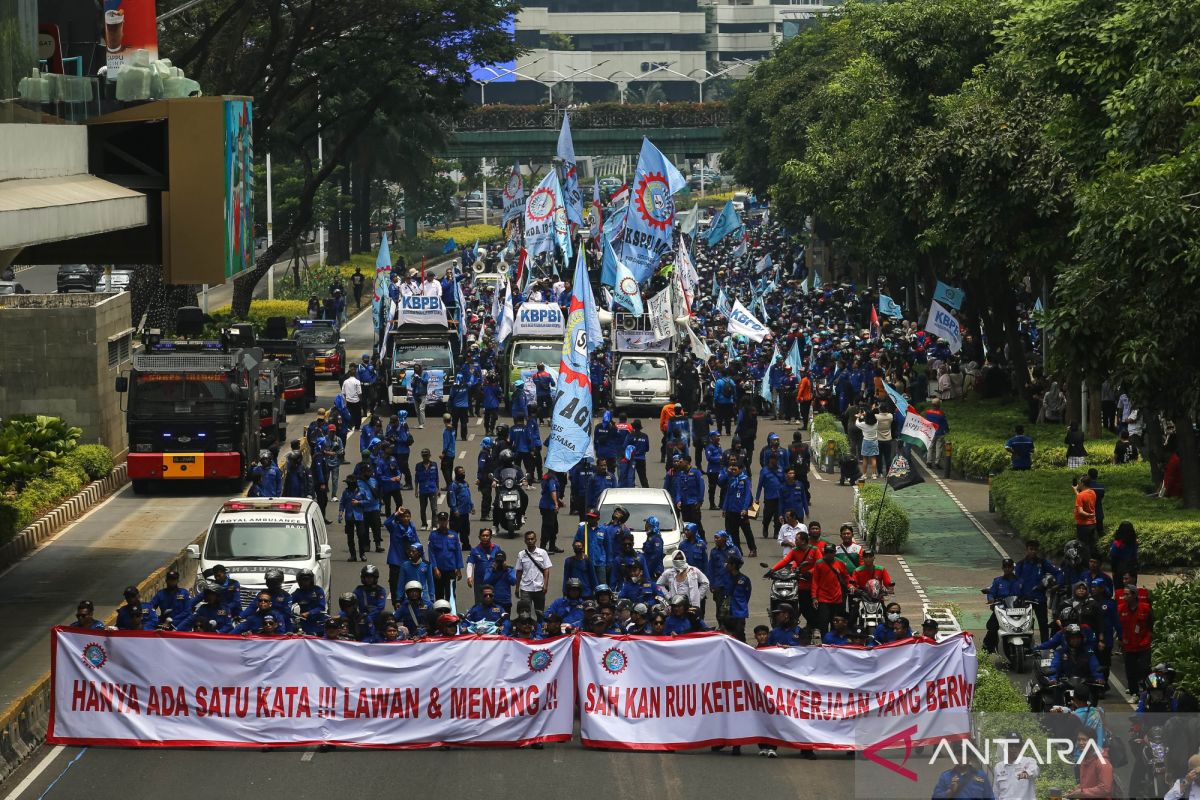
Jakarta (ANTARA) - The Indonesian Employers Association (Apindo) has stated that the revision of the Labour Protection Law must adhere to the principle of ‘flexicurity’ (flexibility and security).
Bob Azam, Apindo’s Head of Labour Affairs, explained that under this principle, employers gain flexibility while workers receive protection. “The Labour Law is not a standalone regulation. There must be collaboration with the industrial sector, the trade sector, and other sectors,” Bob stated in Jakarta on Saturday.
He noted that every sector faces different specific issues. “If everything is regulated by Law, it will not function. For example, regarding the 8-hour workday, workers in the tourism sector actually work 24 hours on public holidays,” he said.
In the palm oil plantations, he added, it is also impossible for workers to take 4-hour breaks as it could disrupt overall operations. Similarly, provisions regarding Fixed-Term Employment Contracts (PKWT) and outsourcing are also difficult to implement.
According to Bob, with an 8-hour workday, workers must perform overtime to achieve optimal production. Consequently, employers must incur additional costs. “In our industry, if our defect ratio is such that we only produce 50 percent, workers must work overtime and their wages double; that is what happens,” he said.
Zainul Munasichin, a member of Commission IX of the House of Representatives (DPR RI) and also part of the Labour Law Draft Working Committee, stated that the discussion of the Labour Protection Bill has entered Level I deliberations between the DPR and the government.
The discussion of the Bill covers aspects of worker protection, job creation, and certainty for the business world. One approach being discussed is the shift from the concept of “permanent work” to “permanent employment.”
Through this approach, protection is not only directed at the continuity of a worker within a single company but also ensures that workers have support when they lose their jobs and can re-enter the labour market.
According to Zainul, in the current era, a permanent work approach alone is no longer sufficient. The DPR wants to ensure that as long as workers are employed, all their rights are fulfilled. Meanwhile, when they lose their jobs, the state provides a cushion so they can re-enter the labour market.
It is noted that the Deputy Speaker of the DPR RI, Sufmi Dasco Ahmad, stated that the Labour Protection Bill is scheduled for completion by October 2026.
Speaking at the parliamentary complex in Jakarta on Thursday (24/9), Dasco mentioned that differences of opinion still exist between labour federations and Apindo. Therefore, he said, the DPR RI will first mediate to bring about an agreement between labour and employers regarding the Bill.