
Apindo Hopes New Finance Minister Suahasil Maintains Fiscal Credibility and Policy Certainty
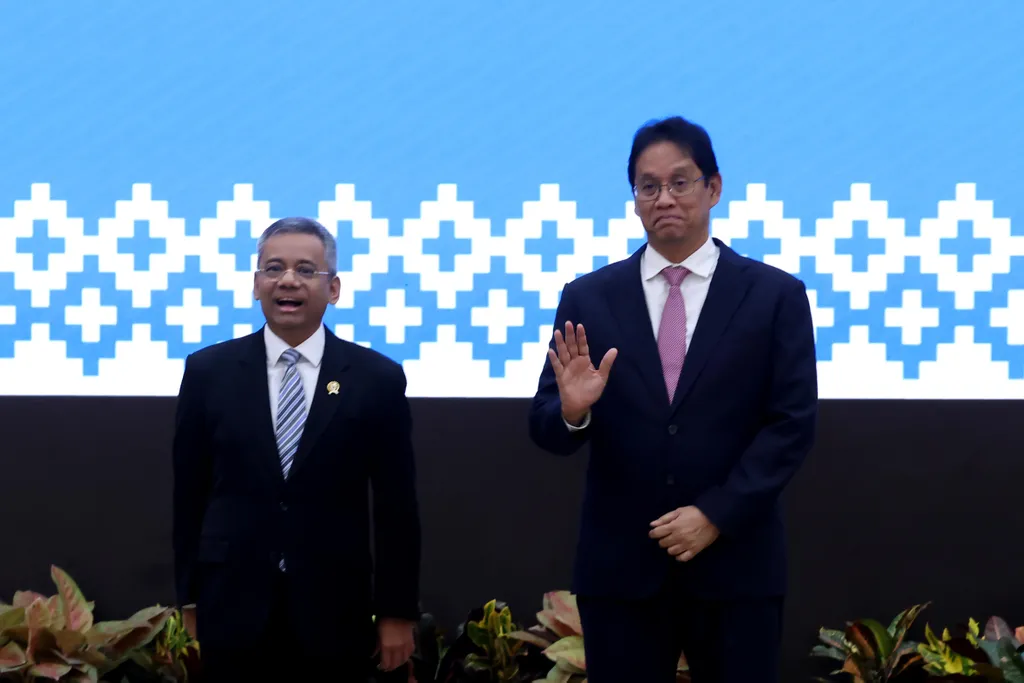
Business and investor confidence can be maintained if fiscal management is conducted credibly and cautiously, policies are predictable, and the state budget supports investment.
15 Sep 2026 19:14 WIB · Ekonomi & Bisnis
KOMPAS/TOTOK WIJAYANTO
JAKARTA, KOMPAS — The business world hopes that the change in the Minister of Finance will not abruptly alter the direction of fiscal policy. Policy certainty is considered important to maintain the trust of business actors and investors amid global economic uncertainty.
The Chairperson of the Indonesian Employers Association (Apindo), Shinta Kamdani, stated that the replacement of the Minister of Finance is the authority and prerogative of the President to ensure the effectiveness of governance. However, the transition process is expected to maintain the credibility of fiscal management and certainty in policy direction.
“The most important thing for us is that this leadership transition process can proceed smoothly while maintaining the credibility of fiscal management, certainty in policy direction, and the trust of business actors and investors in the Indonesian economy,” said Shinta in her written response to Kompas, Tuesday (15/9/2026).
Shinta believes that Suahasil Nazara’s experience in managing national fiscal policy can assist in the transition process. Suahasil previously served as the Deputy Minister of Finance and has held the position of Head of the Fiscal Policy Agency at the Ministry of Finance.
“In a current economic situation filled with uncertainty, we hope that this continuity can help ensure that the leadership transition does not lead to abrupt changes in policy direction,” said Shinta.
The business world also emphasizes the importance of balancing fiscal health and the need to encourage economic growth. The state budget is considered necessary to be managed carefully and sustainably, while also being able to maintain purchasing power, encourage investment, enhance productivity, and strengthen the real sector.
Shinta said that policy certainty or predictability is important for business actors in making business decisions, especially regarding taxation, customs, investment incentives, government spending, and fiscal policies that affect business costs.
Therefore, every change in fiscal policy is expected to be carried out in a measured manner and accompanied by communication and a dialogue space with the business world. This is necessary so that companies have certainty in formulating investment and expansion plans.
The challenges facing the Minister of Finance ahead, according to Shinta, are not easy. The government must finance various development priorities while maintaining fiscal space and the credibility of the state budget amid global uncertainties.
The quality of spending, the effectiveness of state revenue, fiscal discipline, and market confidence need to be prioritized. Revenue policies should not solely focus on short-term revenue increases but must also consider the competitiveness and capacity of the productive sector to grow.
“For the business world, the measure is not merely the change of figures, but the consistency and quality of policies after the transition,” said Shinta.
The business world is optimistic; the confidence of the business community and investors can be maintained as long as fiscal management is conducted credibly and cautiously, policies are predictable, and the state budget effectively supports economic activities and investments.
Paramadina University economist Wijayanto Samirin considers the change in the Minister of Finance to be a positive step. According to him, Suahasil is an experienced bureaucrat who can provide stability in management and improve coordination of fiscal policy.
“However, fiscal policy transformation will only work if Suahasil is given the authority and flexibility to innovate,” Wijayanto said.
The President’s message to Suahasil to maintain the credibility of the State Budget while also overseeing the government’s strategic programs is not an easy task. These two agendas can conflict if the strategic programs are not aligned with fiscal capacity.
On the other hand, the government needs to end policies that could add pressure on the business sector. The withholding of tax restitution and aggressive tax collection involving law enforcement is considered to disrupt company operations while also worsening the investment climate.
For the 2027 State Budget, Wijayanto believes there is still room for adjustments as the budget discussion will be approved at the end of October.
Several fundamental assumptions, such as the exchange rate of the rupiah, the yield on 10-year government securities, global oil prices, economic growth, and inflation, need to be reassessed as they are considered overly optimistic.
If changes to the assumptions cannot be made before the ratification of the State Budget, Wijayanto continued, Suahasil needs to prepare an adjustment scenario through changes to the State Budget posture with a presidential regulation, revisions to the budget implementation list (DIPA), and automatic adjustments.
Continue improvements
Nevertheless, Wijayanto believes that several policies initiated by Purbaya still need to be continued. This includes the eradication of illegal cigarettes, the restructuring of the Directorate General of Customs and Excise, as well as the strengthening of governance in the Directorate General of Taxes.
In the industrial sector, the improvement of fiscal policies is also considered important to prevent deeper premature deindustrialization. This condition not only hinders the increase in state revenue and the creation of quality jobs but also suppresses the competitiveness of the economy.
“The Ministry of Finance is only a small screw in a large system in the context of industrialization, but it is a very important screw—indispensable,” said Wijayanto.
Wijayanto believes that legal and regulatory uncertainty is one of the root causes of deindustrialization. This condition leads investors to prefer sectors with short supply chains, particularly primary sectors based on natural resources.
“For sophisticated products, investors choose other countries such as Singapore, Malaysia, and Vietnam, which promise better certainty,” he said.
According to him, this condition makes Indonesia still dependent on commodity exports, which account for about 60 percent of total exports. The employment structure is also still dominated by the informal sector, estimated to reach 60-70 percent, thus not providing optimal welfare.
Industrialization requires a comprehensive policy overhaul, encompassing monetary, fiscal, and sectoral aspects. From a fiscal perspective, tax policies need to be simplified, clarified, and provide incentives for the manufacturing industry.
Meanwhile, sectoral policies need to be more consistent and competitive, particularly regarding employment, the domestic component level (TKDN), and logistics.
Writer:
Aguido AdriEditor:
FX Laksana Agung Saputra
Source: jawawa.id (https://jawawa.id/newsitem/apindo-hopes-new-finance-minister-suahasil-maintains-fiscal-credibility-and-policy-certainty-1789480212)
Originally published by kompas.id (https://www.kompas.id/artikel/the-new-minister-of-finances-challenge-is-to-create-business-certainty?open_from=English_Page)