
APEC Members Meet in Shanghai to Prepare Agenda for Summit
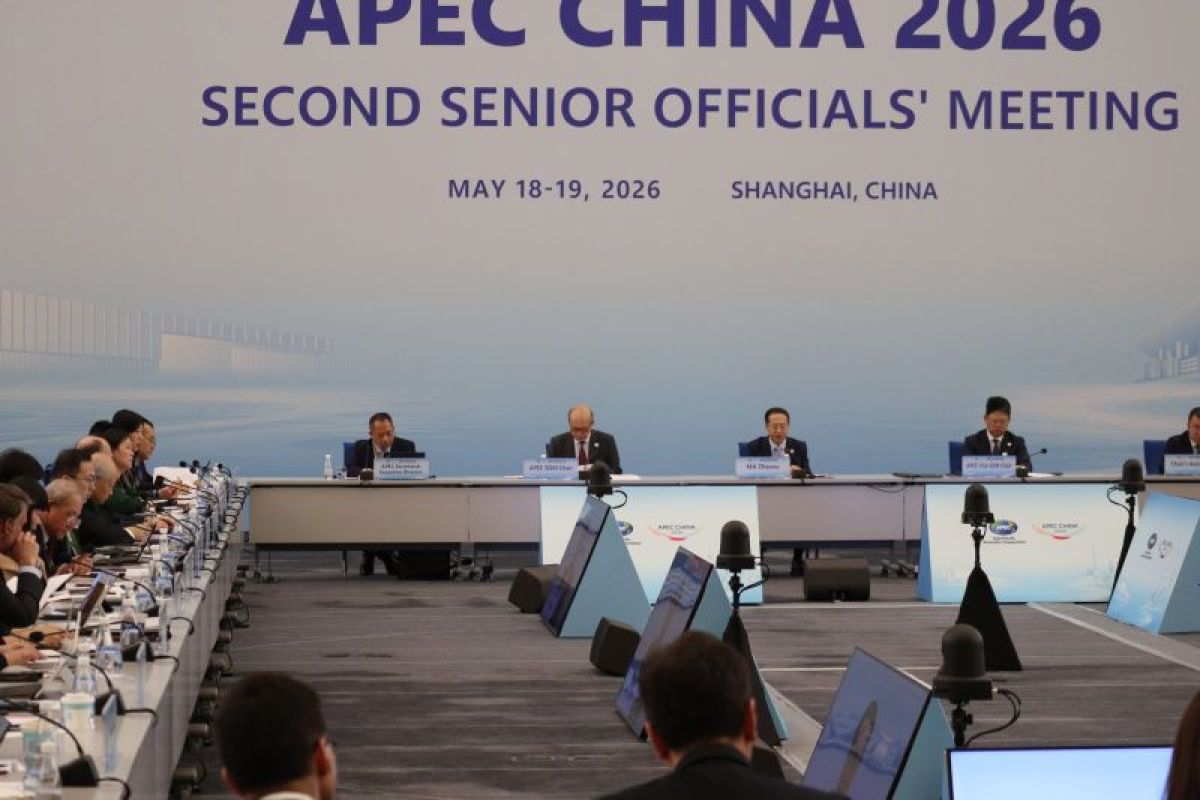
Shanghai (ANTARA) - Representatives of the Asia-Pacific Economic Cooperation (APEC) member economies met in Shanghai to prepare the agenda for the APEC Summit, which is scheduled to takeplace in November 2026.
“Today, the baton for China’s APEC Year has passed to Shanghai. This Senior Officials’ Meeting (SOM) serves as a link between the previous and subsequent stages,” stated China’s Executive Vice Foreign Minister Ma Zhaoxu during the opening of the APEC SOM in Shanghai on Monday.
This SOM is the second held in China and took place on 18-19 May 2026. The first APEC SOM 2026 was held from 1-10 February 2026 in Guangzhou, Guangdong Province, attended by Chinese Foreign Minister Wang Yi to deliver opening remarks and serve as the first official meeting under China’s hosting.
Indonesia was represented at the Shanghai APEC SOM by the Director General for Asia Pacific and Africa of the Indonesian Ministry of Foreign Affairs, Santo Darmosumarto.
“We will review the progress achieved during the first half of this year, detail the design of outcomes, summarise initial achievements, and lay a strong foundation for various important activities in the second half of the year, particularly for the outcomes of the Leaders’ Informal Meeting,” Ma added.
Ma noted that during the Informal Senior Officials’ Meeting in Shenzhen, APEC members expressed their desire to build an Asia-Pacific community and promote shared prosperity as the primary goal for the 2026 APEC hosting.
“We have also established three priority areas: openness, innovation, and cooperation, which officially launch the series of events for China’s APEC Year,” said Ma.
Meanwhile, during the APEC SOM in Guangzhou, Ma mentioned that Foreign Minister Wang Yi encouraged all parties to work together to ensure the Leaders’ Meeting produces a meaningful list of achievements.
“APEC members also uphold the spirit of cooperation by conducting in-depth discussions on trade and investment, connectivity, the digital economy, innovative growth, and other fields, as well as formulating a series of outcome ideas and work plans. I express my appreciation for the efforts made by all parties and am satisfied with the progress we have achieved,” Ma added.
Ma noted that the current international situation is fraught with change and volatility, including a resurgence of unilateralism and protectionism, alongside worsening energy and food crises, which are overshadowing global economic growth.
The Asia-Pacific region, however, is deemed capable of overcoming external risks and challenges while maintaining relatively rapid development momentum, further highlighting its position as a global growth engine.
“In last year’s APEC meeting, President Xi Jinping earnestly stated that China will follow the trends of the times, listen to the aspirations of all members, and join hands with all parties to build an Asia-Pacific community, thereby providing new impetus for peace and development in the Asia-Pacific region and the world,” Ma revealed.
Ma also stated that the theme adopted for the Shanghai APEC SOM—trade, connectivity, innovation, and development—is closely aligned with China’s three priority areas for this year’s APEC hosting: openness, innovation, and cooperation.
“All of these are effectively connected to and support the Putrajaya Vision 2040, serving as important pillars for the development of the Asia-Pacific community. On this basis, we will design the outcome documents for the Leaders’ Meeting. We hope all parties will continue to provide constructive views and valuable contributions through active discussion,” Ma said.
China is hosting APEC 2026 under the grand theme “Building the Asia-Pacific Community for Shared Prosperity”. The summit is planned for November 2026 in Shenzhen, Guangdong Province.
APEC is a cooperation forum comprising 21 economies in the Pacific Rim, established in 1989. Its members include Australia, Brunei Darussalam, Canada, Chile, China, Hong Kong-China, Indonesia, Japan, South Korea, Malaysia, Mexico, New Zealand, the Philippines, Peru, Papua New Guinea, Russia, Singapore, Taiwan, the United States, and Vietnam.
Apec cooperation is non-political, characterised by the membership of Hong Kong and Taiwan. Members are referred to as “economies” as each member interacts as an economic entity rather than a nation-state.
The primary objective of APEC is outlined in the long-term Putrajaya Vision 2040, agreed upon in 2020. This vision replaces the Bogor Goals, which had served as APEC’s long-term vision since 1994.