
ANTARA Uses World Media Summit to Build Networks to Address AI Challenges
Beijing (ANTARA) — Indonesia’s National News Agency (LKBN ANTARA) is using the 7th World Media Summit in Beijing to build networks with media companies in various countries to address the challenges posed by artificial intelligence (AI).
“AI is not only changing how information is produced and distributed, but also posing challenges to media credibility, journalists’ professionalism and the future of the press industry,” ANTARA President Director Abdul Hakim said at the Great Hall of the People in Beijing on Saturday.
Abdul Hakim made the remarks on the sidelines of the opening ceremony of the World Media Summit, themed “Media in the Age of Intelligence: From Consensus to Action”. The event brought together nearly 500 delegates from about 330 mainstream media organisations, think tanks, government agencies and international organisations in 112 countries and territories.
Abdul said that, on the one hand, AI was widening the public’s ability to produce and distribute information, potentially increasing the spread of misinformation and disinformation and blurring the distinction between credible information and content designed merely to attract public attention.
On the other hand, AI offers strategic opportunities for the media industry, as the technology can improve operational efficiency, speed up news production, strengthen research, and enable large-scale data processing and analysis (big data analytics).
“This requires media professionals to continue building their capabilities while redefining the human added value that technology cannot easily replace, particularly editorial judgement, social sensitivity, ethics and in-depth analysis,” Abdul added.
For news agencies with decades of accumulated data and journalistic archives, AI could also become a tool for creating a competitive advantage that is difficult to replicate, he said.
“Specifically in the context of LKBN ANTARA, the wealth of news archives and journalistic data accumulated over nearly nine decades is a strategic asset that can be developed through the use of AI,” Abdul Hakim said.
This means the future of journalism will not be determined by how far AI can replace people, but by how intelligently people use AI to produce journalism that is higher-quality, credible and valuable.
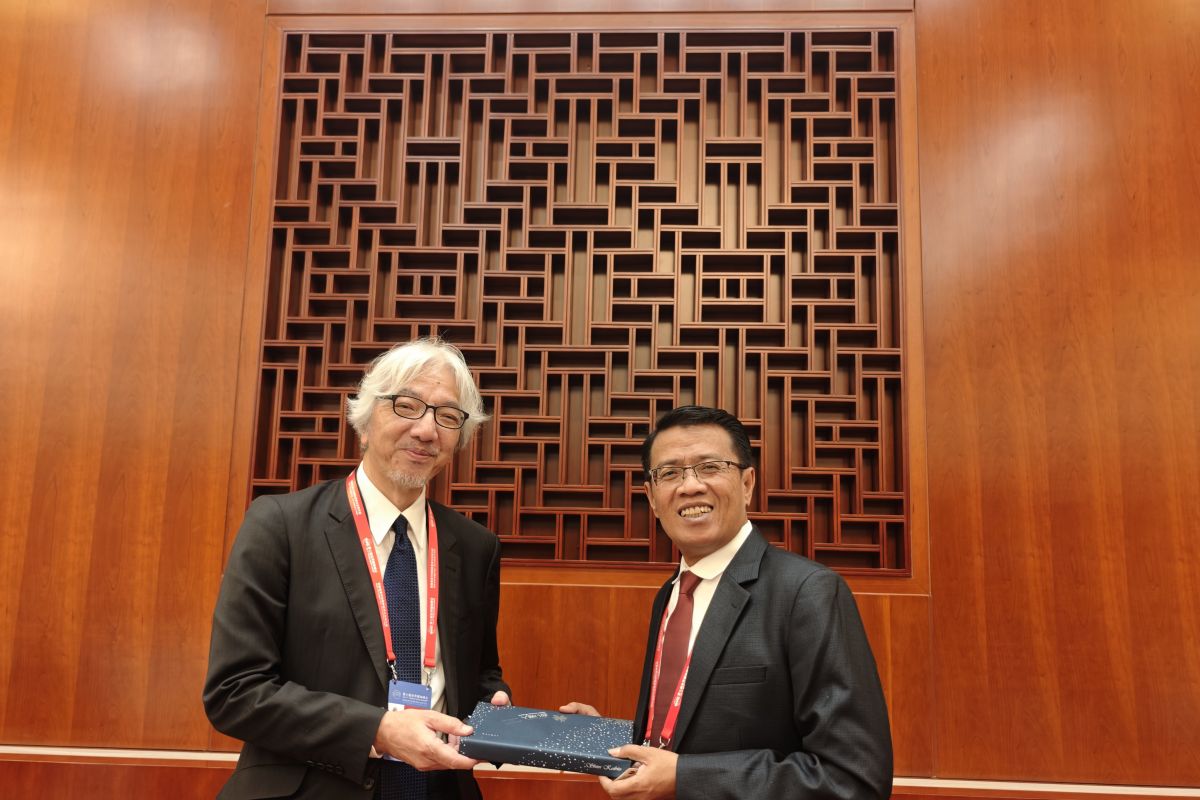
At the event, Abdul Hakim had the opportunity to meet and speak with media leaders from several countries, including Toshimitsu Sawai, president and editor-in-chief of Japan’s Kyodo News.
“Kyodo News is actively promoting the safe and effective use of generative AI, while taking into account our responsibilities and ethical considerations as a news organisation,” Sawai said in his speech.
Kyodo News has established rules for AI use in editorial work and stresses that decision-making authority and accountability must remain in human hands, Sawai said.
“Even so, Kyodo is currently facing an urgent challenge in securing new sources of revenue, as subscription fees from customer media continue to decline, with some cases seeing a fairly sharp drop. We are therefore developing several monetisation projects to diversify our revenue sources,” he said.
Abdul Hakim also met Wong Chun Wai, head of Malaysia’s national news agency BERNAMA, on Friday (6 November), a day before the opening ceremony.
Mastering AI
Wong argued that countries must not merely adapt to AI developments, but should play a meaningful role in shaping their direction and ensure that their languages, experiences and people’s voices are represented.
“AI may not replace journalists in general. However, journalists who fail to master AI skills will lose their jobs; this is the reality we need to emphasise in newsrooms,” Wong said during a panel discussion.
He also called for the development of multilingual AI, the protection of cultural diversity and measures to ensure smaller newsrooms are not left behind in this transformation.
“No single country or organisation can face these challenges alone,” he stressed.
At the opening ceremony, Xinhua President Fu Hua said China’s national news agency was developing an AI agent called “Xinhua Yudian”.
“The intelligent content production engine supports more than 100 functions, including reporting and editing, content production and creative development. It can update itself every day and continue to improve,” Fu Hua said.
He said media organisations should actively embrace emerging technologies and learn to use them effectively.
“We must use artificial intelligence to improve our reporting and news-editing capabilities. We must combine basic standards with the various factors brought by technological development,” Fu Hua said.
Abdul Hakim had met Fu Hua on Thursday (5 November). At the event, Abdul Hakim also met Enkh-Orshikh Khurlee, director-general of Mongolia’s MONTSAME news agency; Lebanon’s Information Minister Paul Morcos; Voice of Nigeria chief executive Jibrin Baba Ndace; and Marek Traczyk, director of the Polish Media Association.
The World Media Summit is also being held to mark the 95th anniversary of Xinhua News Agency. Delegates are also due to visit several locations in Beijing during the conference.
The summit was first proposed in 2009 and has become an important global forum for high-level media exchange and co-operation.
Source: jawawa.id (https://jawawa.id/newsitem/antara-uses-world-media-summit-to-build-networks-to-address-ai-challenges-1794063071)
Originally published by Antara (Indonesian) (https://www.antaranews.com/berita/5838883/antara-gunakan-world-media-summit-bangun-jejaring-atasi-tantangan-ai), translated from Indonesian