
ANTARA Journalist Presents Dissertation on WhatsApp-Based Stunting Counselling
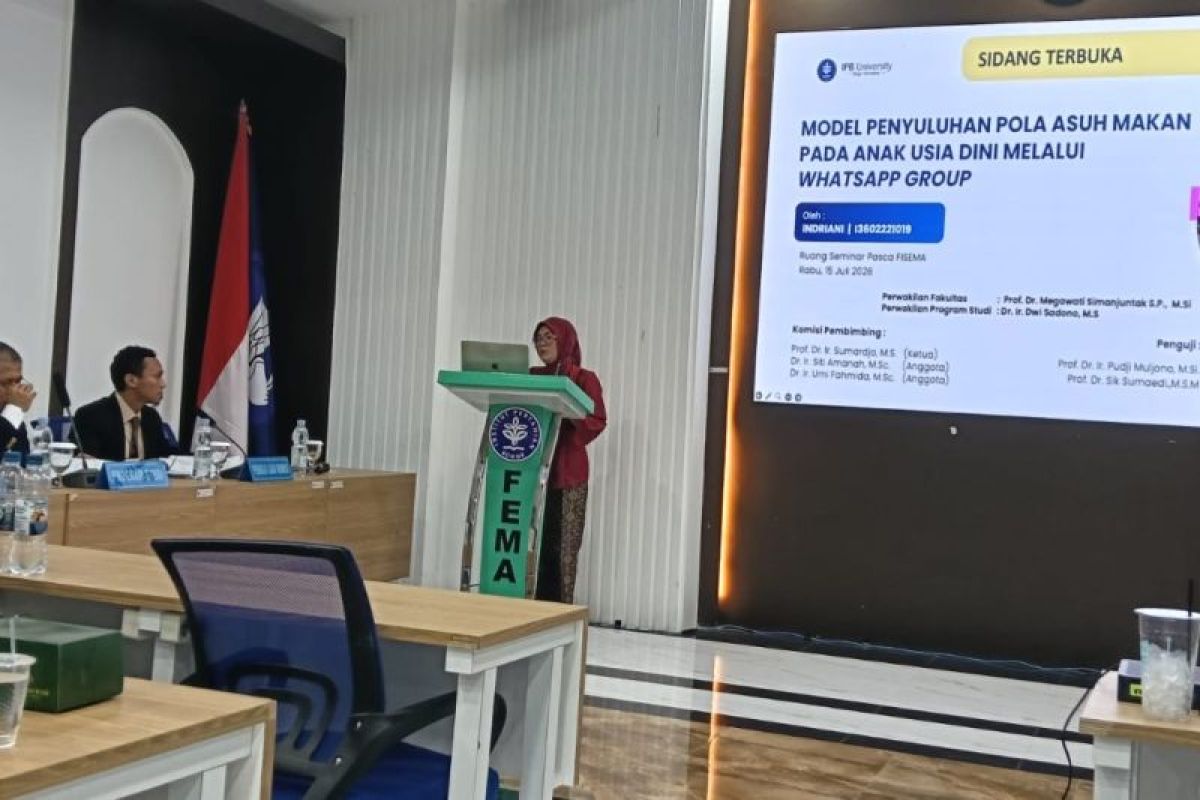
Efforts are needed to promote counselling that drives behavioural change in feeding practices for young children through the use of WhatsApp, the application most widely used by Indonesians.
Bandung (ANTARA) — Indriani, a journalist at the National News Agency (LKBN) ANTARA, has presented a dissertation concluding that WhatsApp Group-based counselling can be an effective medium for supporting changes in children’s feeding and care practices as part of stunting reduction efforts.
In her research, Indriani chose East Lombok Regency, West Nusa Tenggara (NTB), as the study site because the area still has a relatively high stunting prevalence, reaching 27.6 per cent according to the 2024 Indonesian Health Survey.
“The regency also has a strong commitment to tackling stunting, as evidenced by the introduction of several regional regulations (perda) aimed at addressing the issue,” Indriani said in a statement received in Bandung on Thursday.
Indriani passed her doctoral promotion examination held at the Faculty of Human Ecology (FEMA), IPB Dramaga Campus, Bogor Regency, West Java, on Wednesday (15/7).
According to her, East Lombok was judged to have a strong commitment to accelerating the reduction of stunting, making it a relevant location for testing a counselling model based on digital technology.
“Counselling efforts are needed to encourage behavioural change in the feeding and care of young children through the use of WhatsApp, the application most frequently used by Indonesians,” she said.
The research, carried out between July and October 2025, involved 128 respondents from six early childhood education centres (PAUD) in East Lombok using a quasi-experimental method.
The findings showed that message characteristics, environmental influence, and perceived ease of use of technology were important factors in driving behavioural change among childcare providers.
Based on these findings, Indriani formulated the SEMETON model, an abbreviation of Sosial (Social), Edukasi (Education), Mediasi Transmisi (Transmission Mediation), Orientasi (Orientation), and Norma (Norms). In the Sasak language, “semeton” also means sibling or relative.
Nevertheless, Indriani acknowledged that her research had limitations, as the intervention lasted only 10 weeks, which was insufficient to observe more significant behavioural change.
She suggested that similar research be conducted over a period of 12 to 16 weeks with follow-up measurements.
Indriani is an ANTARA journalist born in Tanjungkarang, Lampung, on 26 June 1986. She completed her undergraduate studies at Sultan Ageng Tirtayasa University and earned a master’s degree in communication from the University of Indonesia before pursuing her doctorate at IPB University.