
Anindya urges new trade corridors to navigate global geopolitics
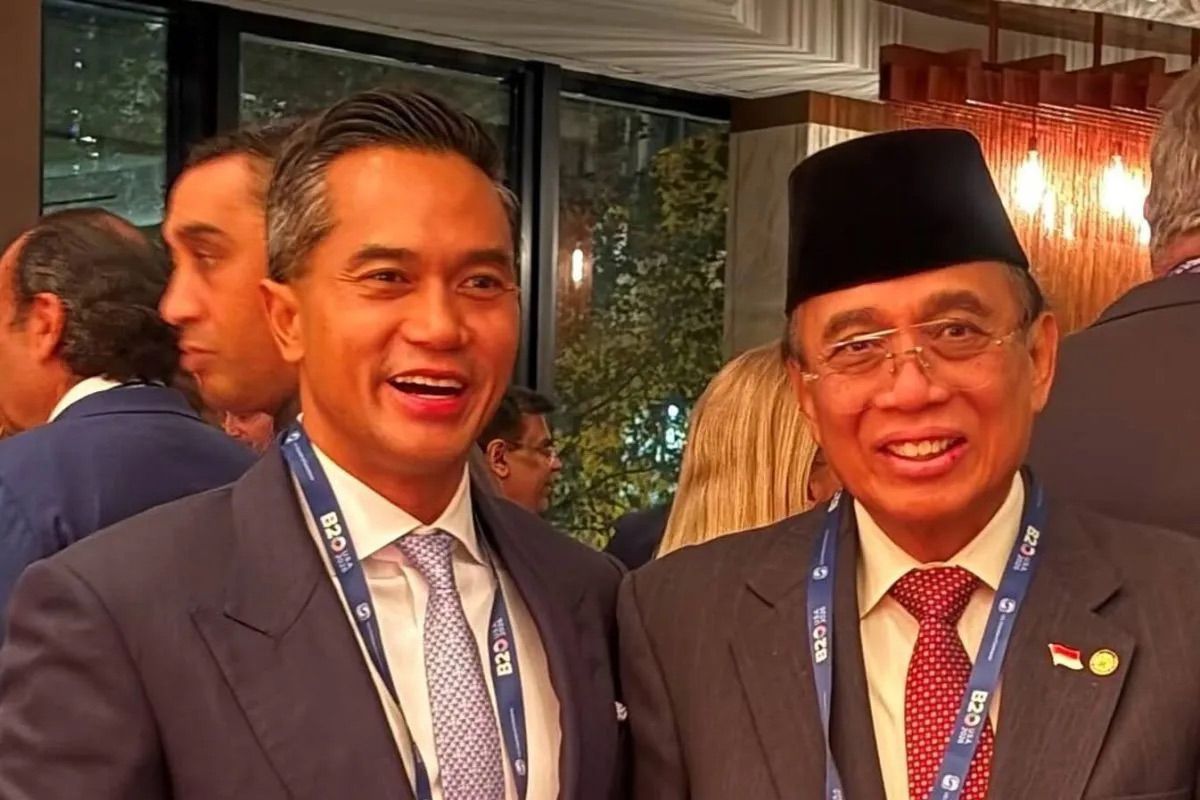
Jakarta (ANTARA) – Indonesian Chamber of Commerce and Industry (Kadin) chairman Anindya Novyan Bakrie says Indonesia needs to keep opening new trade and investment corridors to sustain economic growth amid global geopolitical shifts.
“Diversifying trade partners, downstreaming natural resources and strengthening investment collaboration are strategic steps to reinforce national economic resilience,” Anindya said in a statement in Jakarta on Thursday.
He made the remarks during a panel discussion, “Trade Shifting Global Markets”, at the B20 Stage at District Pier. The discussion was part of the events and meetings for participants in the B20 USA 2026 Summit at The Wharf in Washington, DC, on Tuesday (10 November).
Anindya, commonly known as Anin, said Indonesia had significant economic potential, with a population of 285 million and a median age of about 30.
This also presents a challenge: Indonesia must sustain economic growth and create jobs.
“Every year, we need to create at least four to five million jobs, because around four to five million babies are born annually,” he said.
Anin said China was currently Indonesia’s largest trading partner, with bilateral trade worth about US$160 billion. The United States was the second-largest partner, with trade worth around US$40 billion.
“Indonesia has recorded a trade surplus with both countries this year. One way to increase trade value is through downstream processing of natural resources,” he said.
He cited nickel, which was previously exported as ore, with export value of about US$3 billion. After being processed into stainless steel and battery materials, its export value rose to around US$33 billion.
“This is just one critical mineral. We also have bauxite, copper and various other commodities,” he said.
Nevertheless, he stressed the importance of diversifying trade and investment corridors so Indonesia would not depend on a limited number of trading partners. One approach is to strengthen trade agreements with various countries.
He noted that Indonesia signed the Indonesia-Canada Comprehensive Economic Partnership Agreement (ICA-CEPA) last year.
Indonesia and the European Union are also preparing to sign a comprehensive economic partnership agreement (IEU-CEPA), which is expected to be concluded by the end of November.
Anin said such trade agreements were important to provide stability and certainty for businesses engaged in cross-border trade and investment.
“We see this as an opportunity, but also as a strategic risk. Although we have natural resources at home, we still depend on other countries for technology and capital,” he said.
He said investment in Indonesia had reached about 40 per cent of gross domestic product (GDP), twice the G20-country average. This made Indonesia’s ability to build good relations with many countries increasingly important.
Anin also highlighted the growing opportunities for cross-border investment collaboration amid changes in global geopolitics. One example was an investment by an Indonesian company, together with Indonesia’s sovereign wealth fund, in oil and gas fields in the Permian Basin in West Texas, US.
According to Anin, the investment was one way to balance trade relations between Indonesia and the US, given Indonesia’s longstanding trade surplus with the country.
“Ten years ago, it might never have crossed anyone’s mind that an Indonesian company would invest in the Permian Basin in West Texas. But now Indonesia, through its sovereign wealth fund and our business group, is investing in those oil fields because we want to balance trade between the US and Indonesia,” he said.
Anin also cited opportunities for investment collaboration with Saudi Arabia through the development of an Indonesian Hajj Village in Mecca.
With around 100,000 Indonesian pilgrims travelling for the Hajj, development of the area was seen as an opportunity not only for cooperation but also for joint investment.
Anin said Indonesia needed to strengthen supply-chain resilience through investment collaboration with a range of international partners.
He said Indonesia now had opportunities to invest alongside G20 member countries, particularly in critical minerals and downstream processing.
He also urged national leaders to involve businesses from the outset in policy-making, especially on trade and investment.
In addition, Anin stressed the importance of including micro, small and medium-sized enterprises (MSMEs) in the global trade agenda. MSMEs, he said, were key drivers of the economy and had the potential to grow into larger businesses.
Source: jawawa.id (https://jawawa.id/newsitem/anindya-urges-new-trade-corridors-to-navigate-global-geopolitics-1794477313)
Originally published by Antara (Indonesian) (https://www.antaranews.com/berita/5849243/anindya-dorong-koridor-dagang-baru-hadapi-geopolitik-global), translated from Indonesian