
Anindya Bakrie Proposes Three Strategies to Strengthen Trade and Services Among BRICS Members
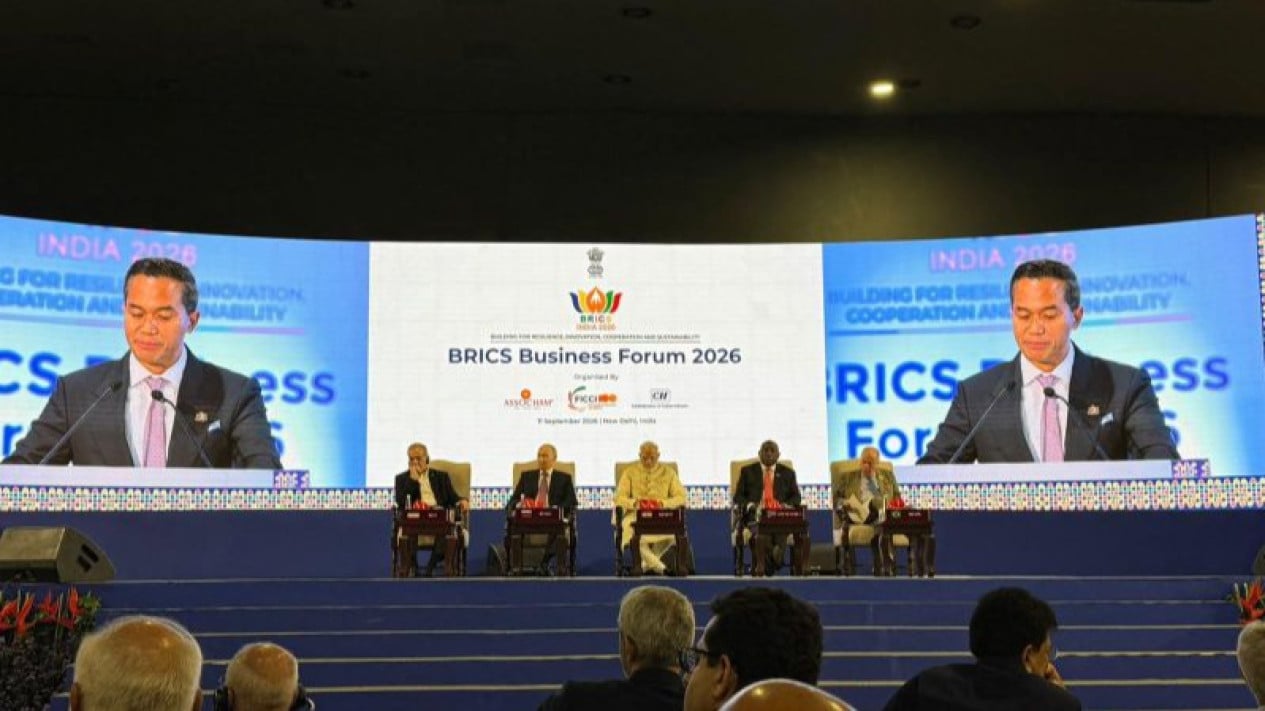
The Chairman of the Indonesian Chamber of Commerce and Industry (Kadin), Anindya Novyan Bakrie, has proposed three steps to strengthen trade and services among BRICS member nations.
These three steps include facilitating the mobility of companies and professionals, strengthening the connectivity of cross-border payment systems, and increasing investment in human resources and services trade infrastructure.
Anindya presented these proposals during the BRICS Business Forum 2026 held in New Delhi, India, on Friday, 11 September 2026.
In the first step, Anindya encouraged BRICS to ease the mobility of companies and professionals across borders. He suggested that the BRICS Business Council needs to identify concrete obstacles faced by the business community and subsequently present specific resolution proposals to the respective governments of each nation.
According to Anindlar, mutual recognition of certain professional qualifications and easier business travel could accelerate transactions and investments. He also proposed the development of a BRICS Business Travel Card to support the mobility of business actors.
The second step involves connecting and strengthening cross-border payment systems, particularly digital payments. Anindya noted that India, Brazil, and China have demonstrated the significant potential of real-time payments. The challenge lies in making these payment systems interconnected and efficient for cross-border transactions.
He added that BRICS should also expand the use of local currencies in appropriate trade transactions while maintaining data security and financial system stability. “Financial sovereignty does not have to mean financial isolation,” said Anindya, who also serves as the Chairman of the BRICS Business Council Indonesia, in a statement on Saturday, 12 September 2026.
These proposals align with discussions at the BRICS Business Forum regarding payment system connectivity, increasing transactions using local currencies, and developing fast, cheap, and secure cross-border payment mechanisms.
In the third step, Anindya urged BRICS nations to increase investment in human resources and the infrastructure that supports services trade. He stated that the business community needs to enhance worker training, build collaborations with universities, and assist companies—particularly micro, small, and medium enterprises (MSMEs)—in utilising Artificial Intelligence (AI).
Anindya proposed that every branch of the BRICS Business Council should have measurable targets regarding the number of workers trained each year.
Source: jawawa.id (https://jawawa.id/newsitem/anindya-bakrie-proposes-three-strategies-to-strengthen-trade-and-services-among-brics-members-1789214057)
Originally published by VIVA.co.id (https://www.viva.co.id/bisnis/1928100-anindya-bakrie-kasih-3-strategi-perkuat-perdagangan-dan-jasa-anggota-brics), translated from Indonesian