
Anggrek Train vs KRL Collision: Police Cite SOP Violations During Emergency
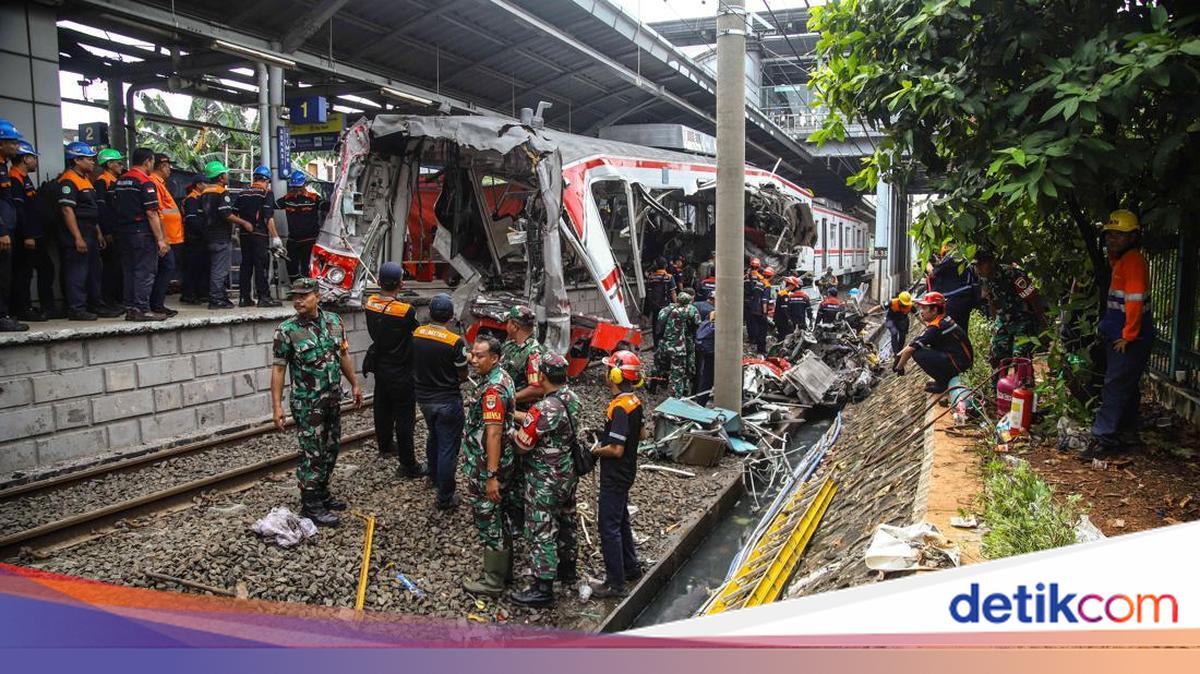
Police have named the driver of the Anggrek train (formerly Argo Bromo Anggrek), identified as AN, as a suspect in the fatal collision with a KRL commuter train at Bekasi Timur Station. Police stated that AN hesitated to apply the emergency brake due to fears that the Anggrek train might derail, despite the existence of Standard Operating Procedures (SOP).
This was disclosed by AKP Muhammad Rizka, Head of Unit 1, Sub-division 1 of the Criminal Investigation Unit, when asked when the driver began using the emergency brake before the collision. Rizka noted that expert calculations indicate the train could have come to a complete stop before hitting the KRL if the emergency brake had been applied sooner.
“The total distance visible was approximately 1 kilometre. Ideally, according to railway experts using the Minden theory, braking was possible. The train could have stopped completely within 600 metres based on the data logger records,” Rizka stated on Wednesday (30/9/2026).
He added that AN should have made the decision to apply the emergency brake much earlier. He noted that AN only applied the emergency brake approximately 263 metres from the accident site because of concerns regarding a potential derailment.
“He claimed that if we perform an emergency brake or sudden braking, it could cause the carriages to [derail]. However, this is refuted by railway experts through the Minden theory formula,” he said.
Regarding the signalling, Rizka stated that the signals were clear. He noted that the repeater or auxiliary signals should have mirrored the main signal, which commanded a stop.
“The signals were all clear and safe. Because they are mirrored, the main signal and the repeater signal are identical. If the previous signal was present, the repeater would also command a stop,” he explained.
He emphasised that there is an SOP regarding the emergency brake, stating that AN should have applied it despite any hesitation.
“It is stipulated in Railway Service Regulation 19, Article 50. He claimed he was hesitant, saying, ‘I was unsure if it was red or not.’ Article 50 states that if there is doubt, one must take the most severe action: stop. Then confirm. Even if they claim a lack of training, it is clearly stated in the SOP and Article 50 of Service Regulation number 19,” he said.
KNKT Report
For context, the accident occurred at Bekasi Timur Station on 27 April 2026, at 20:52:12 WIB. The collision resulted in 16 deaths and 107 injuries.
According to the National Transportation Safety Committee (KNKT) report, two separate incidents occurred on that night. First, a collision occurred between a KRL train from Tambun Station towards Bekasi Timur and an electric taxi at a level crossing on Jalan Ampera, involving train KA 5181B.
Second, the collision between the Anggrek train and a KRL train heading towards Tambun, which was stationary at Bekasi Timur Station, resulted in 16 fatalities and 107 injuries. This involved the Anggrek train (KA 4B) and KRL train KA 5568A.
The KNKT identified six contributing factors to the accident, noting that these factors are not intended to assign administrative, civil, or criminal liability.
The KNKT highlighted communication chaos on that night, which began with the electric taxi being struck by the KRL train. The KRL driver contacted the South PPKP via an individual call to report the accident at JPL 8K6 Jalan Ampera. The KNKT noted that neither the driver involved in the taxi collision nor the driver held at Bekasi Timur pressed the emergency call button.
Transcripts from the KNKT report also show repetitive conversations between the driver and the South PPKP, a process that lasted 3 minutes and 20 seconds. This communication breakdown meant that the South and East PPKP did not receive accurate situational information.
Furthermore, the KNKT revealed that numerous scratches on the Anggrek locomotive’s windscreen caused visibility issues for the driver, creating excessive light glare. The KNKT also noted that the visibility distance for signal block B104, located after a curve, did not meet the minimum 600-metre requirement stipulated in Ministry of Transportation Regulation Number 44 of 2018.
The KNKT found that the auxiliary signal UB104 used white LED bulbs arranged in a pattern that made it difficult to distinguish from surrounding residential lighting due to similar light intensity and colour.
The KNKT noted that the driver performed several braking stages, from service braking to emergency braking. The driver maintained full service braking from 611 metres to 322 metres before the impact, after seeing the B104 signal turn red. The emergency brake phase lasted 25 seconds, from 20:51:56 to 20:52:21, being activated approximately 275 metres before the collision. The driver delayed the emergency brake after passing a curve to prevent the train from overturning at high speed. Additionally, the KNKT found no specific procedure for emergency braking at high speeds on curved tracks, and noted the driver had not received training for such scenarios.