
Andy Burnham Leads Britain, These Are the Five Major Challenges He Faces
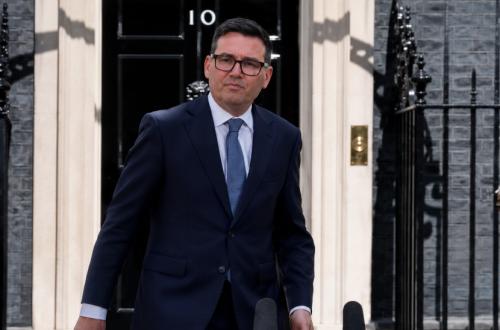
Andy Burnham entered 10 Downing Street carrying a reputation as a champion of northern England, a manager of metropolitan government, and a Labour politician who twice failed to win his party’s leadership. Now, the reputation built over nearly a decade in Greater Manchester will be tested on a far larger scale.
Burnham officially became British Prime Minister on Monday, 20 July 2026. The UK government noted that he had previously been elected Labour Party leader on 16 July 2026, after returning to Parliament through the Makerfield by-election in June. He replaced Keir Starmer and became the seventh prime minister to lead Britain in roughly a decade.
In his first speech in Downing Street, Burnham promised sweeping changes to Britain’s political and economic model. He spoke of strengthening the regions, reindustrialisation, building council housing, public control over essential services, and rapid action on the cost-of-living and homelessness crises.
“We must make this moment a circuit-breaker for Britain,” Burnham said in his first speech as prime minister on Monday, 20 July 2026. He promised a new political and economic model and what he called the biggest change in four decades, as reported by several European media outlets.
However, those great hopes meet hard constraints. Britain faces long-stalled economic growth, high public debt, interest costs eroding the budget, millions on healthcare waiting lists, cost-of-living pressures, the need to increase defence spending, and an electoral threat from Reform UK.
Burnham has also never led the Labour Party through a national general election. His path to becoming prime minister came through a combination of a by-election victory, a leadership change within the incumbent party, and Labour’s majority in the House of Commons.
From Westminster to Manchester
Burnham was born in the Liverpool area and grew up between Liverpool and Manchester. His father worked as a telephone technician, while his mother was a receptionist. He came from a working-class Catholic family and was among the first generation in his family to pursue higher education. Burnham went on to study English literature at the University of Cambridge.
After graduating, he briefly worked as a journalist for a trade magazine before becoming a researcher and political adviser for the Labour Party. His parliamentary career began when he was elected MP for Leigh in June 2001.
Burnham subsequently held a number of government positions. He served as a minister of state at the Department of Health from May 2006 to June 2007, Chief Secretary to the Treasury from June 2007 to January 2008, Secretary of State for Culture, Media and Sport from January 2008 to June 2009, and Health Secretary from June 2009 to May 2010.
That experience means Burnham is not entirely unfamiliar with fiscal or health matters. However, his tenure in each role was relatively brief. He had also been away from central government for nearly a decade when he returned to Parliament in 2026.
After Labour’s defeat in the 2010 general election, Burnham twice ran for the party leadership, in 2010 and 2015. Both bids ended in defeat. He then left Parliament in 2017 to contest the Greater Manchester mayoral election.
That decision initially looked like a step away from the centre of power. It was precisely from Manchester that Burnham rebuilt his political identity and gained the base that would eventually carry him to Downing Street.
Hillsborough and the Politics of Justice
One of the most defining experiences of Burnham’s career relates to the Hillsborough tragedy of 1989, which killed 97 Liverpool supporters.
When attending the tragedy’s memorial in 2009, Burnham came under direct pressure from victims’ families who had spent years fighting the false narrative that football supporters’ behaviour was the main cause of the disaster.
Burnham subsequently supported the release of government documents, new inquiries, a formal apology, and efforts to establish a duty of candour for public officials when a tragedy is investigated. The AP described the Hillsborough affair as an experience that helped shape Burnham’s image as a politician who sided with victims’ families when facing the institutions of the state.
That track record matters for his political image. Burnham is known not only through the offices he has held, but also through his ability to turn the suffering of particular groups into a national issue.
Yet as prime minister, moral solidarity alone is not enough. He must now show that political empathy can be translated into budget decisions, regulation, and measurable public services.