
Andalas University Trains Coffee Farmers in Post-Harvest Processing to Improve Quality
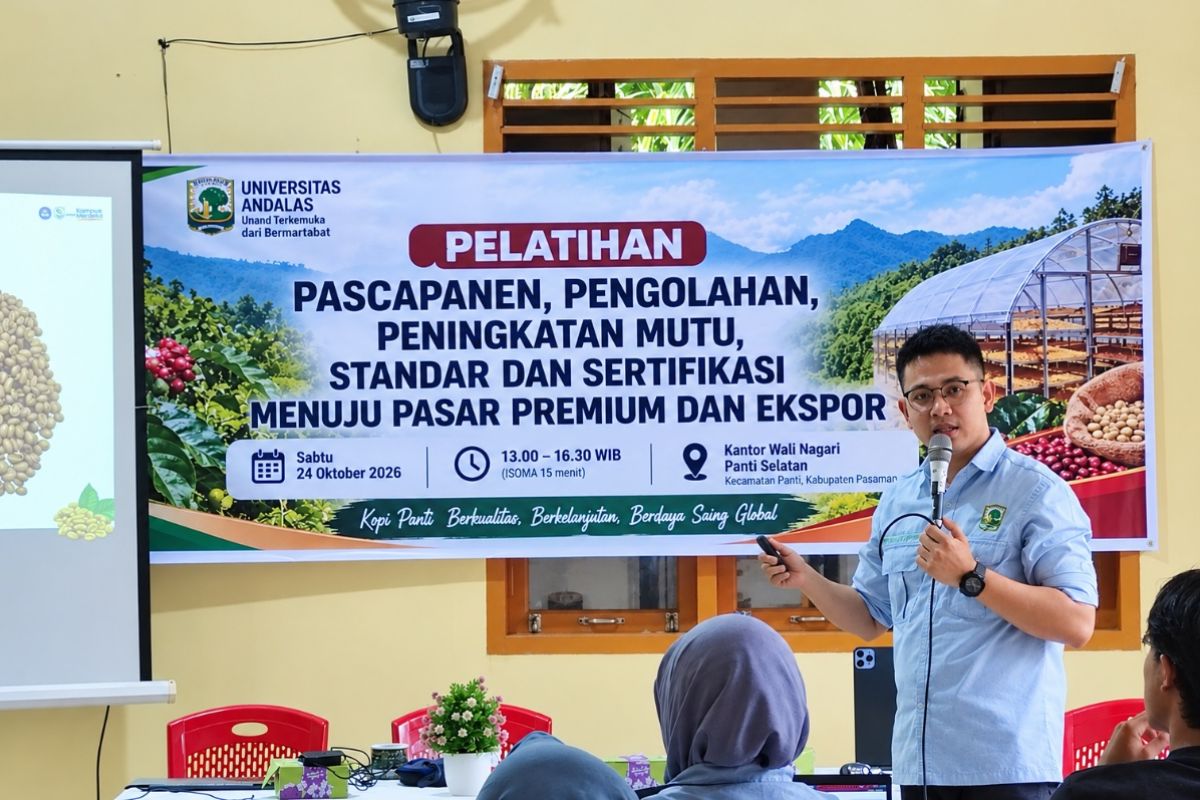
Padang (ANTARA) – The Nagari Panti Selatan village development programme team from Andalas University’s Institute for Research and Community Service (LPPM) has trained farmers in Pasaman Regency, West Sumatra, in post-harvest coffee processing to improve quality and add value to their coffee.
“The training is expected to help farmers apply the right techniques to process coffee after harvesting, resulting in better-quality products with a higher selling price,” Khairil Agustoria, MEng, coordinator of the Andalas University community service team for the Nagari Panti Selatan development area, said in a statement received in Padang on Thursday.
He said the training aimed to strengthen farmers’ capacity to manage their harvests and produce quality coffee beans that meet market standards.
The sessions covered several topics, including selective picking of ripe red cherries and sorting, post-harvest handling, export coffee quality, coffee grade calculations, and the use of a dome dryer—a dome-shaped drying device designed in collaboration with the community service team.
The training introduced farmers to the proper stages of coffee handling, from selecting cherries in the field to drying the beans to meet market standards.
He cited West Sumatra Deputy Governor Vasko Ruseimy’s remarks on the importance of transforming agriculture in the province by paying attention to the entire post-harvest process, from harvesting methods to the use of appropriate technology.
“Paying attention to post-harvest practices, from how the crop is harvested to its treatment using appropriate technology, is itself one form of transformation,” he said.
He said coffee quality was determined by how the fruit was handled from the moment it was picked. Proper selective picking of ripe red cherries and sorting are therefore the first steps in determining the price and competitiveness of farmers’ coffee in domestic and export markets.
The team is also seeking to design coffee-farming machinery suited to farmers’ needs. The technology is being developed not only with advanced sensors and electronic devices in mind, but also for ease of operation, so that local people can use and maintain it themselves.
He added that transforming local coffee production, particularly in Nagari Panti Selatan, still faced a number of fundamental challenges that needed to be addressed gradually with support from various parties.
“This is not an easy task. The problems we face today cannot all be solved by tomorrow, but at least we can start tackling them step by step. If we are willing to make the effort, we can do it,” he said.
He stressed that the community service team was committed to supporting the people of Nagari Panti Selatan over the long term, not only through training but also by providing technology suited to local farmers’ needs.
Yulinda, PhD, another member of the team and a training speaker, emphasised the importance of calculating farm-business costs so that farmers could understand their actual profits and make sound business decisions.
She said good record-keeping and cost analysis were necessary to help farmers manage their operations in a measurable way and earn a fair return from farming.
Through the training, the LPPM Andalas University team hopes coffee farmers in Nagari Panti Selatan will adopt good post-harvest practices, produce coffee of export quality and increase their income sustainably.
It also hopes collaboration between the university, the regional government and the nagari government will continue to support the development of agriculture in West Sumatra.
The training was led by Dr Nofialdi and attended by West Sumatra Provincial Forestry Agency head Ferdinal Asmin, the heads of Nagari Panti Selatan and Nagari Panti Timur, coffee-farming residents and the LPPM Andalas University village development team.