
Ancient Records Reveal Islam Was Known in Srivijaya Since the 7th Century
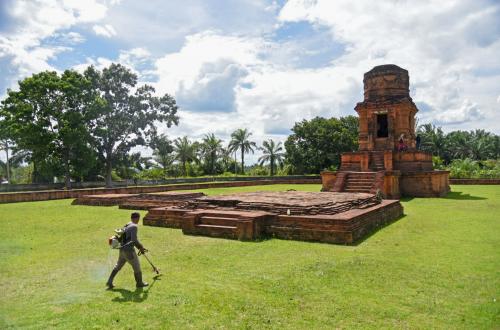
As a centre of Buddhist scholarship in Southeast Asia, Srivijaya was also known as a kingdom open to various nations. Evidence shows that the ports of Srivijaya were frequently visited by Arab and Persian ships, leading to early interactions between the local community and Islam. Through the arrival of Arab and Persian traders and sailors, the inhabitants of this maritime kingdom began to learn about Islamic teachings, with some records even hinting at the presence of native Muslims within the Srivijaya realm.
The book ‘Jaringan Ulama Timur Tengah dan Kepulauan Nusantara Abad XVII-XVIII’ notes that although Srivijaya was renowned as a prominent centre of Buddhist learning, it was a cosmopolitan kingdom. The Chinese monk and traveller I-Tsing provided information that he boarded Arab and Persian ships to reach the port of Srivijaya. Yuantchao, in the ‘Tcheng-yuan-sin-ting-che-kiao-mou-lou’ written in the early 9th century, stated that in the year 99 H (717 AD), around 35 Persian ships arrived in Palembang. Following unrest in Canton, many Arab and Persian Muslims were expelled and sought safe haven in Palembang.
Based on I-Tsing’s records, Professor Azyumardi Azra explained in the book ‘Jaringan Ulama Timur Tengah dan Kepulauan Nusantara Abad XVII-XVIII’ that there are indications the people of Srivijaya interacted with Muslims from the Middle East. To a certain extent, they also became familiar with some Islamic teachings. Furthermore, al-Ramhurmuzi’s ‘Aja’ib al-Hind’ suggests the existence of a number of native Muslims among the population of Srivijaya. This account appears to be corroborated by Chau Ju-Kua, who stated that a large number of the inhabitants of that country (San-fo-chi) bore the initial name ‘P’u’. As explained by Hirth and Rockhill, the term ‘P’u’ derives from ‘Bu’, an abbreviation of ‘Abu’ (father), which is commonly found in many Muslim personal names.