
Analyst: Market undergoing 'repricing' as investors adjust to domestic risks
In the current climate, investors are not only looking at economic growth potential but are also assessing the extent of the risks they must bear.
Capital market observer and founder of Republik Investor, Hendra Warduna, stated that the pressure on Indonesia’s financial markets indicates a repricing process, where global investors are readjusting their risk assessments regarding the Indonesian market. As the Rupiah weakens, the Jakarta Composite Index (IHSG) continues to correct, and capital outflows persist; essentially, the market is demanding a higher risk premium to invest in Indonesia, according to him.
“In these conditions, investors are not just looking at economic growth potential, but are also assessing how much risk they must bear,” Hendra said when contacted in Jakarta on Monday. The primary concern for the market currently is not merely slowing economic growth, but rather the increasing uncertainty regarding policy direction, fiscal sustainability, the stability of the Rupiah exchange rate, and the government’s ability to maintain market confidence.
“When uncertainty increases, investors tend to demand compensation in the form of cheaper valuations before re-entering the market,” Hendra noted. While global factors were the primary drivers of the Indonesian market’s movement a few years ago, he believes domestic factors now play an increasingly significant role. On the other hand, he did not deny that high US interest rates, the strengthening US Dollar, and global geopolitical tensions continue to exert pressure on all emerging markets.
“However, what differentiates the performance of each country is their domestic condition,” Hendra explained. He noted that investors are currently comparing various emerging markets, selecting countries deemed to have better policy certainty, lower fiscal risk, and more predictable development trajectories. “Therefore, when global pressure coincides with questions regarding domestic policy, the impact on Indonesia becomes greater than that on other countries with similar fundamentals but lower perceived risk.”
Regarding recent issues—ranging from rating outlooks and fiscal policy to Danantara and various regulatory changes—Hendra believes the most influential factor on investor perception is the level of policy certainty and consistency. “Investors can essentially accept new policies as long as the direction, objectives, and governance are clear,” he said. He explained that the market tends to respond negatively when there is ambiguity regarding long-term fiscal implications, state asset management mechanisms, potential conflicts of interest, or regulatory changes perceived as too rapid or lacking effective communication.
“In the investment world, uncertainty is often more feared than bad news itself. Investors can calculate risk if the data is clear, but they tend to reduce exposure if it is difficult to predict the future direction of policy.”
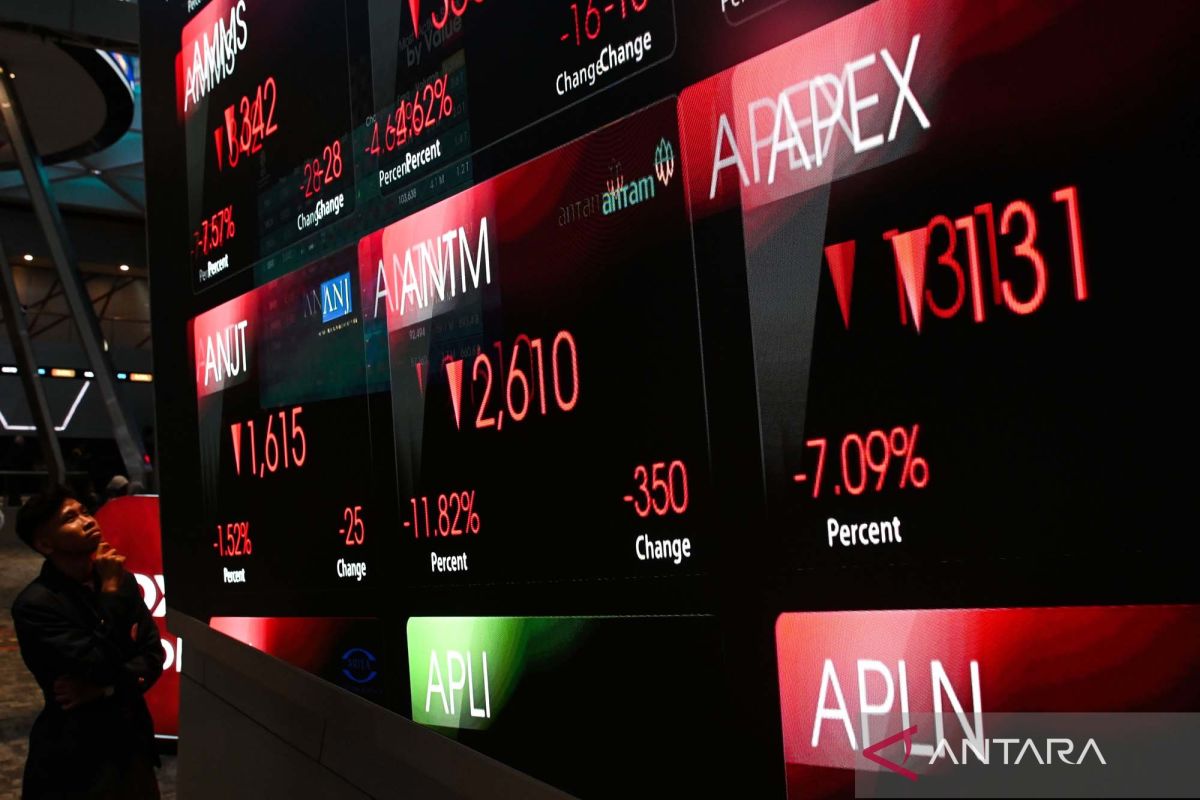
According to trading data from the Indonesia Stock Exchange (BEI) on Monday (08/06) at 10:30 WIB, the IHSG was recorded weakening by 220.47 points or 3.94 per cent to 5,374.18, marking the fourth consecutive day of decline. Previously, on Wednesday (03/06), the IHSG closed down 254.36 points or 4.11 per cent to 5,941.07. The correction continued with a 3.48 per cent drop to 5,734.25 during the first session on Thursday (04/06), before slightly improving to close down 1.70 per cent at 5,839.78. The decline continued on Friday (05/06), dropping by 147.62 points or 2.53 per cent to 5,692.15 in the first session, and eventually closing down 245.01 points or 4.20 per cent at 5,594.77.