
Analyst: Increasing Domestic Content is Key to Mineral Downstreaming in the Electric Vehicle Industry
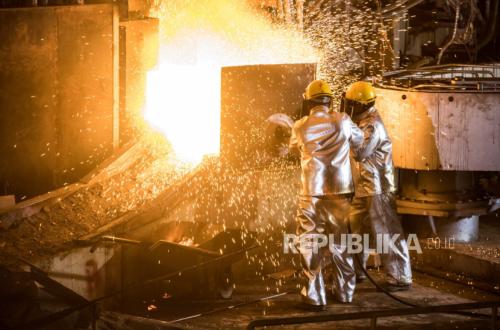
The development of electric vehicles (EVs) in Indonesia is considered necessary to be continuously strengthened to provide more optimal economic impacts. One aspect that is a concern is the low domestic content level (TKDN), which is still seen as a challenge in building the national electric vehicle industry.
Fahmy Radhi, an Energy Economics Observer at Universitas Gadjah Mada (UGM), stated that the dominance of imported products in the electric vehicle market could potentially make Indonesia merely a market for global producers.
According to him, this condition indicates that the development of the national electric vehicle industry has not yet been fully integrated from upstream to downstream.
He assessed that the government’s mineral downstreaming efforts, which have been ongoing, need to be continuously strengthened to build a comprehensive electric vehicle industry ecosystem domestically.
“So far, the downstreaming that has been carried out is more accurately called smelterisation. First- and second-derivative products are still exported, so it has not encouraged the formation of an electric vehicle industry ecosystem domestically,” said Fahmy on Sunday (30/3).
Fahmy explained that mineral downstreaming should not stop at the initial processing stage but continue until producing high value-added products that can be used in the electric vehicle industry.
With integrated downstreaming, Indonesia not only gains added value from mineral processing but also builds an industry chain from the upstream sector to electric vehicle production.
However, according to him, the policy on importing completely built-up (CBU) electric vehicles is not yet fully aligned with those efforts.
He noted that most electric vehicles entering Indonesia still come from imports without adequate local content. This situation risks making Indonesia just a market for producers from countries like China, South Korea, and Japan.
“The policy at that time required the factory to be in Indonesia, then there must be gradual local content from 40 to 80 percent. Well, then that policy was changed so it does not support the formation of an industrialisation ecosystem,” said Fahmy.
He added that the low TKDN causes the economic impact from the electric vehicle industry to be not yet optimal, both for supporting industries, labour absorption, and increasing the added value of domestic minerals.
“TKDN is very important. So we should not only be a market but also participate in producing independently,” he emphasised.
According to Fahmy, strengthening TKDN can be done through cooperation with foreign investors accompanied by technology transfer processes.
With that approach, Indonesia can build the electric vehicle industry capacity gradually until it is able to produce components and electric vehicles independently.
“Perhaps in the first five years, we cooperate with companies from China, Korea, and Japan to carry out technology transfer. Then in the next five to ten years, Indonesia can produce some components and electric cars itself,” he said.