
Anak Krakatau Surfaces From the Sea Nearly 100 Years Ago — Here Is Its Journey
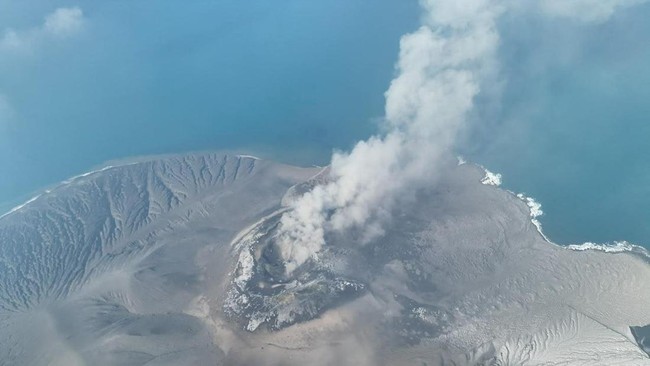
Jakarta, CNBC Indonesia — Mount Anak Krakatau in Lampung has experienced a prolonged or continuous series of eruptions from Friday night (4/9/2026) until Sunday night (6/9/2026). Following that period, eruptive activity returned to the characteristics of mild eruptions that have long been typical of Anak Krakatau.
According to the Geological Agency of the Ministry of Energy and Mineral Resources (ESDM), at 23:07 WIB on 4 September 2026, a continuous eruption occurred accompanied by sustained lava fountains, rumbling sounds and loud blasts. The eruption ceased at 00:04 WIB on 6 September 2026.
The booming sounds heard in several areas of West Java were linked to low-frequency acoustic waves from the eruption that can travel great distances under certain atmospheric conditions.
“Volcanic ash has also been observed spreading towards Banten, parts of West Java and DKI Jakarta, as well as Lampung and Bengkulu. The direction of ash dispersal may change depending on wind conditions,” the Geological Agency wrote on its Instagram account @badan.geologi, quoted on Monday (7/9/2026).
So, what is the history of Mount Anak Krakatau?
Mount Anak Krakatau is a volcano that continues to grow within the Krakatau caldera.
The Geological Agency records its history as follows:
20 January 1929: Anak Krakatau first emerged above sea level
October 1952: A new cone formed within the Somma crater
22 December 2018: A major eruption caused a landslide and tsunami
2023: A series of small-scale eruptions continued until 16 December 2023
2 July 2026: Anak Krakatau erupted again, reaching Level III (Alert) status
4 September 2026: Intensive eruption with lava fountains, rumbling sounds and loud blasts.
On 4–5 September 2026, booming sounds and vibrating glass doors were reported in several areas of West Java. The timing coincided with Anak Krakatau’s eruptions and signals at monitoring stations in West Java, strongly supporting the conclusion that the phenomenon originated from the volcano’s acoustic waves.
Currently, Anak Krakatau’s volcanic ash is being carried by the wind towards Bengkulu, Lampung, Banten, DKI Jakarta and parts of West Java.
Anak Krakatau Will Continue to Erupt
Volcanology expert Surono explained that Mount Anak Krakatau naturally still has the potential for follow-up eruptions. This phenomenon is part of the volcano’s physical growth phase following the major landslide in 2018, as it rebuilds a complete volcanic structure.
Surono, affectionately known as Mbah Rono, explained that as a young volcano, Anak Krakatau needs time to rebuild its body into a complete form. He stressed that the accumulated magma pressure requires the volcano to release energy towards the surface.
“The most likely danger is that the potential for landslides still exists. But not in the near future — the last one was only in 2018. It takes time to rebuild a complete body. That’s why it will erupt frequently and so on,” he told CNBC Indonesia on Monday (7/9/2026).
Mbah Rono said the frequency of intensive eruptions is a natural way for the volcano to build a taller and larger peak structure. However, this condition also enlarges the magma chamber, which increases the potential strength of future eruptions.
“The bigger Anak Krakatau gets, the bigger its magma kitchen — its magmatic chamber — automatically becomes. And the bigger it is, the greater the potential eruption will be,” he added.
The physical formation of Anak Krakatau involves the expulsion of new material, most of which will fall around the volcano’s peak and body. Although heavy material remains in the crater area, the impact most felt by surrounding regions is the dispersal of fine ash carried by the wind’s direction and speed.
“It has to release new material, which falls around its body, so Anak Krakatau becomes bigger and taller. The fine ash that spreads high is a consequence of every volcanic eruption like this,” he explained.
Mbah Rono considered the eruption risk a major public concern because of the volcano’s geographical proximity to nationally strategic vital facilities such as Soekarno-Hatta Airport and Raden Inten Airport. He predicted that operational disruptions to air transport due to volcanic ash exposure could well recur in the future.
“Now Soekarno-Hatta has been affected, and it will certainly be affected again in the future — that becomes a problem. I’m not trying to scare anyone, but something that has been affected now has the potential to be affected again,” he added.
Regarding the simultaneous increase in volcanic activity at other mountains such as Semeru, Merapi and Mount Ibu, he confirmed that these phenomena are driven by separate magma chambers. The string of eruptions occurring concurrently across different parts of Indonesia is purely coincidental and does not stem from a single shared geological system.
“Actually it’s quite ordinary because we have so many volcanoes — it’s just a coincidence they happened at the same time. But fundamentally, they each have different magma sources and different pressure sources,” he explained.
The government has in fact provided disaster-prone zone maps as a reference for regional governments in spatial planning. Mbah Rono emphasised that regional governments have full authority to regulate community activities on the ground based on technical recommendations provided by geological experts.
“Now it’s up to the regional governments to respond to reports on the volcano’s activity, based on the recommendations given by the Centre for Volcanology and Geological Hazard Mitigation,” he concluded.
Source: jawawa.id (https://jawawa.id/newsitem/anak-krakatau-surfaces-from-the-sea-nearly-100-years-ago-here-is-its-journey-1788781899)
Originally published by CNBC Indonesia (https://www.cnbcindonesia.com/news/20260907172340-4-765943/anak-krakatau-muncul-di-permukaan-laut-hampir-100-tahun-ini-jejaknya), translated from Indonesian