
Anak Krakatau eruption suspected to have caused loud booms across three provinces
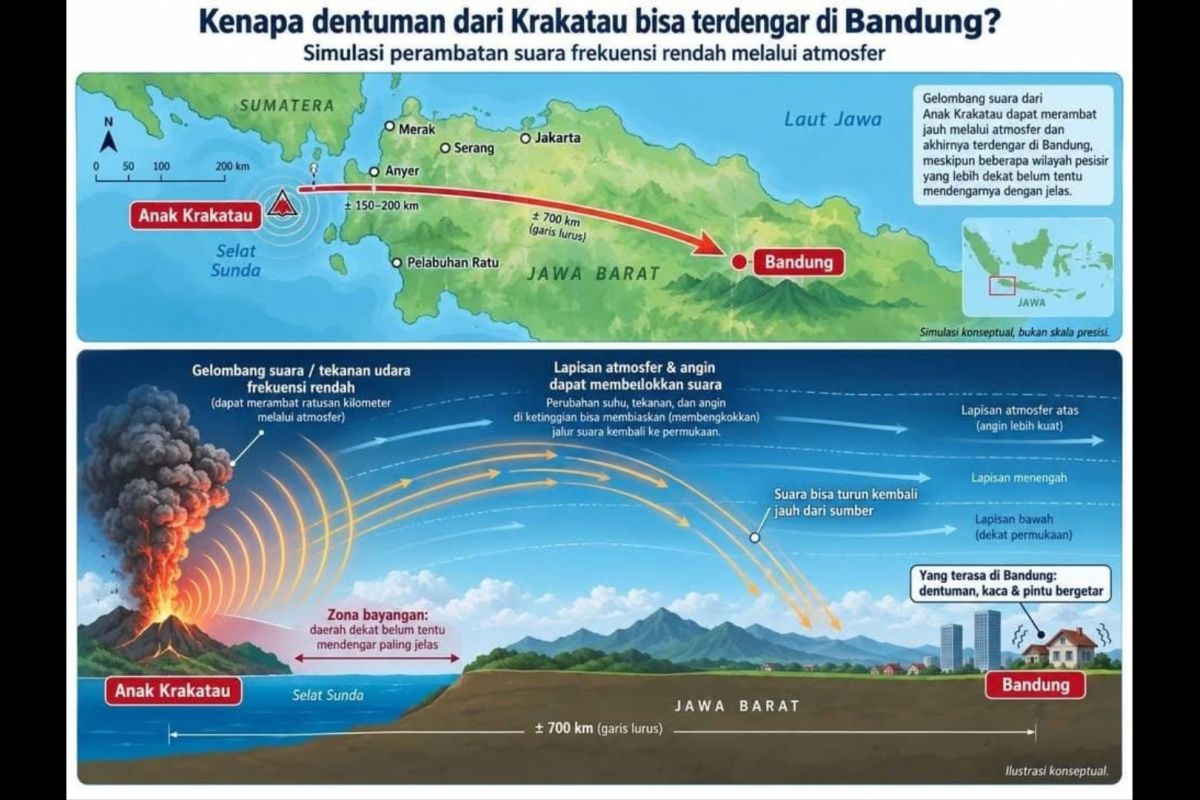
The eruption of Mount Anak Krakatau in the Sunda Strait, which occurred continuously from 23:07 WIB on 5 September 2026 until 04:40 WIB, is suspected of causing loud booms heard by residents across three provinces.
Lana Saria, Head of the Geological Agency of the Ministry of Energy and Mineral Resources (ESDM), stated that reports of booms and vibrations from residents in West Java (including Greater Bandung), Banten, and Lampung are likely linked to the eruptive activity monitored by the Centre for Volcanology and Geological Hazard Mitigation (PVMBG).
“Continuous eruptions lasting several hours associated with lava fountain phenomena are common. The booms and vibrations felt by the public are strongly believed to be related to the eruptive activity of Mount Anak Krakatau during that same period,” Lana said in Bandung on Saturday.
According to Lana, even though the distance from Mount Anak Krakatau is significant, the sound could be heard as far as Greater Bandung due to the rapid expansion of gas release, as well as the friction and turbulence of high-speed lava flows within the conduit.
“Sound waves from Anak Krakatau can travel far through the atmosphere and eventually be heard in Bandung, even though some closer coastal areas may not necessarily hear them clearly,” she said. “The sound can descend far from the source. What was felt in Bandung, which is 700 km away (in a straight line), was a boom, with windows and doors vibrating.”
Lana revealed that based on PVMBG monitoring, the eruption was accompanied by a rumbling sound heard as far as the Anak Krakatau Volcano Observation Post in Pasauran, Banten. Visual observations showed continuous bright red eruptions. While the height of the eruption column has not been confirmed, the character of the eruption resembles a lava fountain phenomenon that can produce lava flows.
Lana Saria urged the public to remain calm and not panic regarding the activity of Mount Anak Krakatau, and to avoid believing unverified information regarding tsunami potential.
“We urge the public to remain calm and not panic. Based on evaluations to date, the growth of the body of Mount Anak Krakatau, which reformed after the 22 December 2018 eruption, is still relatively small and does not have the potential to collapse on a scale that could trigger a tsunami,” said Lana.
Ash dispersal may also affect visibility and health. “We ask the public to remain vigilant regarding the potential dangers of the eruption, including volcanic ash dispersal, but there is no need to panic. If ashfall occurs, residents in affected areas are advised to use respiratory protection and follow official directions from the Geological Agency, PVMBG, and local Disaster Management Agencies (BPBD),” she added.
For safety, the public, visitors, tourists, and hikers are prohibited from entering or conducting activities within a 3-kilometre radius of the centre of Mount Anak Krakatau’s activity. “The 3-kilometre radius must be cleared of all activity. This regulation must be obeyed due to the potential for lava flows and the ejection of incandescent material,” she said.
Lana also advised the public to refer to official information and not to spread unverified news to prevent misunderstanding and unrest. The Ministry of Energy and Mineral Resources, through PVMBG, will continue to monitor and evaluate the activity of Mount Anak Krakatau. Official information can be obtained through the PVMBG or the Krakatau Volcano Observation Post, and activity can also be monitored via the MAGMA Indonesia application and the official websites and social media of the Ministry of Energy and Mineral Resources, the Geological Agency, or PVMBG.
Source: jawawa.id (https://jawawa.id/newsitem/anak-krakatau-eruption-suspected-to-have-caused-loud-booms-across-three-provinces-1788591561)
Originally published by Antara (Indonesian) (https://www.antaranews.com/berita/5727253/erupsi-gunung-anak-krakatau-diduga-sebabkan-dentuman-tiga-provinsi), translated from Indonesian