
Anak Krakatau Eruption in Numbers
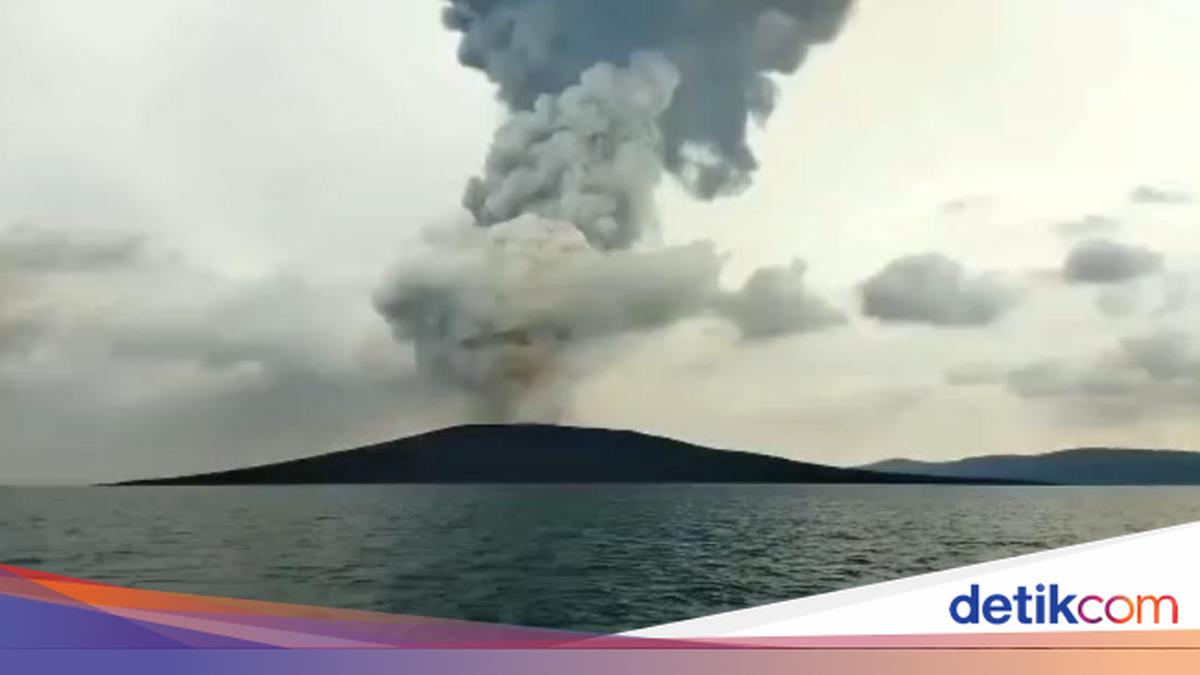
Mount Anak Krakatau has erupted, sending volcanic ash towards Jakarta and surrounding areas. The eruption has been ongoing since Friday (4/9).
The eruption produced rumbling and tremors. Residents nearby felt the vibrations strongly, with doors and windows shaking on their own.
In a video recording shared by the Banten Regional Disaster Management Agency (BPBD) on Saturday (5/9/2026), the eruption of Anak Krakatau shook the doors of residents’ homes. The strong vibrations caused the doors to rattle loudly.
BPBD Banten reported that the tremors occurred several times starting at 01.00 WIB. At 07.00 WIB, residents also reported strong tremors due to the Anak Krakatau eruption.
From Saturday (5/9) until Sunday (6/9) morning, Mount Anak Krakatau continued to erupt with level III or alert status. From the Pasauran Observation Post, explosions and rumbling were heard, and officers also reported one eruption earthquake with an amplitude of 70 mm.
“This type of eruption condition is interpreted as a ‘lava fountain’. Explosions and rumbling were heard from the GAK Pasauran Post,” read a statement from the Magma Indonesia website of the Ministry of Energy and Mineral Resources on Sunday (6/9/2026) at 00.31 WIB.
The eruption of the volcano located in the Sunda Strait has affected Lampung, Banten, Jakarta and West Java. A number of flights had to be cancelled in an effort to prioritise passenger safety.
Volcanic ash spread to five provinces. Head of the Geological Agency of the Ministry of Energy and Mineral Resources, Lana Saria, said volcanic ash from the Anak Krakatau eruption spread to five provinces: Banten, parts of West Java, DKI Jakarta, Lampung and Bengkulu.
“Based on combined information from the eruption and VONA (Volcano Observatory Notice for Aviation) from PVMBG through Magma Indonesia, information from the Darwin VAAC (Volcanic Ash Advisory Centre) and analysis of Himawari-9 satellite imagery by BMKG, volcanic ash from Mount Anak Krakatau has been observed spreading in the atmosphere towards Banten, parts of West Java, DKI Jakarta, Lampung and Bengkulu,” Lana said in an online press conference on Sunday (6/9/2026).
She said the direction of the ash dispersion from Mount Anak Krakatau could change. The Ministry of Energy and Mineral Resources urged the public to remain indoors for the time being.
“The direction and range of ash dispersion can change depending on the direction and speed of ash fall. Therefore, as I mentioned earlier, people are advised not to carry out outdoor activities and to follow official information from the government,” she said.
Mount Anak Krakatau has been active for three months. Head of the Geological Agency Lana Saria explained the cause of the repeated eruptions of Mount Anak Krakatau. She said eruptive activity had been recorded since July, with the peak occurring in early September 2026.
“We are currently experiencing a volcanic eruption, Mount Anak Krakatau, where this volcano actually began to be active in July 2026 and the highest activity occurred yesterday, 5 September 2026. There are certainly some concerns about the activity of Mount Krakatau, as its current activity has indeed increased compared to previous periods, marked by repeated and continuous eruptions,” Lana said in an online press conference on Sunday (6/9/2026).
Lana said the Geological Agency continues to monitor the activity of Mount Anak Krakatau. Monitoring is not only based on the number or height of eruption columns.
“These conditions indicate an ongoing supply of magma and gas within the volcano. However, frequent eruptions do not automatically mean a larger eruption will occur. The Geological Agency will continue to evaluate activity developments based on all monitoring data, not only on the number or height of eruption columns,” she said.
Lana said the hazards that the public needs to be aware of are the ejection of incandescent material and volcanic ash. She said the incandescent ejections could damage equipment located in the central activity zone.
“The most significant hazard to be aware of at present is the ejection of incandescent material, volcanic rocks, volcanic ash, high-concentration volcanic gases, and the possibility of eruption material flows around the crater and the body of Mount Anak Krakatau. This ejected material can damage equipment located near the centre of activity and endanger anyone entering the restricted zone,” she said.
She said the activity of Mount Anak Krakatau has the potential to increase based on recorded low-frequency earthquakes. However, the next eruption cannot be predicted precisely, so continuous evaluation is required.
“Activity has the potential to fluctuate and increase because low-frequency, hybrid, harmonic and tremor earthquakes are still being recorded. These types of seismicity indicate the movement or release of volcanic fluids within the volcanic system,” Lana said.
“Nevertheless, the timing, size and form of the next eruption cannot be determined precisely. Therefore, evaluation is carried out continuously based on changes in all monitoring parameters,” she said.
A total of 923 flights at Soekarno-Hatta International Airport have been affected. The airport temporarily suspended operations due to the eruption of Mount Anak Krakatau. Based on flight data as of 21.00 WIB on Sunday (6/9) evening, 923 flights were affected.
“The figure consists of 671 domestic flights, 232 international flights and 20 cargo flights,” said Yudistiawan, Assistant Deputy for Communication and Legal at PT Angkasa Pura Indonesia KC Soekarno-Hatta International Airport.
Yudistiawan said the figure is an accumulation of flight cancellations, flight delays and diversion of flight landings to other airports.
“With a total of 119,215 passengers,” he said.
Soekarno-Hatta Airport has activated Service Recovery Activation (SRA). As part of this, the airport provided food and light refreshments for affected passengers and prepared buses at each terminal to support passenger mobility to hotels in coordination with airlines.
“In addition, as part of efforts to provide alternative mobility for affected passengers, InJourney Airports has prepared free bus services to Yogyakarta, Solo, Semarang and Surabaya. In the initial phase, eight buses were prepared, two for each destination, with the first departure today (6/9) at 21.00 WIB,” he explained.
Eight airports were temporarily closed due to the eruption of Mount Anak Krakatau. As a result, around 150,000 passengers were affected and 467 flights were impacted.
Of the 467 flights, 58 were international and 409 were domestic.
Minister of Transportation Dudy Purwagandhi said the eight airports temporarily closed were Soekarno-Hatta Airport, Halim Perdanakusuma Airport, Radin Inten II Lampung Airport, Husein Sastranegara Airport, Budiarto Curug Airport, Pondok Cabe Airport, Taufik Kiemas Airport and Atung Bungsu Airport.
Dudy said the temporary suspension or closure of airport operations was carried out as part of mitigation efforts if volcanic ash conditions were deemed to endanger flight safety.
“If the ash dispersion is still extensive and the paper test is still positive, then we will not force the airport to open or aircraft operations to resume,” said Minister Dudy while inspecting Soekarno-Hatta Airport in Tangerang, Banten, on Sunday (6/9/2026).