
Anak Krakatau ash reaches Bogor and Sukabumi, here's why
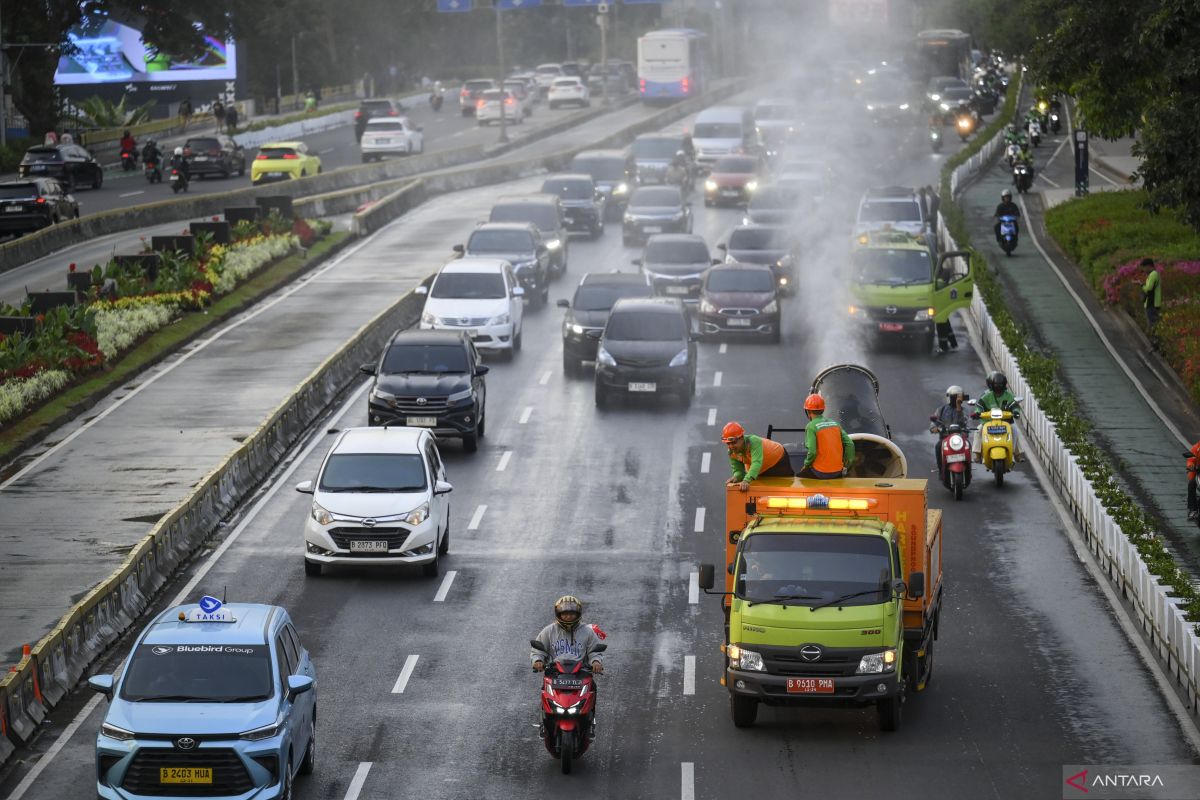
Jakarta (ANTARA) - Mount Anak Krakatau in the Sunda Strait has drawn renewed attention after eruptions in recent days caused volcanic ash to spread across a number of areas. The ash has even been observed reaching the Greater Jakarta area and West Java, including Bogor, Cianjur and Sukabumi.
The Meteorology, Climatology and Geophysics Agency (BMKG) said on Sunday (6/9) that satellite imagery analysis showed two clusters of volcanic ash from Mount Anak Krakatau covering Banten, Jakarta, West Java and as far as Bengkulu. At altitudes of up to 20,000 feet, the ash moved northeast to south, covering parts of Jakarta, Banten and West Java. Meanwhile, ash at altitudes of up to 50,000 feet moved southwest to northwest.
The Geological Agency also reported that Mount Anak Krakatau remains at Level III, or Siaga (Alert). Continuous eruptive activity producing volcanic ash has been ongoing since Saturday (5/9) and has been accompanied by rumbling sounds. The public has been asked to increase vigilance against heavy ashfall and to avoid activities within a 3-kilometre radius of the volcano’s centre of activity.
So how could ash from a volcano located in the Sunda Strait be carried by wind as far as Bogor and Sukabumi, which are quite far away?
The answer is closely linked to atmospheric conditions.
When a volcano erupts, the material ejected is not only lava or incandescent rock. Eruptions can also produce very small volcanic ash particles that are pushed into the atmosphere along with the eruption column.
Once in the air, these particles can be carried by the wind. Therefore, the direction and extent of ash dispersal depend heavily on wind conditions at specific altitudes.
In the case of Mount Anak Krakatau, BMKG found ash dispersal at several atmospheric layers with different directions of movement. Ash at altitudes of up to 20,000 feet moved towards the northeast to south, while material at higher altitudes moved towards the southwest to northwest.
This means volcanic ash does not necessarily fall around the volcano. If particles remain in the atmosphere and are carried by wind, the material can travel tens to hundreds of kilometres before eventually falling to the surface.
Bogor and Sukabumi are located in West Java and are geographically positioned along a path that can be affected when wind carries ash from the Sunda Strait towards the southern part of West Java.
So it does not mean volcanic ash from Mount Anak Krakatau ‘flew directly’ from the volcano to Bogor or Sukabumi. The process takes place in the atmosphere.
Simply put, when an eruption occurs, ash is lifted into the air. Wind at certain altitudes then moves it towards other areas. When atmospheric conditions cause the particles to begin descending, the ash can eventually reach the surface and be seen or felt by the public.
This is why areas located quite far from a volcano can still experience ashfall or find a thin layer of ash on vehicles and surfaces.
The higher the eruptive material reaches into the atmosphere, the greater the chance of ash being carried by wind over longer distances.
In monitoring on Sunday (6/9), BMKG recorded ash dispersal from Mount Anak Krakatau reaching altitudes of up to 20,000 feet for movement towards the east and up to 50,000 feet for movement towards the west. These conditions meant the eruption’s impact was not only felt around the Sunda Strait.
Besides distance, wind speed also determines how quickly ash moves. Changes in wind direction at different atmospheric layers can also make ash dispersal appear to spread in several directions at once.
That is why BMKG continues to monitor ash movement using satellite imagery and various meteorological instruments. The monitoring is also important for aviation safety because volcanic ash in flight paths can disrupt aircraft operations.
BMKG has even issued dozens of Significant Meteorological Information (SIGMET) advisories to provide information on hazardous conditions for aviation. On Sunday (6/9), BMKG said it had issued 50 SIGMETs periodically since the initial eruption.
Regarding this situation, the question arises: ‘do residents of Bogor and Sukabumi need to panic?’
There is no need to panic, but vigilance is still required.
People in affected areas should follow the latest information from BMKG, the Geological Agency or local government. If the air appears hazy or ash is falling, outdoor activities should be reduced.
Volcanic ash is also not just ordinary dust. The particles can irritate the eyes and respiratory tract. Therefore, people need to use appropriate protection if they must be active outside the home.
It should also be noted that ash dispersal can change according to wind dynamics. So even if an area has not yet experienced ashfall, it does not mean conditions will always remain the same.
The phenomenon of Mount Anak Krakatau’s volcanic ash reaching distant areas such as Greater Jakarta, Bogor and Sukabumi essentially shows how the atmosphere can carry eruptive material across a fairly wide area.
As long as Mount Anak Krakatau’s activity continues, monitoring the direction and altitude of ash dispersal remains important. The public should also rely on official information, not just social media posts, to find out whether their place of residence or travel destination is being affected.
Source: jawawa.id (https://jawawa.id/newsitem/anak-krakatau-ash-reaches-bogor-and-sukabumi-heres-why-1788706351)
Originally published by Antara (Indonesian) (https://www.antaranews.com/berita/5728783/abu-anak-krakatau-sampai-bogor-dan-sukabumi-ini-penyebabnya), translated from Indonesian