
Anak Krakatau and Semeru Erupt Simultaneously: What Is Happening?
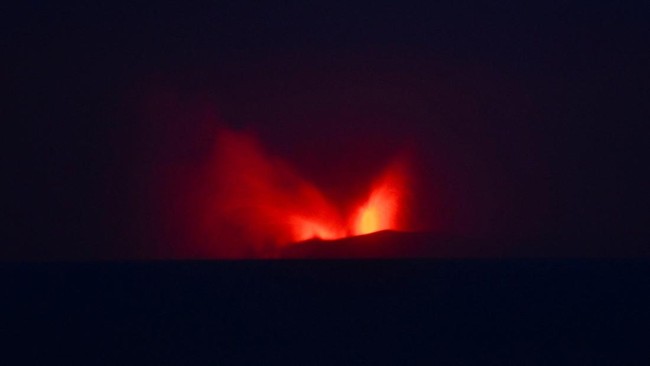
Volcanic activity in Indonesia has once again drawn attention. A number of volcanoes have erupted within a short period, from Mount Anak Krakatau in the Sunda Strait, Mount Sinabung in North Sumatra, Mount Semeru in East Java, to Mount Lewotobi Laki-laki in East Nusa Tenggara.
The phenomenon has raised the question: are eruptions of several volcanoes occurring close together connected to one another?
The phenomenon of volcanoes erupting simultaneously is not the first time it has happened in Indonesia. In April 2020, six volcanoes—Kerinci, Anak Krakatau, Merapi, Semeru, Ibu and Dukono—were also recorded as experiencing volcanic activity at relatively the same time.
At that time, volcanologist from the Bandung Institute of Technology (ITB), Mirzam Abdurrahman, explained that there are several possibilities that can cause volcanoes to experience activity at close intervals.
The first possibility is that the volcanoes are located on different arcs or tectonic systems. In such conditions, the coincidence of eruption timing can occur without any direct connection between one volcano and another.
“A simple analogy is like when I am eating, my neighbour is eating and you are also eating—it just happens to be the same lunchtime,” Mirzam explained, quoting the official ITB website, Sunday (6/9/2026).
Indonesia itself has several volcanic arcs, including the Sunda, Banda, Halmahera, and Celebes-Sangihe arcs. Volcanoes located on different arcs have their own geological systems and conditions.
However, if volcanoes are located on the same arc, according to Mirzam, there is a possibility that the same tectonic factors are influencing the volcanic activity. Nevertheless, this does not necessarily mean that one volcano triggers another.
This explanation is relevant to Indonesia’s current situation. Mount Anak Krakatau, Sinabung, Semeru and Lewotobi Laki-laki are located in different regions and each has its own volcanic system characteristics.
With the large number of active volcanoes in Indonesia, volcanic activity occurring at close intervals is not something impossible.
Indonesia is known to be located in the Ring of Fire, or the Pacific Ring of Fire. This geological condition means that Indonesia has many active volcanoes.
Therefore, when several volcanoes erupt within the same period, the phenomenon does not automatically indicate a single trigger causing all of them to erupt.
The most important thing is to observe the activity of each volcano based on monitoring data. Changes in seismicity, deformation of the volcano’s body, crater conditions, and eruptive activity are among the indicators used to understand the development of volcanic activity.
The phenomenon of simultaneous eruptions is therefore more accurately viewed as part of the dynamics of Indonesia’s highly active volcanoes, rather than being directly linked to a single common trigger.
Moreover, each volcano has its own magma system and volcanic conditions. The activity of one volcano cannot immediately be used as an indicator that another volcano will erupt.