
An Eagle That Cannot Return Home, a Forest That Was Never Properly Counted
Kamojang has felt the threat of fire
Jakarta (ANTARA) – Pelong has only one eye. The changeable hawk-eagle had already lost its right eye before arriving at the Kamojang Eagle Conservation Centre (PKEK) in Garut, West Java, and since then its vision has been limited to one side.
Its name comes from this disability, derived from the Sundanese expression “teu bisa melong”, meaning “unable to see”. But it is Pelong’s behaviour that is unusual. Whenever people visit the educational enclosure at PKEK, Pelong moves close to the wire mesh. It then adopts an intensely alert stance, fixing its sharp gaze on people as if preparing to attack.
Staff say Pelong is trying to seize food, as it used to see its former owner do. As an apex predator, an eagle should avoid humans, but Pelong approaches them like a pet dog asking for food.
This strange habit is a legacy of its former owner. Pelong was kept tame for too long, eroding its wild instincts.
At PKEK’s educational enclosure, Pelong shares its space with other eagles in similar circumstances: permanently disabled, no longer fit for release into the wild, and now used to educate visitors. The aim is to prompt people to reflect on the ways they can damage wildlife’s bodies and lives, particularly those of protected eagles.
National Flora and Fauna Love Day, observed every 5 November, was established under Presidential Decree No. 4 of 1993. The decree designated jasmine as the national flower and the Javan hawk-eagle as the national rare animal—two names still familiar from textbooks and exam papers.
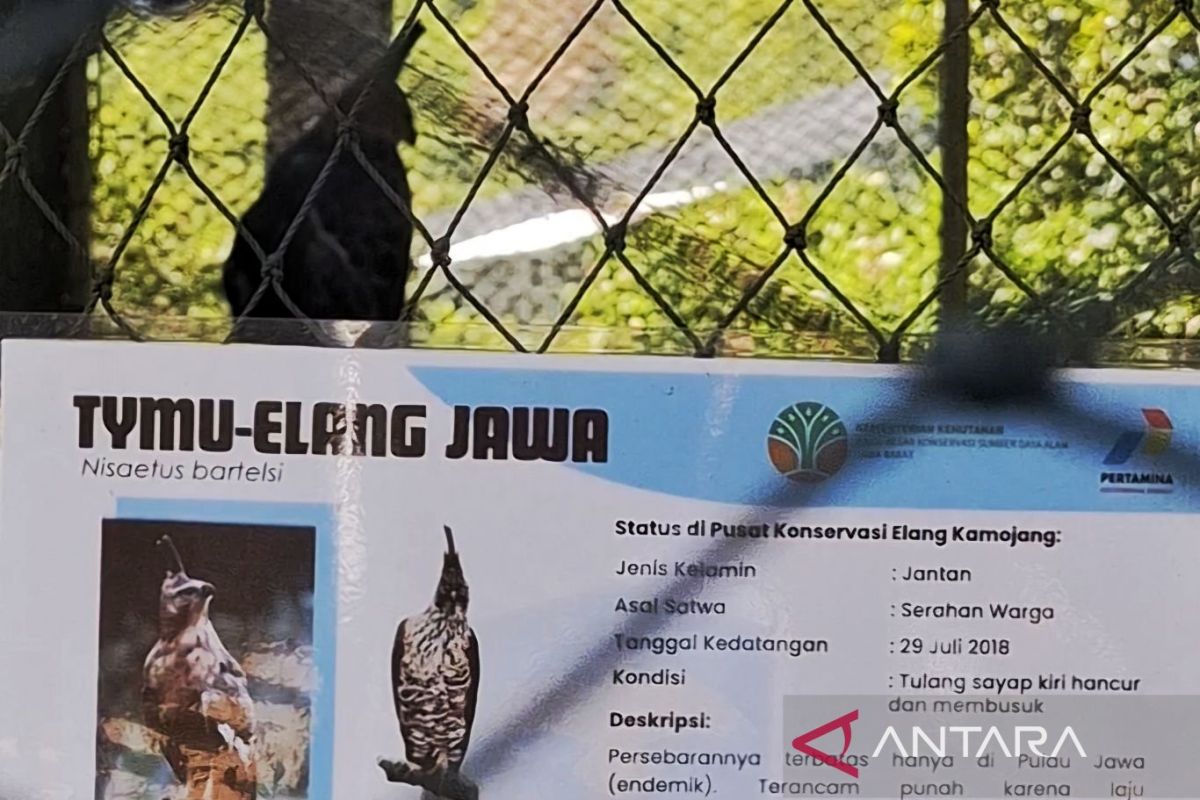
The Javan hawk-eagle that pupils memorise in classrooms is also cared for at Kamojang; some of the birds there no longer have intact wings.
Almost every school pupil in the country can name the national flower and animal without hesitation. That knowledge is valuable, but it often remains on paper. This phenomenon is known as the “extinction of experience”.
What disappears first is people’s experience of contact with nature, long before the species themselves become extinct. Children who grow up without encountering wildlife tend to know it only as pictures, Latin names or brief videos on their phone screens.
Too much distance breeds indifference. But getting too close in the wrong way causes harm.
Jacky, a brahminy kite housed next to Pelong, broke a wing after its former owner whipped it whenever the bird refused to return to their hand. Tymu, a Javan hawk-eagle, was found in a cardboard box outside PKEK’s gate in 2018, as if someone had abandoned it like a newborn kitten. Tymu had been discarded with permanent damage to its right wing. Both were victims of the desire to possess.