
An 87-Year-Old Leaf That Still Tells a Story
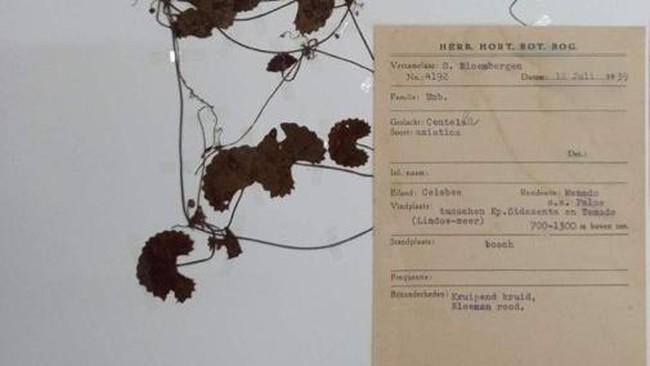
The door of the collection cabinet opened slowly. Inside, thousands of brown folders were neatly arranged, each holding plants that had long been dried. At a glance, nothing appeared special. Only sheets of leaves, flowers, and fruit arranged and pressed onto white paper with an information label in the bottom right-hand corner. Yet one specimen caught the eye.
The pegagan plant (Centella asiatica) had lost its green colour. Its stem looked dry and its leaves had turned brown with age. But it was the label attached beside it that made anyone pause: 12 July 1939.
Did you know that a leaf collected before Indonesia’s independence can still support research in the 21st century? Not many objects can survive for nearly a century while continuing to generate new knowledge. One of them is a herbarium specimen.
This specimen stores taxonomic information, location, habitat, collector, and collection date that remains valuable decades later. The date was written almost nine decades ago, when Indonesia had not yet gained independence.
Eighty-seven years later, the same plant is still used as a source of scientific information. This is the wonder and importance of herbaria in botanical research. To the public, it may be just a dried leaf. To scientists, it is a historical document recording the natural conditions and plant diversity of a particular place and time.
When botanist S. Bloembergen collected this specimen in July 1939, he likely had to travel a long way to the Lake Lindu area, which at the time was still dominated by natural forest. He believed that almost a century later, the specimen he collected would continue to be studied and serve as a source of scientific information for future generations of researchers.
Every specimen that is pressed and stored carries the identity of the species, location, habitat, collector’s name, and collection date. When habitats change or a species becomes rare, herbarium collections often become the only authentic evidence that the species once lived in a particular location. That is why herbaria are often called the memory and valid documentation of biodiversity.
Even when a habitat has changed due to development, forest fires, or climate change, the herbarium often becomes the only authentic evidence that a species once lived in that location. In other words, herbaria store traces of history that often cannot be repeated.
The journey of Herbarium Bogoriense began in 1844 when Johannes Elias Teijsmann was appointed curator of the Bogor Botanical Gardens. In carrying out his duties, Teijsmann began systematically collecting, preserving, and documenting plant specimens as scientific reference material.
This activity later became the foundation for the establishment of Herbarium Bogoriense as an institution dedicated to managing plant specimen collections. From a modest collection, the herbarium grew into one of the largest plant collection centres in Southeast Asia. Over more than a century and a half, thousands of expeditions have documented the flora of the archipelago and produced millions of specimens that now form part of the national scientific collection.
The value of a herbarium lies not in the number of cabinets, but in the information accompanying each specimen. Leaves, flowers, and fruit that appear simple can help identify species, serve as comparisons when new species are discovered, track changes in plant distribution, and support research on environmental change.
For example, if a researcher finds a plant suspected to be a new species, the specimen must be compared with existing herbarium collections and previously published literature. Without comparative collections, identification becomes far more difficult and potentially leads to scientific errors.
As technology develops, herbarium collections are also used through digitisation, online databases, spatial analysis, and molecular approaches, so their value continues to increase. Thousands of herbarium specimens have now been digitised as high-resolution images.
The development of artificial intelligence is opening new opportunities to help identify species through leaf shape analysis, accelerate collection data management, and expand researchers’ access to scientific collections without having to move the original specimens.
At BRIN, the herbarium collections at Herbarium Bogoriense are managed as part of the national research infrastructure by the Directorate of Scientific Collection Management. This management includes acquisition, preservation, documentation, digitisation, data validation, and the provision of services for researchers, students, government, and the public. Thus, the collections are not merely stored but continue to generate new knowledge.
Every specimen stored at Herbarium Bogoriense is not just a plant sample, but a scientific record that stores information about space and time. Its value only increases as science and technology develop.
Scientific collections are not only useful for botanists, but are also used by researchers in other fields, such as forestry, ecology, agriculture, pharmacy, school and university students, government, and industrial sectors that require information on plant identity, species distribution, and the potential of Indonesia’s biological resources.
Imagine someone collecting a pegagan plant at Lake Lindu on the morning of 12 July 1939. After being carefully pressed, the plant was carried on a long journey to Herbarium Bogoriense.
Eighty-seven years have passed. Its collector is long gone, the forest where the plant grew may have changed, but the specimen still ‘speaks’.
It no longer lives as a plant.
It lives as knowledge.
And as long as Herbarium Bogoriense continues to safeguard it, the story of Indonesia’s floral wealth will continue to inspire research, education, and the use of scientific knowledge for generations to come.
Source: jawawa.id (https://jawawa.id/newsitem/an-87-year-old-leaf-that-still-tells-a-story-1786103577)
Originally published by CNBC Indonesia (https://www.cnbcindonesia.com/opini/20260807164317-14-757498/selembar-daun-berusia-87-tahun-yang-masih-bercerita), translated from Indonesian