
Amsakar Reveals Key to Batam's Growing Appeal for Investors
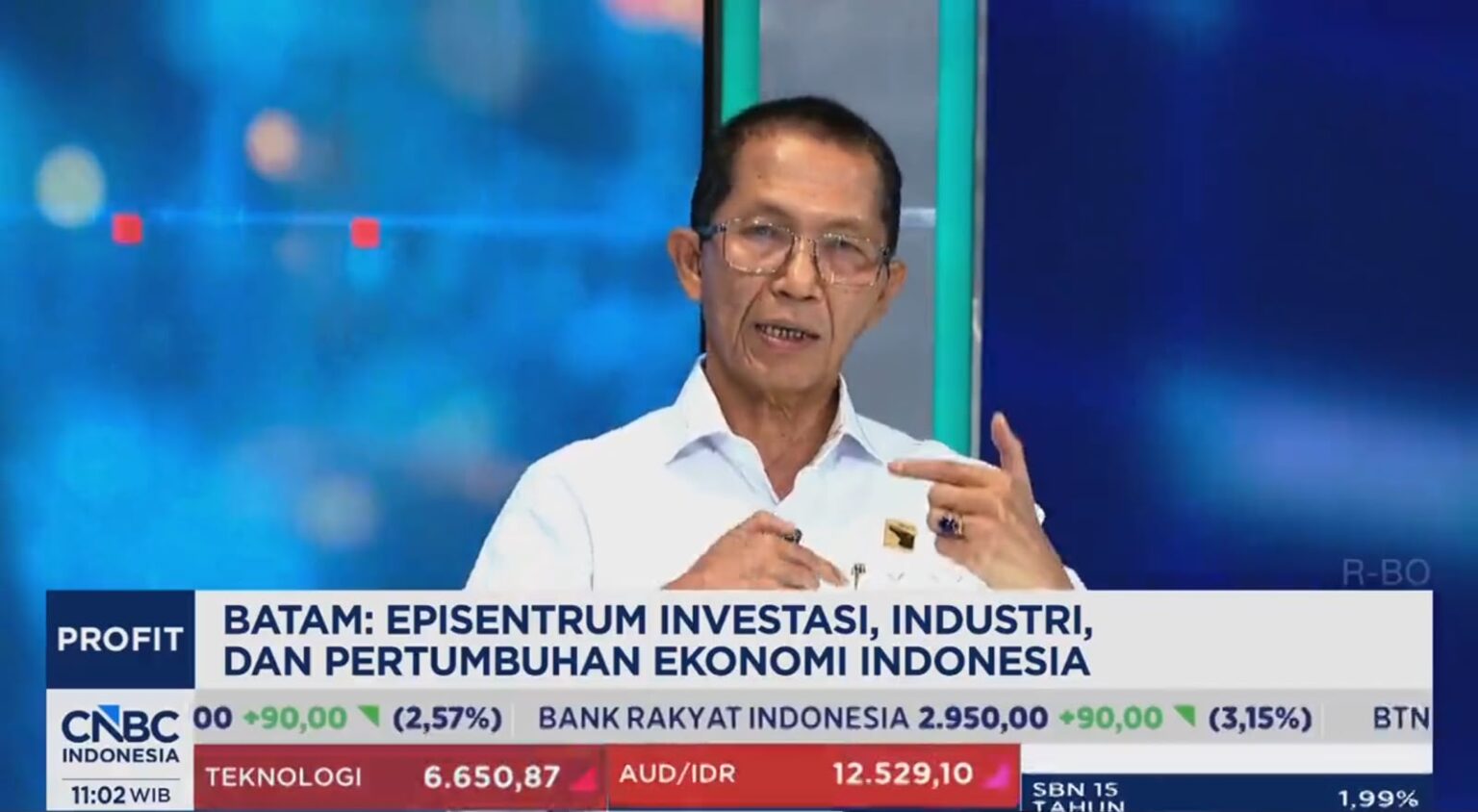
Batam continues to strengthen its position as one of Indonesia’s premier investment destinations. Amid economic growth of 6.76 percent, investment realisation in Batam surged 72.83 percent to Rp44.01 trillion in 2025. Batam Mayor and Head of BP Batam, Amsakar Achmad, revealed that the surge was driven by regulatory reform, accelerated licensing services, strengthened infrastructure, and increased investor confidence in the business climate. He made the remarks while speaking on CNBC Indonesia’s PROFIT programme on Friday (17/7/2026). Amsakar explained that during approximately one year and five months of leadership alongside Deputy Mayor and Deputy Head of BP Batam, Li Claudia Chandra, the government has continuously carried out improvements through various investment-friendly regulations. A number of strategic central government policies have served as the basis for strengthening regional governance while providing legal certainty and ease for investors. ‘Batam’s economy is performing well and investment continues to grow. The various regulations issued by the government are important instruments to increase the region’s competitiveness,’ Amsakar said. He noted that the President of Indonesia had directed that all services to the business community be simplified so that the investment climate becomes faster, easier, and more competitive. Following up on this directive, Batam carried out a comprehensive reform of its investment service system. One result is that the approval process for Environmental Impact Analysis (AMDAL), which previously took six months to two years, can now be completed in an average of 38 days. Meanwhile, the process for Approval of Suitability of Marine Space Utilisation Activities (PKKPRL) can now be completed in about two months. The acceleration of services has directly impacted the increase in investment realisation. In 2024, investment in Batam reached Rp25.46 trillion, then surged to Rp44.01 trillion in 2025, a growth of 72.83 percent. This realisation also exceeded the investment target of Rp36.9 trillion, with an achievement rate of 118.87 percent. ‘The President asked us to simplify services for the business community. We continue to do this so that investors obtain certainty and ease of doing business in Batam,’ he said. In addition to accelerating the licensing process, Batam has also built a digital-based service monitoring system that allows every application to be monitored in real time. Through this system, leaders can track the progress of each permit and conduct evaluations if there are applications that have not been followed up within a certain timeframe. To improve service quality, Batam has also introduced the Investment Ambassador programme, which is tasked with assisting investors from the initial stage until the entire investment process is underway. ‘We do not leave investors to go it alone. They are assisted from the beginning until the investment is realised, making the entire process easier and more certain,’ Amsakar said. In the logistics sector, port activity in Batam continues to increase, including the addition of direct call vessels conducting loading and unloading directly in Batam. This increased mobility has also boosted the tourism sector. Domestic tourist numbers rose from around 1.7 million to nearly 2.1 million people. Meanwhile, foreign tourist arrivals increased from around 1.2 million to around 1.5 to 1.6 million people. According to Amsakar, the growth of the logistics, port, and tourism sectors mutually reinforces one another, creating a multiplier effect on various business sectors, from hospitality and transportation to culinary and MSMEs. Amsakar also clarified the perception that Batam is merely a relocation site for investment from Singapore. He stated that the relationship between Batam, Singapore, and Johor is one of growth partners, not competitors or a mere recipient of relocated investment. ‘To advance, we do not have to go it alone. We can grow together. Batam is present as a partner that complements Singapore and Johor, not as a competitor or simply a recipient of investment spillover,’ he stressed. He assessed that Batam’s position on the international trade route of the Malacca Strait is a strategic advantage that is a key attraction for both domestic and foreign investors. Amsakar noted that the data centre sector is now a new engine of economic growth in Batam. By mid-2026, investment in this sector had reached approximately Rp120 trillion, with 20 projects under development. Batam is also supported by digital infrastructure in the form of several international submarine cable landing stations in the Nongsa area, such as the Indonesia Cable Express, Nongsa China Cable System, and Singapore Cable System. According to Amsakar, these advantages make Batam increasingly attractive to investors in the digital and artificial intelligence (AI) industries. ‘We have land, digital infrastructure support, clean water availability, and electricity supply that is continuously being prepared with PLN. Therefore, investors choose Batam based on the competitiveness we possess,’ he said. Amsakar also revealed the results of his meeting with the President of Indonesia, which lasted about one hour and 45 minutes. During the meeting, the President emphasised the importance of maintaining Batam’s competitiveness through licensing simplification, service acceleration, and the development of international-standard ports to optimally leverage the potential of the Malacca Strait. The President also requested that Batam continue to maintain its role as one of the locomotives of national economic growth. Amsakar also conveyed a number of challenges in the transition process.